
CART
No products in the cart.
ISO Compliance Insights & Best Practices
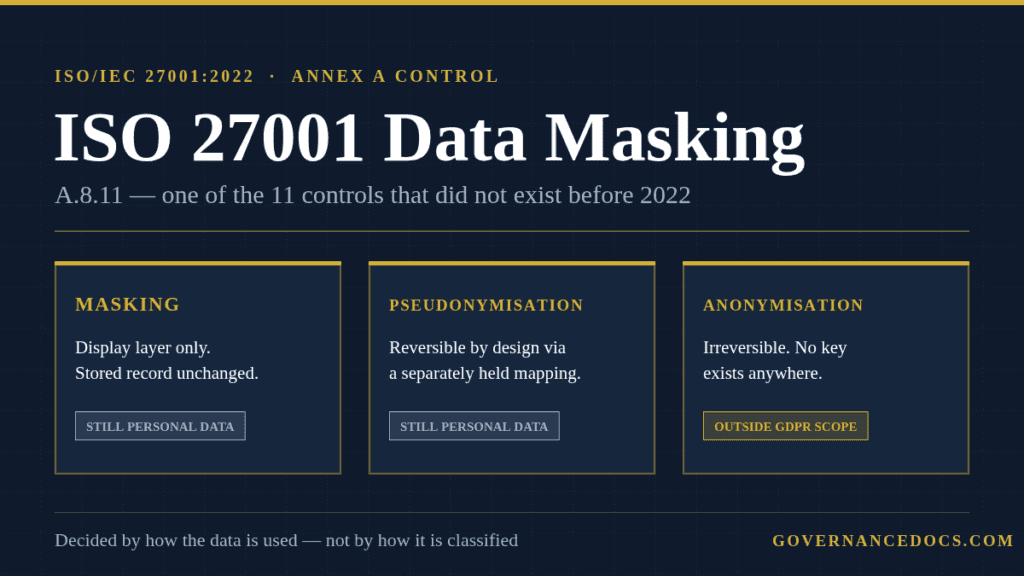
ISO 27001 data masking is Annex A control 8.11, and it is one of the eleven controls that did not exist before the 2022 edition. That newness is the whole problem. There is no 2013 predecessor to rename, no legacy policy already sitting in the document set, and the control statement in Annex A is two sentences long. So teams open the Statement of Applicability, see A.8.11 marked applicable, write “we mask data in test environments,” and move on. That sentence is usually true and almost always insufficient.
This guide covers what A.8.11 asks for, the one decision rule that separates a passing implementation from a failing one, how masking differs from pseudonymisation and anonymisation in a way that changes your regulatory scope, and the evidence an auditor will ask to see. Every requirement claim here is traceable to the standard, the regulation or the framework named beside it.
Free gap assessment
Where do you actually stand against ISO 27001?
Score every management system clause and all 93 Annex A controls, free, and get a prioritised gap list back.
Run the free ISO 27001 gap assessment → or View premium report sample
A.8.11 sits in the technological theme, which holds 34 of the 93 Annex A controls in ISO/IEC 27001:2022 (Edition 3, published October 2022, now carrying one amendment). The control, paraphrased rather than quoted, says that the masking of data is to be done in line with the organisation’s topic-specific policy on access control and other related topic-specific policies, and in line with business requirements, taking applicable legislation into account.
Read that slowly, because three obligations are hiding in it:
What A.8.11 does not say matters just as much. The standard names no mandatory technique, no re-identification risk threshold, no k-value, no retention period for masked datasets, and no review cycle. The detailed technique guidance lives in ISO/IEC 27002:2022’s clause 8.11, which is guidance an auditor reads for context, not a requirement they can raise a nonconformity against on its own. If a vendor page tells you ISO 27001 requires tokenisation or format-preserving encryption, it is describing a product, not the standard.
A.8.11 is also genuinely new rather than renumbered. Most 2022 controls map back to a 2013 clause; this one does not, which is why gap assessments built on a 2013 control set miss it entirely. For the full theme-by-theme picture, see our ISO 27001 Annex A controls breakdown.
Here is the single mistake that generates the most findings. Teams approach A.8.11 as a classification exercise: pull the information classification register, find everything labelled confidential or personal, mask it. That produces a project that masks the wrong things and leaves the real exposure untouched.
ISO 27001 data masking is a question about context of use, and the clue is the control’s own anchor to access control. Access control asks who may see a record. A.8.11 asks a narrower question: of the people who legitimately need this record, which of them need the actual values in it, and which of them only need its shape?
Those are different populations. A support agent verifying a caller’s identity needs the last four digits, not the full account number. An analyst measuring churn needs a consistent customer key, not a name. A developer reproducing a production bug needs realistic data volumes and referential integrity, not real humans. A fraud investigator genuinely does need unmasked values, which is why the exception path has to be designed, logged and time-bounded rather than denied.
Run the decision this way round and ISO 27001 data masking stops being a data-discovery project and becomes a short, defensible matrix: dataset, audience, purpose, what they see, what they do not see, who can break the glass. That matrix is the artefact. Your classification register is an input to it, not a substitute for it.
ISO 27002’s guidance on 8.11 points at pseudonymisation and anonymisation as the two main approaches, alongside display-level masking. Teams treat the three words as synonyms. Regulators do not, and the difference decides whether a dataset stays in scope of data protection law at all — which makes it the most consequential choice in any ISO 27001 data masking implementation.
| Technique | What it does | Reversible? | Still personal data under GDPR? | Typical use |
|---|---|---|---|---|
| Masking (display) | Hides characters at the point of presentation; the stored record is untouched | Not applicable — the real value still exists behind it | Yes. The underlying record is unchanged | Call-centre screens, receipts, admin consoles |
| Pseudonymisation | Replaces identifiers with tokens or pseudonyms; a separate mapping allows re-linking | Yes, by design, using the additional information held separately | Yes. GDPR Article 4(5) assumes the mapping exists | Analytics, research, test data that must join |
| Anonymisation | Removes or generalises identifying detail so re-identification is no longer reasonably possible | No. If you can reverse it, it was not anonymisation | No. GDPR Recital 26 puts truly anonymous data outside the Regulation | Published statistics, long-retention datasets |
| Synthetic generation | Creates new records with the statistical shape of the original and no source individuals | No source record to reverse to | No, provided no real records leak into the output | Development, demos, load testing |
The practical trap: a team writes “test data is anonymised” in the Statement of Applicability, and then keeps a mapping table so defects can be traced back to the real customer. That is pseudonymisation. GDPR Article 4(5) defines pseudonymisation as processing after which the data can no longer be attributed to a specific data subject without the use of additional information — and it requires that additional information to be kept separately and protected. Keep the mapping and every copy of that test estate remains personal data, with the retention, access, breach-notification and data-subject-rights obligations that follow. Claim anonymisation in your SoA while holding the key and you have written your own nonconformity.
Article 32(1)(a) of the GDPR names pseudonymisation and encryption as example security measures, so the technique earns credit in both frameworks at once — but only when it is the technique you actually deployed. We cover the legal distinction in depth in pseudonymisation vs anonymisation; this page stays with the ISO 27001 data masking control itself.
Because A.8.11 sets no thresholds, auditors look for whether you found the numbers that do apply to your data and applied them. Two schemes are worth knowing by heart because they cover the datasets most organisations hold.
| Source | What it fixes | The actual rule |
|---|---|---|
| PCI DSS v4.x, requirement 3.4.1 | Display of card numbers | The primary account number is masked when displayed; the BIN plus the last four digits is the maximum that may be shown, and anyone who needs more must sit in a documented role with a legitimate business need. Requirement 3.5.1 separately covers rendering stored card data unreadable. |
| HIPAA Privacy Rule, 45 CFR §164.514(b)(2) | De-identification of US health data — the “Safe Harbor” method | Remove all 18 categories of identifier. Dates more granular than the year go, and ZIP codes are cut to the first three digits — with any three-digit ZIP area covering 20,000 people or fewer recoded to 000. The alternative route, Expert Determination, sits at §164.514(b)(1) and needs a qualified person to document that re-identification risk is very small. |
| NIST SP 800-188 (September 2023) | Method and governance for de-identification | No certification requirement, but a free, citable methodology for re-identification risk, disclosure review and governance — useful when you need to defend a judgement call rather than assert it. |
| NIST CSF 2.0, PR.DS-01 | Cross-framework credit | “The confidentiality, integrity, and availability of data-at-rest are protected.” Masking and de-identification evidence maps here directly. CSF 2.0 (published 26 February 2024) has 6 functions, 22 categories and 106 subcategories, and carries no certification. |
If none of these schemes touches your data, you set the threshold yourself — and then you must be able to show the reasoning. “We mask to the minimum the role needs, reviewed annually” is a defensible position when a named owner signed it. “The tool’s default profile” is not. For the framework side of that mapping, the NIST Cybersecurity Framework pages set out the current subcategory structure.
Four technological controls get collapsed into a single SoA justification more often than any other group in Annex A. Keeping them apart is what makes an ISO 27001 data masking entry look deliberate.
| Control | Question it answers | Not its job |
|---|---|---|
| A.8.11 Data masking | Who sees real values, and who sees a transformed view of the same record? | Stopping data leaving; destroying data at end of life |
| A.8.10 Information deletion | When is data removed, and how is removal proved? | Hiding data that must be kept. See our guide to ISO 27001 secure disposal |
| A.8.12 Data leakage prevention | Can sensitive data move to an unauthorised destination? | Deciding what an authorised viewer should see |
| A.8.33 Test information | Is test data selected, protected and controlled? | Specifying the transformation technique itself |
A.8.11 and A.8.33 are the pair that overlap in practice, and the clean split is this: A.8.33 governs the lifecycle of the test dataset — approval to use it, protection while it exists, removal afterwards — while A.8.11 governs the transformation applied on the way in. One sentence in each SoA row, pointing at the same masking procedure from two directions, reads as understanding rather than duplication.
Expect the auditor to sample rather than read the whole procedure. In a stage 2 or surveillance audit, ISO 27001 data masking is typically tested through four or five artefacts:
That last point is the quiet failure mode. Masking is applied once during a migration, then a production restore into staging six months later lands unmasked, because the refresh runbook was written by a different team. If your masking is a one-off script rather than a step inside the refresh procedure, the control is not operating, whatever the policy says.
The Statement of Applicability is mandatory under clause 6.1.3, and it is where ISO 27001 data masking is accepted or questioned before anyone looks at a system. Two patterns work.
Free ISO 27001 risk assessment
Which of your risks sit above your appetite line?
Set your own risk criteria, pick from 61 information security risk scenarios, rate likelihood and impact, and decide how to treat each one. You get a heat map, a process score and the findings an auditor would raise, free.
Run the free risk assessment → or View premium report sample
Applicable. Name the datasets, the techniques and the authority: “Applicable. Display masking of account identifiers in service tools per PCI DSS 3.4.1; deterministic pseudonymisation of customer identifiers in analytics and non-production environments, with the mapping held in a separate key store. Rules defined in the Access Control Policy; implementation recorded in the Data Masking Procedure.”
Not applicable. This is defensible, but only on a factual basis: no personal or sensitive data is processed at all, or no environment or audience exists other than the one authorised to see real values. “We do not have a masking tool” is not a justification — it is a gap described in the present tense. A thin SoA row is the most common reason this control gets looked at hard; our guide to the ISO 27001 Statement of Applicability covers what a complete justification contains.
No Annex A control is automatically mandatory. Clause 6.1.3 requires you to compare your chosen controls against Annex A, determine whether A.8.11 is necessary, and record the decision with a justification in the Statement of Applicability. In practice, if you process personal data or hold non-production copies of live records, marking A.8.11 not applicable will be challenged.
No. ISO/IEC 27001:2022 states no frequency for masking, review or re-identification testing anywhere in Annex A, and ISO/IEC 27002 only speaks of doing things periodically. Annual review is a widely used convention, not a requirement — set your own cycle, write it down, and meet it.
They answer different questions. Encryption protects data from someone with no authorisation to the record at all; masking limits what an authorised viewer sees inside a record they may legitimately open. A.8.24 covers cryptography; A.8.11 covers the authorised-but-limited view. Most environments need both, and encrypting a database does nothing for the support agent who can read every field on screen.
No document is mandated by name. What auditors consistently look for is an access control policy that states the masking rules, a data masking or test-data procedure describing techniques per dataset, the audience matrix, and records of break-glass access and re-identification testing. Information classification feeds all of them.
Only if it is genuinely irreversible. Where a mapping, token vault or key exists — anywhere in the organisation, held by anyone — the data is pseudonymised under GDPR Article 4(5) and remains personal data. Recital 26 places only truly anonymous data outside the Regulation, and the test is whether re-identification is reasonably possible, not whether you intend to do it.
A.8.33 governs the selection, protection and control of test data as a lifecycle. A.8.11 governs the transformation applied to it. If your SoA uses one sentence for both rows, expect the auditor to ask which procedure implements which — so write each row to its own control.
ISO 27001 data masking is cheap to implement and expensive to evidence, because the artefacts auditors ask for — the audience matrix, the procedure, the break-glass log, the SoA justification — are all documents rather than tooling. If you would rather start from drafted templates than a blank page, the ISO 27001 Toolkit includes 165 editable templates covering the access control policy, the Statement of Applicability, information classification and the supporting records for the full 93-control Annex A set, for $99. It is the fastest route from “A.8.11 is applicable” to evidence an auditor can sample.

October 22, 2026
October 22, 2026
October 22, 2026
October 22, 2026
October 22, 2026