
CART
No products in the cart.
ISO Compliance Insights & Best Practices
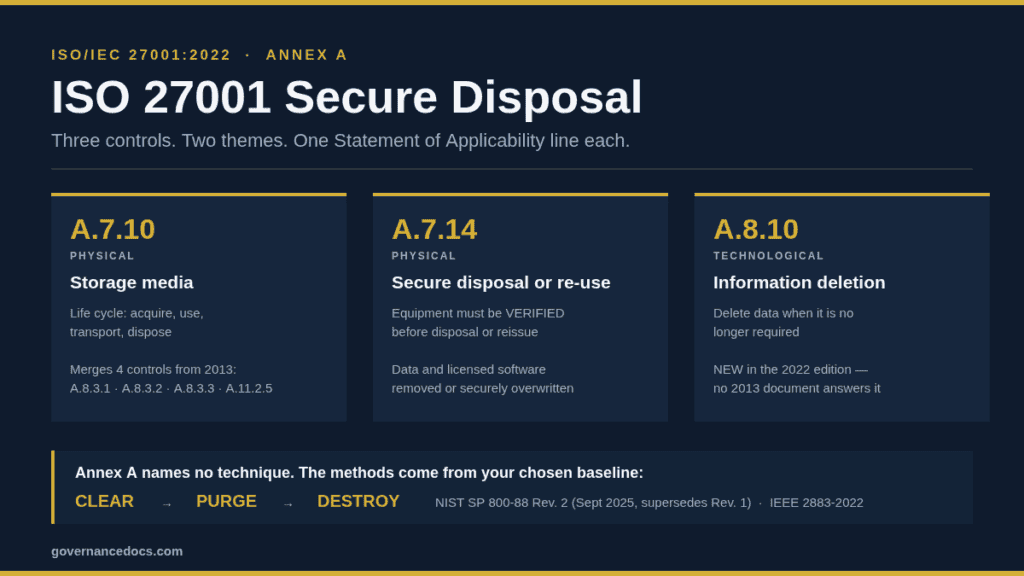
ISO 27001 secure disposal is not one control, and that single misunderstanding is responsible for more disposal findings than any technical failure. Most organizations write a “data destruction policy”, point the Statement of Applicability at it, and discover during stage 2 that the auditor is holding three separate control references and asking which of them the policy actually answers. In ISO/IEC 27001:2022 the disposal requirement is split across two Annex A themes — physical and technological — and each half is audited on its own evidence.
This guide maps the three ISO 27001 secure disposal controls, shows what changed when the 2013 Annex A was restructured, and sets out what an auditor expects to see in practice. It also covers something almost every competing page gets wrong: the technical standard that disposal policies have cited for a decade was superseded in September 2025.
Free gap assessment
Where do you actually stand against ISO 27001?
Score every management system clause and all 93 Annex A controls, free, and get a prioritised gap list back.
Run the free ISO 27001 gap assessment → or View premium report sample
Three Annex A controls carry the ISO 27001 secure disposal requirement. They sit in different themes, use different verbs, and produce different records.
| Control | Theme | What it covers | 2013 origin |
|---|---|---|---|
| A.7.10 Storage media | Physical | The whole life cycle of storage media: acquisition, use, transport and disposal, against your classification scheme | A.8.3.1 + A.8.3.2 + A.8.3.3 + A.11.2.5 |
| A.7.14 Secure disposal or re-use of equipment | Physical | Verifying that equipment containing storage media has had sensitive data and licensed software removed before it leaves or is reissued | A.11.2.7 |
| A.8.10 Information deletion | Technological | Deleting information held in systems, devices and media once it is no longer required | New in 2022 |
Read the themes rather than the numbers and the design becomes obvious. A.7.10 and A.7.14 are about things — the drive, the tape, the laptop, the multifunction printer. A.8.10 is about data, wherever it happens to live, including in systems you will never physically touch. A policy that only destroys hardware satisfies two thirds of the requirement and leaves the third unevidenced, which is exactly the shape of the nonconformity that gets raised.
Two neighbouring controls complete the picture without being disposal controls themselves. A.5.11 Return of assets (from 2013’s A.8.1.4) is the trigger event — a leaver hands back a laptop, and that is the moment A.7.14 starts. A.8.11 Data masking sits beside A.8.10 as the alternative when deletion is not available because the data still has a purpose. If you are building the wider document set, our ISO 27001 implementation guide shows where disposal fits in the sequence.
A.7.10 is the most heavily consolidated control in the ISO 27001 secure disposal family, and the one auditors open first. Four separate 2013 controls collapsed into it, and under the old Annex A each one was independently auditable.
| ISO 27001:2013 control | Title | What it still demands under A.7.10 |
|---|---|---|
| A.8.3.1 | Management of removable media | Authorization, registration and handling rules for removable media by classification |
| A.8.3.2 | Disposal of media | Formal, documented disposal procedures with records |
| A.8.3.3 | Physical media transfer | Protection of media in transit, including to a destruction vendor |
| A.11.2.5 | Removal of assets | Authorization before media or equipment leaves the site |
The consequence is structural, not cosmetic. A.7.10 is now one line in your Statement of Applicability with one combined pass or fail. A removable-media register that lists who holds which encrypted USB stick looks complete until the auditor asks for the authorization record for the batch of decommissioned drives that went to the shredding contractor last quarter, and for the evidence those drives were protected in transit. Same control. Same finding.
The transport half of A.7.10 overlaps with A.5.14 Information transfer, which is where the 2013 physical-media-transfer requirement also has a foothold; our guide to ISO 27001 information transfer covers the courier, packaging and chain-of-custody side in detail. Keep one set of rules and cross-reference it rather than writing two.
A.7.14 kept its 2013 title and its 2013 number lineage, mapping one-to-one from A.11.2.7. What it asks is that equipment containing storage media is verified before disposal or re-use, to confirm sensitive data and licensed software have been removed or securely overwritten.
“Verified” is the operative word, and it is where ISO 27001 secure disposal programmes fail. Running a wipe is an activity. Verifying it is a control. If your process ends when the wiping tool reports success, you have no evidence that the tool addressed the whole device, and no evidence at all for the devices where it silently did not.
Three categories of equipment account for most ISO 27001 secure disposal gaps:
A manufacturer’s Statement of Volatility — a specification listing a device’s volatile and non-volatile memory, what is stored in it, and how it can be erased — is the document that answers the first two categories. Asking for one before purchase, rather than at decommissioning, is a cheap way to avoid buying equipment you cannot lawfully dispose of.
A.8.10 is one of the eleven controls introduced in the 2022 edition. It has no 2013 ancestor, which has a practical consequence for any organization that transitioned: there is a legacy document sitting behind almost every other control in your SoA, and nothing behind this one.
The control requires that information stored in information systems, devices or other storage media is deleted when it is no longer required. Its stated purpose is to prevent unnecessary exposure of sensitive information and to meet legal, statutory, regulatory and contractual deletion obligations. That second half is why A.8.10 cannot be answered by a hardware process. The data you are obliged to delete is in a database, an object store, a backup set, a log pipeline, a SaaS tenant and an analytics warehouse — and in most cases you do not own the media it sits on. That is the half of ISO 27001 secure disposal no shredder can reach.
What an ISO 27001 secure disposal audit looks for against A.8.10:
A.8.10 is also where deletion and leakage prevention meet. Data you cannot find is data you cannot delete, so discovery and classification underpin both; our guide to ISO 27001 data leakage prevention covers the A.8.11 and A.8.12 side of that boundary.
Annex A states no ISO 27001 secure disposal technique. It never says “three passes”, never names a tool, and never sets a shred particle size. Those numbers come from an external standard you choose and justify — and the standard almost every disposal policy cites has changed.
NIST SP 800-88 Rev. 2, Guidelines for Media Sanitization, was published in September 2025 and supersedes Rev. 1 of December 2014. If your policy cites “NIST SP 800-88 Appendix A” for its technique tables, it is citing a superseded document, because Rev. 2 deliberately removed that material. Technology-specific techniques are now out of scope apart from cryptographic erase, and the publication defers to IEEE 2883, the IEEE Standard for Sanitizing Storage, which was approved in June 2022 and published that August.
Rev. 2’s centre of gravity moved from a menu of techniques to running a programme. It keeps the three methods, and the hierarchy between them matters for every ISO 27001 secure disposal decision.
| Method | What it does | Media left usable? | Resists lab recovery? | Typical use |
|---|---|---|---|---|
| Clear | Logical techniques over the user-facing interface — overwrite of user-addressable space, or a factory reset where rewriting is not supported | Yes | Not assured | Internal re-use of lower-sensitivity media |
| Purge | Logical or physical techniques that make recovery infeasible using state-of-the-art laboratory techniques, while keeping the media potentially reusable — block erase, device sanitize commands, cryptographic erase | Potentially | Yes | The default where the media supports it |
| Destroy | Disintegrate, incinerate, melt, pulverize or shred, to the point that recovery is infeasible and the media can no longer store data | No | Yes | Failed, obsolete or highest-sensitivity media |
Four points from Rev. 2 will change most ISO 27001 secure disposal policies:
None of this is an ISO 27001 requirement. It is the external baseline you name in your ISO 27001 secure disposal policy so that your method choices are defensible rather than inherited, and it is the kind of evidence that turns an auditor’s “why this technique?” into a short conversation.
In ISO 27001 secure disposal terms, cryptographic erase — destroying the key rather than the ciphertext — is a purge technique, and Rev. 2 is notably clear that for logical or virtual storage such as cloud object storage it may be the only viable purge option. The underlying physical media is abstracted away, you have no access to it, and destroy is not an applicable method at all.
That has three consequences for an ISO 27001 secure disposal policy with cloud in scope:
Treat the provider’s statement as a supplier assurance artefact and keep it with the rest of your third-party evidence, alongside your asset management records so that each decommissioned asset ties to a disposal outcome.
Rev. 2 lists what a sanitization policy should address, and it reads almost as a template for ISO 27001 secure disposal — the document an auditor wants to see. Mapped onto Annex A:
| Policy element | What to state | Control evidenced |
|---|---|---|
| Classification to method mapping | Minimum acceptable method — clear, purge or destroy — for each classification level | A.7.10, A.8.10 |
| Disposal and re-use rules | What happens on internal reissue, sale, donation, lease return and warranty replacement | A.7.14 |
| Accepted techniques | The named external standard you follow and the techniques it permits per media type | A.7.10, A.7.14 |
| Authorization and transport | Who approves removal from site, and how media is protected in transit | A.7.10, A.5.14 |
| Retention and deletion | Retention periods per system and the deletion mechanism for each | A.8.10 |
| Roles and competence | Who performs, who verifies, who validates, and the training behind it | A.7.10, A.6.3 |
| Tools and equipment | Approved tools and versions, plus calibration, testing and maintenance of destruction equipment | A.7.14 |
| Vendor assurance | Assurances the equipment vendor and the destruction supplier must provide | A.5.19, A.5.21 |
| Records | The record set, retention of the records themselves, and who holds them | A.7.10, A.8.10 |
Note the separation Rev. 2 draws between two steps that most ISO 27001 secure disposal policies merge. Verification inspects the outcome — did the tool complete, were there errors or anomalies, what do the destruction remnants look like. Validation is the decision that the target data was effectively sanitized given its sensitivity, and it can reject a technically successful operation. Rev. 2’s own example is a shredder that produces optical-disc fragments 50% larger than the organization accepts: the operation completed, and it is still not effective. Writing those as two signatures on one ISO 27001 secure disposal record is the cleanest way to evidence it.
Equally useful is the point that elaborate sampling of a drive’s contents after clear or purge is not necessary unless your own policy demands it. Plenty of organizations have built an expensive forensic read-back step that no external baseline asks for.
ISO 27001 secure disposal is audited almost entirely on records, because the asset is gone by the time anyone looks. Rev. 2 recommends a certificate of sanitization per item, and its field list is a good specification for your own register.
| Field | Why the auditor cares |
|---|---|
| Manufacturer, model, serial number | Ties the record to one physical item, not a quantity |
| Internal asset or property number | Reconciles to the asset inventory, which is how completeness is tested |
| Media type and source | Shows the method was chosen for the medium, and which system it came from |
| Pre-sanitization classification | Justifies the method against your own classification-to-method mapping |
| Method and technique | Separates the decision (purge) from the execution (block erase, cryptographic erase, degauss) |
| Tool and version | Lets a finding be scoped if a tool is later found defective |
| Verification method | Evidences A.7.14’s “verified”, which is the control’s actual requirement |
| Name, title, date, location, signature | Accountability, and the date that must sit inside the window the asset left the inventory |
Two refinements matter more than the fields themselves. First, completeness is tested by reconciliation: records that only exist at the destruction vendor’s end show that specific items were sanitized, not that every item introduced to your estate was accounted for. Keep a record at acquisition, at the point the asset leaves its last location, and at the post-sanitization destination. Second, if sanitization lowers an item’s confidentiality level, remove the markings that still claim the old one.
A.8.10’s purpose explicitly includes legal, statutory, regulatory and contractual deletion obligations, which is the bridge to privacy law. Under the GDPR, Article 5(1)(e) limits storage of personal data to no longer than is necessary for the purpose, and Article 17 gives data subjects a right to erasure. Neither names a sanitization technique, and neither needs to, because ISO 27001 secure disposal is the mechanism by which those duties are actually discharged, and the records are what you produce when a regulator asks.
The practical overlap is the retention schedule. One schedule should drive both the privacy answer and the A.8.10 deletion mechanism. Where organizations run two — a records-management schedule written by legal and a technical deletion configuration written by engineering — they diverge inside a year, and the ISMS inherits the gap.
No. ISO 27001’s mandatory documented information sits in clauses 4 to 10, and a disposal policy is not on that list. In practice it is unavoidable: three Annex A controls have to be evidenced, and excluding them in the Statement of Applicability is not credible for any organization that owns a laptop. Clause 6.1.3 requires the SoA to justify inclusions and exclusions, so a one-line exclusion will be challenged.
Free ISO 27001 risk assessment
Which of your risks sit above your appetite line?
Set your own risk criteria, pick from 61 information security risk scenarios, rate likelihood and impact, and decide how to treat each one. You get a heat map, a process score and the findings an auditor would raise, free.
Run the free risk assessment → or View premium report sample
No. ISO/IEC 27001:2022 Annex A states no pass count, no particle size and no technique anywhere. Your ISO 27001 secure disposal policy chooses an external baseline — NIST SP 800-88 Rev. 2 and IEEE 2883 are the usual pair — and justify your choice against the classification of the data. The multi-pass overwrite comes from DoD 5220.22-M, and the Department of Defense removed overwriting specifications from the NISPOM in 2006.
Yes, and most organizations should. It does not transfer the ISO 27001 secure disposal obligation. You remain responsible for authorizing removal from site, protecting the media in transit, defining the acceptable method, and reconciling the certificates you receive against your own inventory. The destruction supplier becomes a supplier-assurance case like any other, with contractual terms and evidence you review rather than file.
Through A.8.10 rather than A.7.10 or A.7.14, and through contracts rather than certificates. Cryptographic erase may be the only purge technique available for virtual storage, and the evidence is the provider’s deletion commitment, its sanitization attestation and the exit records. Establish what the provider will actually do and prove before you store sensitive data with them, not at termination.
No, but keep ISO 27001 secure disposal records well beyond the certification cycle. A three-year certification cycle plus surveillance means an auditor can sample a disposal from two years ago, so records must outlive the audit window and any statutory retention period attached to the data that was destroyed. Set the retention period for the records in the same policy that sets it for the data.
ISO 27001 secure disposal is a documentation problem wearing a hardware costume. The physical destruction is usually outsourced and usually competent; what fails audit is the policy that maps classification to method, the register that reconciles to the asset inventory, and the verification signature that proves someone looked at the outcome. Three controls, three evidence trails, one set of documents.
If you would rather start from a drafted baseline than a blank page, the ISO 27001 Toolkit ($149) includes 165 templates covering the Annex A control set alongside the clause 4 to 10 documentation, so the disposal policy, asset register and records arrive pre-aligned with the Statement of Applicability rather than being retro-fitted to it. The full standard, including the climate amendment, is available from ISO.

October 21, 2026
October 20, 2026
October 20, 2026
October 19, 2026
October 19, 2026
