PPAP submission levels tell an automotive supplier how much evidence to send a customer when asking for approval of a production part. The Production Part Approval Process is a standardized way for suppliers and customers to agree that a part can be made repeatedly to specification, and the level decides whether the customer receives only the signed warrant, the warrant with samples and some data, or the full package. Sending the wrong level is one of the most common reasons a submission is rejected or delayed.
This guide explains what each level requires, lists the 18 PPAP elements, describes the part submission warrant and approval statuses, and shows when a submission is needed. It also covers the mistakes that lead to returned packages. Always confirm the requirements with your customer, because customer-specific requirements can change the level, the content and the acceptance criteria.
Free gap assessment
Where do you stand on the automotive supplemental requirements?
Score only what IATF adds to ISO 9001, free, including customer-specific requirements, product safety and the core tools.
The Automotive Industry Action Group publishes the PPAP manual, and suppliers commonly work to its fourth edition unless a customer directs otherwise. The process exists to validate a supplier’s ability to produce a part reliably before mass production begins, clarify customer specifications and document what both sides expect. AIAG offers a PPAP training overview on its PPAP course page, which describes the manual as the reference for the procedures and reporting requirements.
IATF 16949 includes a requirement on the product approval process, and a supplier under that standard is expected to follow the customer’s product and process approval procedure. Our guides to IATF 16949 and the IATF 16949 core tools show where PPAP sits among the wider set of methods, and customer-specific requirements explains why every customer may ask for something different.
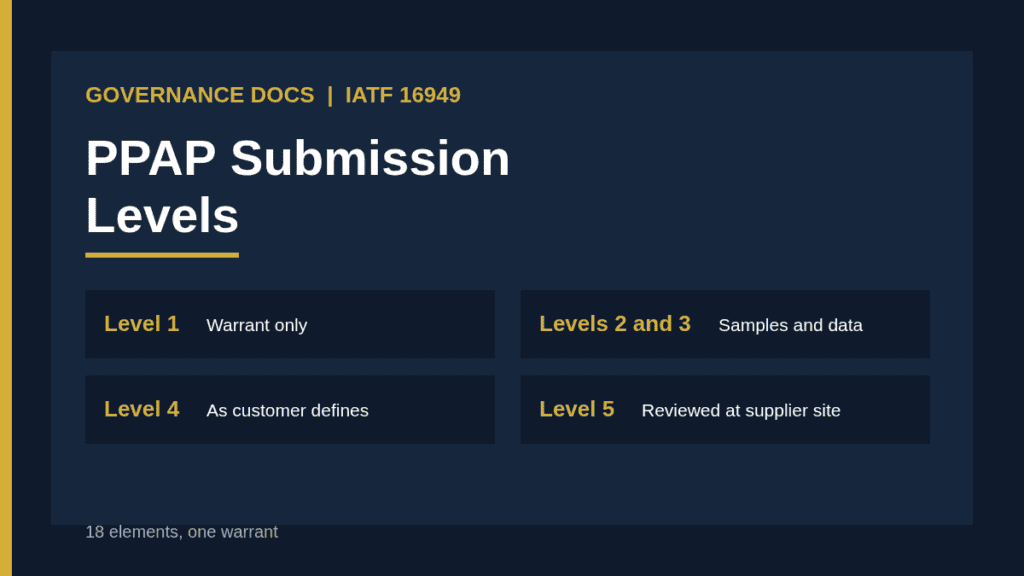
The five PPAP submission levels
Level
What is submitted
Level 1
Part submission warrant only
Level 2
Warrant with product samples and limited supporting data
Level 3
Warrant with product samples and complete supporting data
Level 4
Warrant and other requirements as defined by the customer
Level 5
Warrant with samples and complete supporting data available for review at the supplier’s location
Unless the customer states otherwise, Level 3 is generally treated as the default, and many supplier manuals describe it as the standard level. Customers can direct a lower or higher level for each part, and some define their own level. Read the purchase order and the customer’s supplier manual before you compile anything, and record which of the PPAP submission levels applies to each part number in your project plan. Where the customer is silent, ask in writing and keep the answer with the file.
The 18 PPAP elements
The elements are the building blocks of a submission. Which of them go to the customer, and which you keep on file, depends on the level.
Design records
Authorized engineering change documents
Customer engineering approval, where required
Design FMEA
Process flow diagram
Process FMEA
Control plan
Measurement system analysis studies
Dimensional results
Records of material and performance tests
Initial process studies
Qualified laboratory documentation
Appearance approval report, where applicable
Sample production parts
Master sample
Checking aids
Customer-specific requirements
Part submission warrant
The part submission warrant
The part submission warrant, or PSW, is the cover document that summarizes the submission. It identifies the part, the reason for submission, the level, the results of the checks and a declaration signed by an authorized person at the supplier that the samples and records meet all customer requirements. Treat the signature seriously: it is a statement that the facts are true. If anything is outside requirements, explain it in the space provided and do not simply sign.
When a PPAP submission is needed at any of the PPAP submission levels
A submission is needed for any new part and for approval of changes to an existing part or process. Common triggers include a new part number, an engineering change, a new or modified tool, a change of supplier or subcontractor for a material or process, a change of production location, and production resuming after long inactivity. Customers list their own triggers, so check the supplier manual and notify the customer before you make a change, not after.
Initial process studies and capability
Element 11 is where many submissions come under scrutiny. The customer specifies the acceptance criteria, and they vary. As one example of a published customer requirement, a large automotive supplier’s PPAP guidelines treat a capability index above 1.67 as meeting the criteria, accept values between 1.33 and 1.67 for non-critical characteristics but not for critical ones, and reject values below 1.33. That customer also sets minimum sample sizes for the studies. Treat these figures as an example and not as a universal rule. Link the study to the special characteristics in your control plan, and check your customer’s own numbers.
Approval statuses after the PPAP submission levels are reviewed
After review, the customer typically gives one of three outcomes. Full approval means the submission meets all requirements and the supplier may ship production quantities. Interim approval allows limited shipment for a defined period or quantity while the supplier corrects the deficiencies, and a corrective action plan is normally required. A rejected or returned submission means the package must be corrected and sent again before shipment is authorized. Names differ between customers, so use the terms in the customer’s manual.
A worked example
The following is a hypothetical illustration. A supplier of stamped brackets receives a new part number, and the customer’s purchase order specifies Level 3. The supplier’s team builds the package: drawing and change records, a design review note, a process flow, a PFMEA that covers the stamping and coating steps, and a control plan linked to the characteristics the customer marked as special. They perform a measurement system study on the gauge that checks a critical hole position, measure dimensional results on a set of parts, and run an initial process study on the key dimensions. The coating passes a salt spray test at an accredited laboratory. One characteristic shows a capability of 1.4, below the customer’s target for a critical feature. The supplier does not hide this: it notes it on the warrant, submits an action plan to improve the tool and asks for interim approval. The customer grants interim approval for a limited quantity and full approval after the tool is adjusted and the study repeated.
Common mistakes with PPAP submission levels
Wrong level. Sending Level 3 when the customer asked for Level 1, or the reverse.
Documents that do not agree. The PFMEA, control plan and process flow show different steps or characteristics.
Old drawing revision. Measuring against a superseded drawing invalidates the dimensional results.
Untested measurement systems. Studies run on gauges that have not been shown to be capable.
Studies not on production tooling. Samples from prototype tools or non-production conditions.
Missing customer-specific items. Forgetting an element that appears only in the customer’s supplier manual.
Weak change management. Making a process change without notice and discovering later that resubmission was required.
Keeping PPAP submission levels manageable
Build the package as the work is done, not at the end. Tie the elements to your advanced product quality planning gates, use one master list of elements with owners and due dates, and hold a review before submission, where someone who did not compile the package checks it against the customer’s requirements. Keep the approved package and retain samples and records according to the customer’s rules, and note the retention period on the file, so that a later audit or a warranty question can be answered quickly. After approval, keep the control plan alive through your layered process audits, so that the process that was approved is the process that runs. For the broader compliance context, see our overview of IATF 16949 compliance.
Documents and templates for PPAP submission levels
You will need templates for the PSW, the control plan, the PFMEA, the process flow diagram, the measurement system and capability studies, and a submission checklist. The IATF 16949 Toolkit offers a broad set of templates that you can adapt to your parts, customers and processes. Whatever you use, replace the sample content with your own data.
PPAP submission levels FAQ
Which PPAP submission level is the default?
Level 3 is generally treated as the default unless the customer specifies another level, and the customer’s instruction on the purchase order or in the supplier manual takes precedence.
What is the difference between Level 2 and Level 3?
Both include the warrant and product samples. Level 2 adds limited supporting data, while Level 3 adds the complete supporting data for the elements.
What is Level 5?
Level 5 means the warrant is submitted with samples, and the complete supporting data stays at the supplier’s location for the customer to review there.
When is a new PPAP required?
For a new part and for approval of changes to a part or process, according to the manual and the customer’s own triggers.
Can we ship on interim approval?
Yes, within the limits the customer sets, typically a quantity or time period, and usually with a corrective action plan to reach full approval.