CART
The SAMA Business Continuity Management Framework is the Saudi Central Bank’s set of mandatory requirements for how a financial institution keeps its critical services running through a disruption and recovers when it cannot — issued under Circular 381000058504 of 27 February 2017, recorded In-Force in the SAMA Rulebook, and applicable to all Member Organizations, all banks operating in Saudi Arabia, banking subsidiaries of Saudi banks and subsidiaries of foreign banks in the Kingdom.
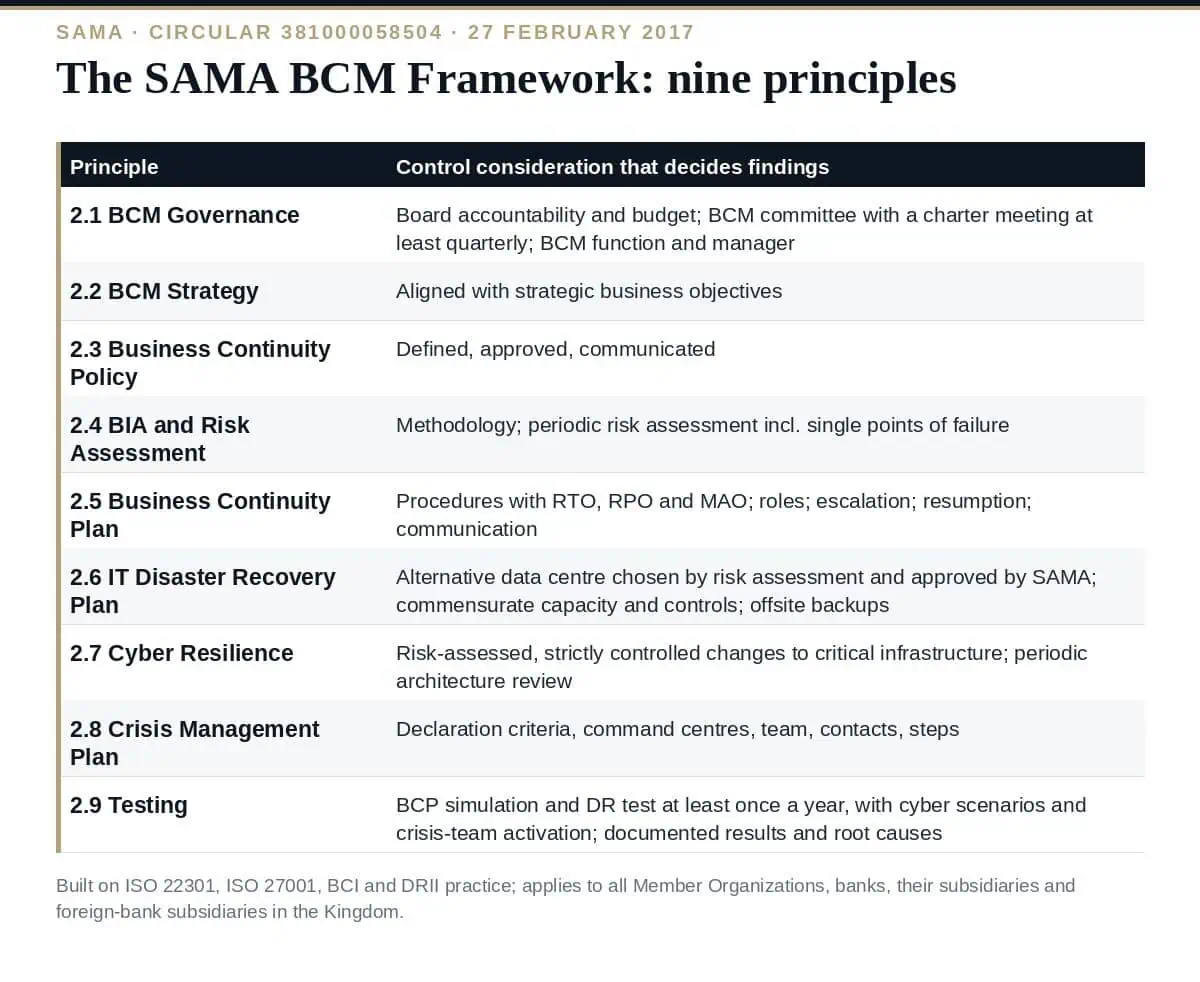
It is built, by SAMA’s own account, on ISO 22301, ISO 27001, the BCI Good Practice Guidelines and the DRII Professional Practices, and it is structured as nine principles — governance, strategy, policy, business impact analysis and risk assessment, the business continuity plan, the IT disaster recovery plan, cyber resilience, the crisis management plan and testing — each with an objective and numbered control considerations.
Some of the considerations are specific enough to fail on their own: a BCM committee meeting at least quarterly, an alternative data centre whose location is approved by SAMA, BCP simulation tests and DR tests at least once a year. This guide sets out the nine principles of the SAMA Business Continuity Management Framework as SAMA writes them, the control considerations that decide most findings, how the Framework relates to the Cyber Security and IT Governance Frameworks and to ISO 22301, and how to build the programme in the order the Framework’s dependencies dictate.
Section 1.1 states the purpose: 24 × 7 availability of business operations is expected of financial institutions in the Kingdom, and the Framework is to enhance organisational resilience so that operations and services stay continuous and available. Section 1.3 defines its scope as principles, objectives and control considerations for business continuity, and section 1.4 the applicability set out above. Section 1.5 mandates it: SAMA owns and updates the document, and Member Organizations adopt and implement it.
The target audience in 1.7 runs from the board and CEO through the CRO, CIO and CISO to business continuity managers and internal auditors — a signal that SAMA expects the programme to be governed, not delegated. Our guide to SAMA compliance covers the Cyber Security Framework issued three months later, which the BCM Framework’s cyber resilience principle points at.
| Principle | What it requires | Control considerations that decide findings |
|---|---|---|
| 2.1 BCM Governance | A business continuity governance framework defined, approved, implemented and maintained, monitored by senior management, with the structure communicated to employees and third parties | The board or a delegated executive holds ultimate responsibility and allocates budget; a BCM committee mandated by the board with CRO, COO, CIO, CISO and the BCM manager represented and a charter with quarterly minimum meetings; a BCM function with an appointed, qualified BCM manager and adequate staff |
| 2.2 BCM Strategy | A business continuity strategy aligned with the organisation’s strategic business objectives | Strategy approved and embedding BCM as part of management practice |
| 2.3 Business Continuity Policy | A policy defined, approved and communicated to relevant stakeholders | Documents the commitment and objectives of the programme |
| 2.4 Business Impact Analysis and Risk Assessment | A BIA and risk assessment for all relevant activities to determine continuity and DR requirements | A defined methodology; periodic risk assessment identifying internal and external threats including single points of failure across people, process, technology and premises; prioritisation of processes and dependencies |
| 2.5 Business Continuity Plan | A BCP for critical activities, defined, approved, implemented and maintained; compliance monitored and effectiveness measured | Procedures covering key resources, roles and authorities, immediate-consequence management and escalation, continuity within RTO, RPO and MAO, resumption to business as usual, and communication with employees, third parties and stakeholders |
| 2.6 IT Disaster Recovery Plan | An IT DRP for critical activities and their technology infrastructure, aligned with the BIA | An alternative data centre at a location chosen by risk assessment so it does not share the main site’s risks and approved by SAMA; configurations and capacity commensurate with the main data centre; the same logical, physical, environmental and cyber security controls; a backup and recovery process with offsite storage; formal third-party contracts |
| 2.7 Cyber Resilience | Critical services, functions and processes run on reliable, robust infrastructure and software | In-depth risk assessment and strict development, testing and change management for changes to critical infrastructure; a periodic architectural review; further resilience controls referred to the Cyber Security Framework |
| 2.8 Crisis Management Plan | A crisis management plan for a well-managed response to major incidents, including rapid communication for the safety of internal and external stakeholders | Criteria for declaring a crisis; a command centre and an emergency command centre; a crisis management team with communications represented; contact details including third parties; defined steps; compliance monitored and effectiveness measured |
| 2.9 Testing | Regular BCP and DRP tests, defined, approved, implemented, executed and monitored, to train employees and third parties and prove the plans | BCP simulation tests at least once a year with well-planned scenarios including cyber security and crisis-team activation, and an integrated test across critical services; a DR test combined with the BCP at least once a year, evaluated for readiness; detailed documented results with objectives met, resource readiness, lessons learnt and, on failure, root causes |
| Relationship | How the Framework handles it |
|---|---|
| Cyber Security Framework (May 2017) | Principle 2.7 covers resilience of critical infrastructure and refers further resilience controls — threat management, vulnerability management and others — to the Cyber Security Framework; the CSF in turn requires cyber security incident management aligned with enterprise incident management |
| IT Governance Framework (November 2021) | To be implemented in conjunction with the BCM Framework; its data backup and recoverability (3.3.10), IT incident (3.3.8) and availability and capacity (3.3.4) subdomains are the operational side of the DRP |
| Cyber Resilience Fundamental Requirements (2022) | The licensing-stage minimum for fintechs and sandbox entities includes a Resilience domain built from BCM principles 2.5, 2.6 and 2.7; full BCM Framework compliance applies after licensing |
| ISO 22301 | Named in 1.1 as a source. The Framework’s principles map to ISO 22301’s clauses — policy (5.2), BIA and risk assessment (8.2), strategies (8.3), plans and procedures (8.4), exercise programme (8.5) — but SAMA’s control considerations are more specific (committee frequency, SAMA-approved DR site, annual tests) and are mandatory rather than certifiable |
| Rules on Outsourcing | Third parties in critical activities appear in 2.5 communications, 2.6 formal contracts and 2.9 test participation |
Our guides to the SAMA IT Governance Framework and SAMA outsourcing cover the two neighbours; the SAMA CSF domains covers where the cyber controls that 2.7 points at live.
What is the SAMA Business Continuity Management Framework?
The Saudi Central Bank’s mandatory business continuity requirements, issued under Circular 381000058504 on 27 February 2017: nine principles — governance, strategy, policy, BIA and risk assessment, BCP, IT DRP, cyber resilience, crisis management and testing — each with an objective and control considerations, built on ISO 22301, ISO 27001, BCI and DRII practice.
Who must comply?
All organisations affiliated with SAMA, all banks operating in Saudi Arabia, banking subsidiaries of Saudi banks and subsidiaries of foreign banks in the Kingdom; the Rulebook records the scope of application as the banking sector, finance sector, payment systems and PSPs, and credit bureaus.
How often must plans be tested?
Principle 2.9: BCP simulation tests at least once a year, with cyber security scenarios considered and crisis-team activation included, and a DR test combined with the BCP at least once a year; results are documented with lessons learnt and root causes of any failure.
Does SAMA have to approve the disaster recovery site?
Yes. Principle 2.6 requires the alternative data centre’s location to be chosen by a risk assessment showing it does not share the main site’s risks, and approved by SAMA, with configuration, capacity and security controls commensurate with the main data centre.
Is ISO 22301 certification enough?
No. SAMA names ISO 22301 as a source, but its control considerations — quarterly committee, SAMA-approved DR site, RTO/RPO/MAO in the plan, annual tests with cyber scenarios — are more specific than the standard and are assessed by SAMA, not by a certification body.
Build the SAMA Business Continuity Management Framework in the order its nine principles depend on each other — governance, strategy and policy; BIA and risk assessment with RTO, RPO and MAO; the BCP, the IT DRP with a SAMA-approved alternative data centre, and the crisis management plan; cyber resilience through change control; and annual tests with cyber scenarios and documented root causes — because SAMA’s control considerations are specific enough to be checked line by line, and the committee minutes, the DR-site approval and the test reports are what the review reads.
The BCM committee charter, the BIA and risk assessment methodology, the business continuity, IT disaster recovery and crisis management plan templates and the annual test and exercise records are in the SAMA Compliance Toolkit, or start with the free templates.

September 21, 2026
September 20, 2026
September 20, 2026
September 19, 2026

September 19, 2026

