CART
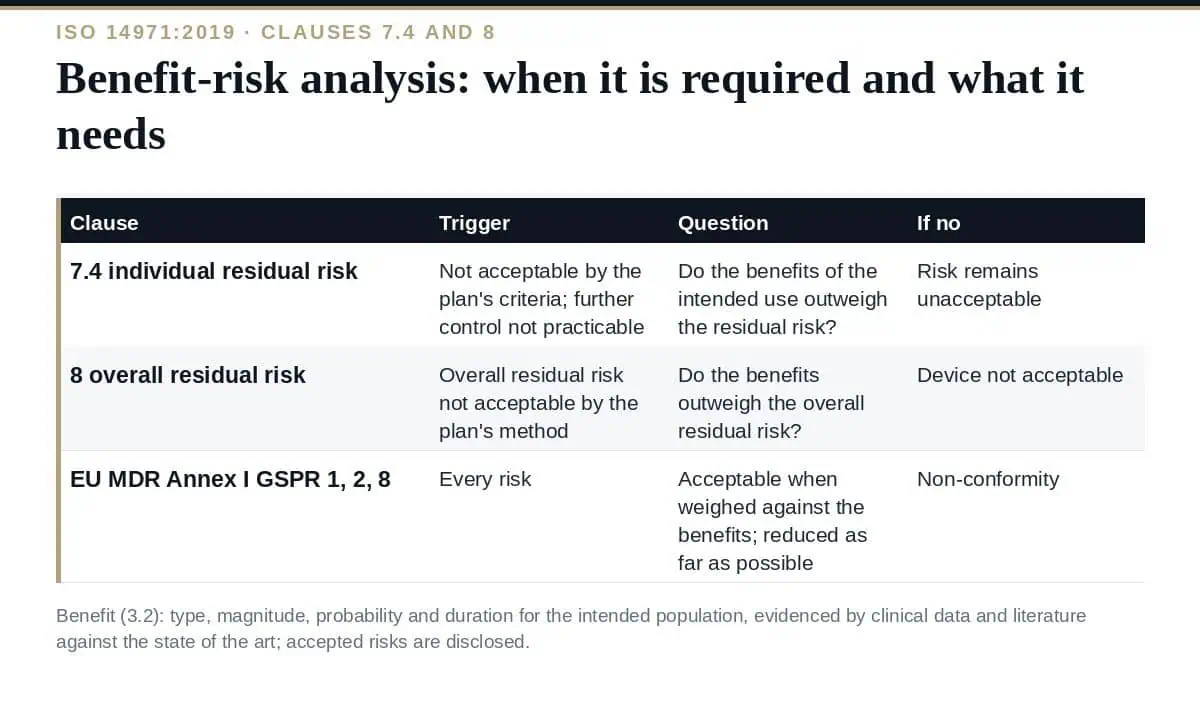
A benefit-risk analysis under ISO 14971:2019 is the step a manufacturer takes when a risk cannot be brought within its own acceptability criteria and the device is still worth making. Clause 7.4 applies it to an individual residual risk: if the residual risk is not judged acceptable using the criteria in the risk management plan and further risk control is not practicable, the manufacturer may gather and review data and literature to determine whether the benefits of the intended use outweigh that residual risk — and if they do not, the risk remains unacceptable. Clause 8 applies the same analysis to the overall residual risk of the device once all risk control measures are in place. The 2019 edition made the concept explicit by defining benefit for the first time (3.2): a positive impact or desirable outcome of the use of a medical device on the health of an individual, or a positive impact on patient management or public health. Under EU MDR the analysis is not optional at all — Annex I requires every risk to be acceptable when weighed against the benefits, and the clinical evaluation must support the benefit-risk determination. This guide sets out when each analysis is required, what benefit means and how it is evidenced, how to structure the analysis so a reviewer can follow it, how MDR and FDA treat it, and the errors that turn a benefit-risk analysis into a rationalisation.
| Clause | Trigger | Question | Outcome |
|---|---|---|---|
| 7.3 Residual risk evaluation | After risk control measures are implemented and verified | Is the residual risk acceptable using the criteria in the plan? | Acceptable → record; not acceptable → further control (7.1) or 7.4 |
| 7.4 Benefit-risk analysis (individual risk) | Residual risk not acceptable and further risk control not practicable | Do the benefits of the intended use outweigh the residual risk? | Yes → acceptable, disclosed as significant residual risk (7.6 / 8); no → unacceptable |
| 7.5 Risks arising from risk control measures | Any risk control measure | Does the measure introduce new hazards or affect other risks? | New risks analysed and evaluated |
| 8 Evaluation of overall residual risk | All risk control measures implemented and verified | Is the overall residual risk acceptable using the plan’s method and criteria? | Not acceptable → benefit-risk analysis of the overall residual risk; acceptable → inform users of significant residual risks |
Two points the sequence enforces. Benefit-risk is reached only after risk control has been exhausted — a manufacturer cannot skip to it because a control is expensive. And the plan’s criteria come first: the analysis is a justified exception to them, recorded as such. Our guide to the ISO 14971 risk management plan covers the criteria the exception is measured against, and risk acceptability criteria covers how they are set.
| Kind of benefit (3.2) | Examples | Evidence |
|---|---|---|
| Positive impact on clinical outcome | Reduced mortality or morbidity; symptom relief; cure or slowed progression | Clinical investigation data; published literature; registry data |
| Positive impact on the patient’s quality of life | Mobility, independence, reduced pain, fewer hospital visits | Patient-reported outcome measures; clinical data |
| Outcomes related to diagnosis | Earlier or more accurate diagnosis; fewer unnecessary procedures | Diagnostic accuracy studies; sensitivity and specificity data |
| Positive impact from diagnostic devices on clinical outcomes | Treatment decisions improved by the result | Outcome studies linking the diagnostic to management |
| Positive impact on public health | Population screening; infection control; access | Epidemiological and health-economic evidence |
Benefit is characterised by its type, magnitude, probability (the proportion of patients who experience it) and duration, and by the population and conditions of use in which it occurs — the same attributes the risk side carries. The analysis compares like with like: a benefit that accrues to most users for years is weighed against a harm of stated severity and probability, not against a label claim.
| Regime | Requirement | Consequence for the ISO 14971 analysis |
|---|---|---|
| EU MDR Annex I, GSPR 1 | Devices achieve their performance and any risks constitute acceptable risks when weighed against the benefits and are compatible with a high level of protection of health and safety, taking into account the generally acknowledged state of the art | Benefit-risk is the acceptability test for every risk, not only the exceptions; the file must show the weighing |
| EU MDR Annex I, GSPR 2, 4, 8 | Risk management system; risk control measures conforming to safety principles; all known and foreseeable risks and undesirable side-effects minimised and acceptable when weighed against the evaluated benefits | Reduce as far as possible without adversely affecting the benefit-risk ratio — the EN ISO 14971:2019/A11:2021 Annex ZA content deviation from ‘acceptable’ alone |
| EU MDR Article 61 and Annex XIV | Clinical evaluation demonstrates the benefit-risk determination; PMCF updates it | The clinical evaluation report is the benefit evidence; the risk file and CER cross-reference |
| EU MDR Article 2(24) | Defines benefit-risk determination as the analysis of all assessments of benefit and risk of possible relevance for the use of the device for the intended purpose | The term of art regulators use for what the ISO 14971 analysis produces |
| FDA premarket review | Benefit-risk factors considered in PMA, de novo and 510(k) decisions; FDA guidance on benefit-risk factors for premarket approval and de novo classifications | The ISO 14971 analysis and clinical data support the submission’s benefit-risk narrative |
Our guide to EU MDR covers the regulation; the practical consequence is that in the EU the benefit-risk analysis is written for every device, not only when a risk fails the plan’s criteria.
When is a benefit-risk analysis required under ISO 14971?
Under clause 7.4, when an individual residual risk is not acceptable by the risk management plan’s criteria and further risk control is not practicable; and under clause 8, when the overall residual risk is not acceptable by the plan’s method and criteria. Under EU MDR, in practice for every device, because Annex I makes acceptability a benefit-risk judgement.
What counts as a benefit?
ISO 14971:2019 clause 3.2: a positive impact or desirable outcome of the use of a medical device on the health of an individual, or a positive impact on patient management or public health — characterised by type, magnitude, probability and duration for the intended population.
Can a benefit-risk analysis make an unacceptable risk acceptable?
Yes, that is its function — but only where the evidence shows the benefits of the intended use outweigh the residual risk; if they do not, clause 7.4 states the risk remains unacceptable. The risk is then disclosed as a significant residual risk.
How does EU MDR change the analysis?
MDR requires risks to be reduced as far as possible and acceptable when weighed against benefits, with the clinical evaluation supporting the benefit-risk determination; EN ISO 14971:2019/A11:2021 Annex ZA records where MDR goes beyond the standard’s own acceptability language.
Who performs the analysis?
The risk management team with clinical input, under the responsibilities and authorities the plan assigns; the plan (4.4) must define who is authorised to accept residual risk.
Write the benefit-risk analysis as the last step it is: exhaust practicable risk control first, state the residual risk and the intended use precisely, evidence the benefit by type, magnitude, probability and duration against the state of the art, record who weighed it and why, disclose the risk, and reopen the analysis when post-production data moves either side — because under ISO 14971 it is the justified exception to your own criteria, and under MDR it is the test every risk has to pass.
The benefit-risk analysis template, the overall residual risk evaluation record, the risk management report and the significant residual risk disclosure register are in the ISO 14971 Toolkit, or start with the free templates.


September 21, 2026

September 20, 2026
September 20, 2026
September 19, 2026

September 19, 2026

