CART

DPDP vs GDPR is the comparison every organisation that processes Indian and European personal data has to make, and the two laws are further apart than their shared vocabulary of consent, rights and breach notification suggests. India’s Digital Personal Data Protection Act, 2023 — Act No. 22 of 2023, with its Rules notified on 13 November 2025 and its substantive obligations commencing 13 May 2027 — covers digital personal data only, allows processing on consent or a short list of “legitimate uses”, knows no special categories, imposes penalties in rupee bands up to ₹250 crore, and gives individuals duties as well as rights.
The GDPR covers all personal data, offers six lawful bases including legitimate interests, treats special categories separately, fines up to €20 million or 4% of worldwide turnover, and imposes no duties on data subjects. This guide sets the two side by side on twelve points, walks the nine differences that change how a programme is built, and shows what a GDPR-compliant organisation has to add — and, in two places, remove — to be ready for India.
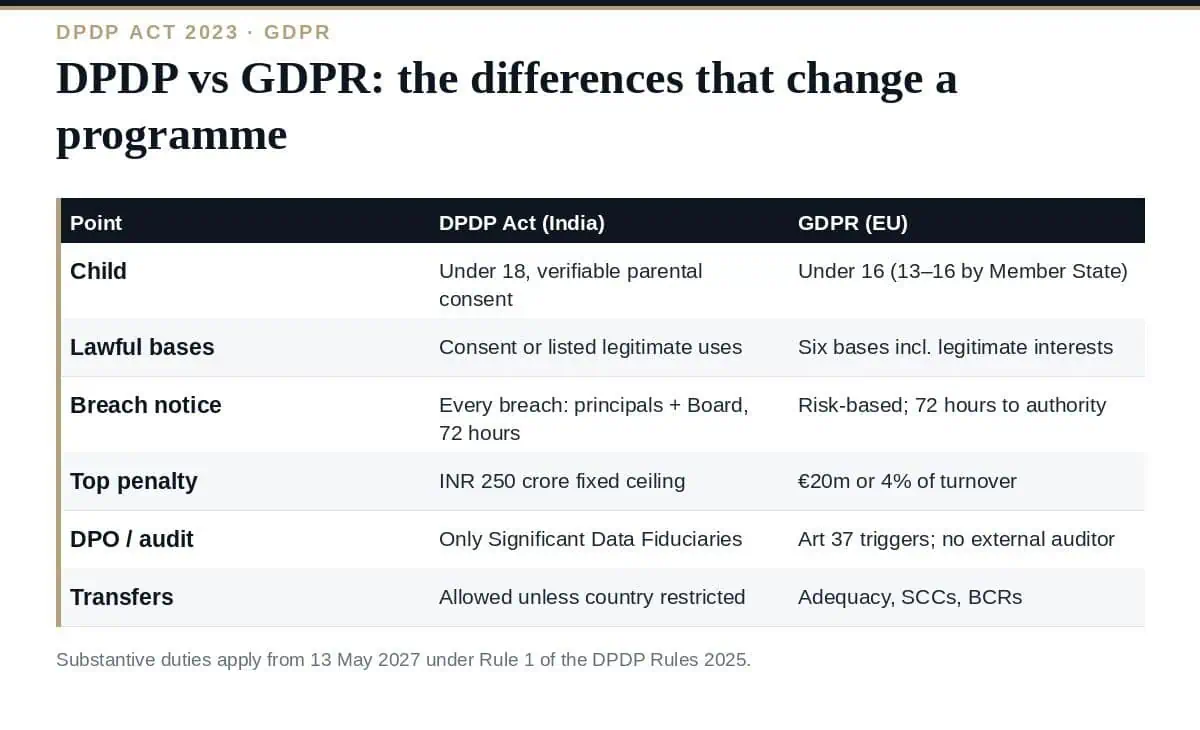
| DPDP Act 2023 (India) | GDPR (EU) | |
|---|---|---|
| Instrument | Act No. 22 of 2023, enacted 11 August 2023; DPDP Rules 2025 notified 13 November 2025; obligations commence 13 November 2026 (consent managers) and 13 May 2027 (everything else) | Regulation (EU) 2016/679, applicable since 25 May 2018 |
| Regulator | Data Protection Board of India — a digital office; appeals to the Telecom Disputes Settlement and Appellate Tribunal | National supervisory authorities; European Data Protection Board; national courts |
| Scope of data | Digital personal data — collected digitally, or collected offline and digitised | All personal data, automated or in a filing system |
| Territorial reach | Processing in India; processing outside India in connection with offering goods or services to data principals in India | Establishment in the EU; offering goods or services to, or monitoring, data subjects in the EU |
| Roles | Data Fiduciary, Data Processor, Data Principal, Significant Data Fiduciary, Consent Manager | Controller, processor, data subject, joint controllers, representative |
| Lawful bases | Consent, or the ‘certain legitimate uses’ listed in section 7 | Six: consent, contract, legal obligation, vital interests, public task, legitimate interests |
| Special categories | None | Article 9 special categories and Article 10 criminal data |
| Children | Under 18; verifiable parental consent; no tracking, behavioural monitoring or targeted advertising | Under 16 (member states may set 13–16) for information society services; no blanket advertising ban |
| Individual rights | Access, correction and erasure, grievance redressal, nomination | Information, access, rectification, erasure, restriction, portability, objection, automated decision-making |
| Individual duties | Yes — section 15, with a penalty up to ₹10,000 | None |
| Breach notification | Every breach: to the Board and each affected data principal, without delay; detailed report to the Board within 72 hours | To the authority within 72 hours where risk is likely; to data subjects where high risk |
| Penalties | Schedule bands: up to ₹250 crore (security safeguards), ₹200 crore (breach notification; children), ₹150 crore (Significant Data Fiduciary duties), ₹50 crore (other) | Up to €20 million or 4% of worldwide annual turnover; €10 million or 2% for the lower tier |
Our guides to the DPDP Act and the DPDP Rules 2025 cover the Indian side in full; GDPR principles covers Article 5.
| Area | GDPR position | DPDP addition |
|---|---|---|
| Lawful basis register | Six bases; legitimate interests assessments | Re-map every activity to consent or a section 7 legitimate use; legitimate-interest processing moves to consent or stops |
| Notice | Articles 13 and 14 | Rule 3: a standalone notice with an itemised description of the data and purposes, the goods or services enabled, and the links to withdraw consent, exercise rights and complain to the Board |
| Consent mechanics | Freely given, specific, informed, unambiguous | Withdrawal as easy as giving; consent manager integration where relevant; consent records retained |
| Children | Age 16 (or 13–16) for information society services | Verifiable parental consent for under-18s per Rule 10; no tracking or targeted advertising; age-gating across the estate |
| Breach process | Risk assessment gate; 72 hours to the authority | No gate: notify every affected individual without delay; immediate Board notification; 72-hour detailed report |
| Security | Appropriate measures | Rule 6 minimum set: encryption or masking, access control, logging with one-year retention, backups, processor contract terms |
| Retention | Storage limitation | Rule 8 and the Third Schedule: fixed erasure periods for specified classes, with 48-hour advance notice to the individual |
| Significant Data Fiduciary | DPO by activity; DPIA by risk | If notified: India-based DPO, independent data auditor, annual DPIA and audit reported to the Board, algorithmic due diligence, possible localisation |
| Rights handling | Eight rights, one month | Access, correction and erasure, grievance redressal within the period the fiduciary publishes, nomination; the published means of exercise per Rule 14 |
Two GDPR mechanisms have no DPDP counterpart: the legitimate-interests assessment, because there is no such basis, and the transfer mechanism (SCCs, adequacy) for data leaving India, because transfers are permitted unless restricted. Keeping the transfer register is still sensible — the government can notify restrictions and Significant Data Fiduciaries may be subject to localisation — and keeping special-category handling is sensible because sector regulators require it even though the Act does not.
What must not be carried over unchanged is the breach playbook: a GDPR-trained team that assesses risk before notifying will miss the DPDP Act’s duty to notify every affected individual and the Board regardless. Our guide to DPDP breach notification covers the 72-hour rule; Saudi PDPL vs GDPR is the comparable exercise for the Gulf.
What is the difference in DPDP vs GDPR?
The DPDP Act covers digital personal data only, allows processing on consent or a fixed list of legitimate uses with no legitimate-interests test, has no special categories, treats under-18s as children with verifiable parental consent, designates Significant Data Fiduciaries, creates consent managers, imposes duties on individuals, requires every breach to be notified, permits transfers unless the government restricts them, and fines in rupee bands up to ₹250 crore. GDPR is broader in scope, more flexible on bases, risk-gated on breaches and fines up to 4% of turnover.
Is the DPDP Act in force?
Partly. The Data Protection Board provisions have been in force since 13 November 2025; consent manager registration commences 13 November 2026; the substantive obligations on data fiduciaries — notice, consent, security, breach, children, rights — commence 13 May 2027.
Does GDPR compliance make us DPDP compliant?
It gets you most of the governance and rights machinery, but not the lawful-basis mapping (no legitimate interests), the Rule 3 notice format, the under-18 verifiable consent, the no-threshold breach notification, the Rule 6 security minimums and the Significant Data Fiduciary duties if notified. Treat DPDP as an extension with three rewrites: bases, breach, children.
Which is stricter?
Neither uniformly. DPDP is stricter on consent (no legitimate interests), children (18, advertising ban) and breach notification (every breach, everyone); GDPR is stricter on special categories, transfers, portability and objection rights, and its fines scale with global turnover.
Do the penalties compare?
DPDP’s maximum is ₹250 crore per instance of failing security safeguards — roughly €25–28 million at recent rates — with fixed bands below it; GDPR’s maximum is the higher of €20 million or 4% of worldwide annual turnover, so for a large group GDPR’s ceiling is higher and DPDP’s is fixed.
Run DPDP vs GDPR as an extension with three rewrites: keep the GDPR governance, rights and security machinery; re-map every processing activity to consent or a section 7 legitimate use; rebuild the breach process without a risk gate; and age-gate for under-18s with verifiable parental consent. Then check whether you are likely to be notified as a Significant Data Fiduciary, because that is where the DPO, auditor and annual DPIA land — and the calendar says 13 May 2027.
The GDPR-to-DPDP gap assessment, the lawful basis and legitimate-use register, the Rule 3 notice template, the verifiable parental consent procedure and the breach notification workflow are in the DPDP Act Toolkit, or start with the free templates.

September 21, 2026
September 20, 2026
September 20, 2026
September 19, 2026

September 19, 2026

