CART
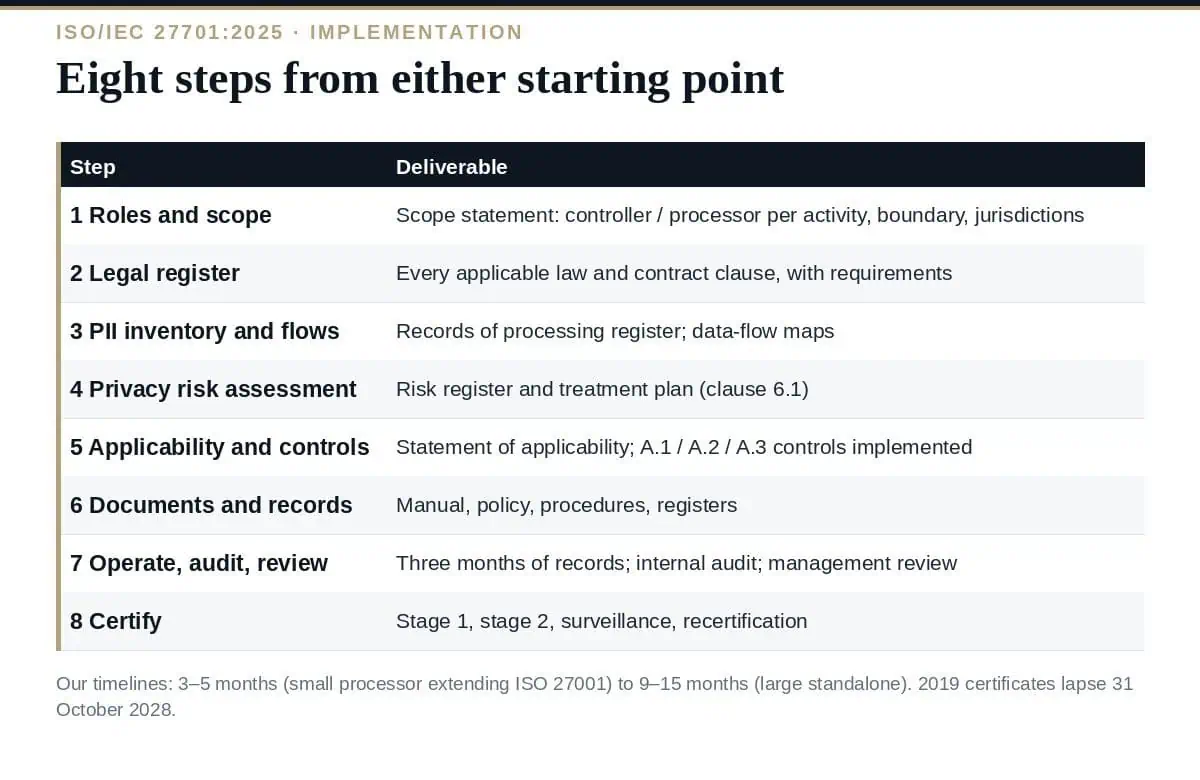
An ISO 27701 implementation in 2026 is a different project from the one described in most guides still online, because the standard changed underneath them. ISO/IEC 27701:2025, published 14 October 2025, is a standalone privacy information management system standard with its own clauses 4 to 10 and its own Annex A of controller, processor and information security controls; the 2019 edition it replaced was an extension to ISO 27001, and every implementation plan written for it starts from an ISMS that the 2025 edition no longer assumes. The practical consequence is that there are now two starting points — an organisation with ISO 27001 that extends it, and one without that builds the PIMS on its own — and one destination. This guide sets out an eight-step ISO 27701 implementation plan that works from either start, with the deliverable and the trap at each step, a timeline by organisation size, the differences for controllers, processors and hybrids, and the transition route for a 2019 certificate holder whose certificate lapses on 31 October 2028.
| Extending an ISO 27001 ISMS | Standalone PIMS (no ISMS) | |
|---|---|---|
| Management system clauses 4–10 | Extend the existing scope, policy, risk method, document control, audit programme and management review to cover privacy | Build them for the PIMS — the 2025 edition contains them |
| Information security controls | Largely in place under ISO 27001 Annex A; map to 27701 Annex A.3 and declare in the PIMS statement of applicability | Implement Annex A.3 within the PIMS — the reason the 2025 edition brought them inside |
| Privacy controls (A.1 controller, A.2 processor) | New in both cases | New in both cases |
| Certification | Integrated audit with the ISMS, or a separate PIMS audit | PIMS certificate on its own |
| Typical effort | Lower — most of the system exists | Higher — the system is built once, for privacy |
Our guide to ISO 27001 vs ISO 27701 covers the decision; the steps below mark where the two routes differ.
| Organisation | Route | Typical timeline to stage 2 (our estimate) | Where the time goes |
|---|---|---|---|
| Small processor (SaaS, one product, ISO 27001 held) | Extension | 3–5 months | A.2 controls, customer instruction records, sub-processor register, three months of operation |
| Small controller (no ISMS) | Standalone | 6–9 months | Building clauses 4–10 and A.3 from nothing; PII inventory; notices and request handling |
| Mid-size hybrid (controller for staff and customers, processor for clients; ISO 27001 held) | Extension | 5–8 months | Role split per activity; both control tables; legal register across jurisdictions |
| Large multi-jurisdiction controller (no ISMS, or ISMS with a narrower scope) | Standalone or scope extension | 9–15 months | Scope alignment; inventory at scale; DPIAs; integration of existing privacy programme artefacts |
| 2019 certificate holder | Transition | 2–4 months of gap work before the next scheduled audit | Clause 4–10 items previously borrowed; A.3 declaration; Annex F mapping of old controls to new |
Certificates issued to ISO/IEC 27701:2019 remain valid until 31 October 2028 and then lapse. The transition is smaller than a fresh implementation because the privacy controls carry over — the 2025 edition’s Annex F maps each 2019 control to its successor — and larger than a relabel because the management system clauses and the A.3 security controls now have to be evidenced inside the PIMS rather than pointed at in the ISMS. Fold the transition into a scheduled surveillance or recertification visit in 2026 or 2027; certification bodies set their own earlier cut-offs for 2019 audits and slots compress as the date approaches. Our guide to ISO 27701:2025 vs 2019 covers what changed.
How long does an ISO 27701 implementation take?
Three to five months for a small processor extending an ISO 27001 ISMS; six to nine for a small controller building a standalone PIMS; nine to fifteen for a large multi-jurisdiction organisation — our estimates, with three months of operating records before stage 2 in every case.
Do we need ISO 27001 first?
Not since October 2025. ISO 27701:2025 is standalone; a PIMS can be built and certified on its own, with the information security controls in Annex A.3. Where ISO 27001 exists, extending it is faster.
What is the first step?
Deciding roles — controller, processor or both — per processing activity, and the PIMS scope. Everything downstream, from the legal register to the statement of applicability, depends on it.
Which controls apply to us?
A.1 for activities where you are a controller, A.2 where you are a processor, A.3 for both. The statement of applicability declares each control applicable or not with justification, per the roles established in the inventory.
What happens to our 2019 certificate?
It remains valid until 31 October 2028, then lapses. Transition at a scheduled surveillance or recertification audit in 2026 or 2027, closing the clause 4–10 and A.3 gaps and using Annex F to map the controls.
Run the ISO 27701 implementation in the order the standard’s logic runs: roles and scope, legal register, inventory, risk, applicability and controls, documents and records, operation and audit, certification — from an ISMS if you have one and on its own if you do not. The 2025 edition removed the prerequisite; it did not remove the work.
The implementation roadmap, the scope and roles workbook, the legal register, the PII inventory and data-flow templates, the privacy risk assessment method, the statement of applicability and the full PIMS document set are in the ISO 27701 Toolkit, or start with the free templates.

September 21, 2026
September 20, 2026
September 20, 2026
September 19, 2026

September 19, 2026

