CART
NIST 800-171 compliance cost has one official anchor and a great deal of unofficial noise. The anchor is the Department of Defense’s own regulatory analysis for the CMMC Program rule, which put a small entity’s cost of a Level 2 self-assessment against the 110 Revision 2 requirements at roughly $37,196 over three years, and the certification path at about $104,670 with the assessor’s fee around $31,234 of that. The noise is everything the DoD figures deliberately exclude: the cost of actually implementing the requirements, which depends on how much CUI you handle, how many people and systems touch it, and how much of the work you already did for other reasons. This guide separates the two — the assessment and affirmation costs the government has estimated, and the implementation costs we estimate by scope and label as ours — sets out the cost drivers that move a program between the bottom and top of each range, gives three worked scenarios, and lists the decisions that cut the total most.
| Cost element | DoD estimate (CMMC Program rule regulatory analysis) | Note |
|---|---|---|
| Level 1 self-assessment, annual | ~$5,977 per year, small entity; ~$4,042 other-than-small | The 15 FAR 52.204-21 safeguards, not 800-171 |
| Level 2 self-assessment, triennial with annual affirmations | ~$37,196 over 3 years, small entity; ~$48,970 other-than-small | The 110 Rev 2 requirements, assessed at 800-171A objective level, scored into SPRS |
| Level 2 C3PAO certification, triennial with annual affirmations | ~$104,670 small entity; ~$117,768 other-than-small; C3PAO fee ~$31,234 within it | The third-party path — suspended since 13 July 2026, still available voluntarily |
| Implementation of the requirements | Not included | DoD’s position is that DFARS 252.204-7012 has required implementation since 2017; the CMMC figures cover assessment, not remediation |
The last row is the one to read twice. The DoD figures assume the 110 requirements are already implemented, because contractually they have been required since the 2017 DFARS deadline; the assessment cost is the cost of proving it. If your program is not there, the implementation cost below comes first. Our guide to CMMC Level 2 certification cost covers the assessment figures in detail.
| Driver | Effect | What you control |
|---|---|---|
| Scope: how many people and systems touch CUI | The single largest driver — every in-scope endpoint, account and server carries the technical requirements | An enclave that confines CUI to a subset of users and systems |
| Starting maturity | A program with MFA, central logging, patching and written policies is closing gaps; one without is building | Reusing ISO 27001, SOC 2 or CIS work already done |
| Cloud and email platform | CUI in email and files needs a platform that can meet the requirements — for DoD, FedRAMP Moderate or equivalent for cloud services holding CDI | Choosing a compliant tenant for the enclave only, not the whole company |
| Internal capacity vs outsourced | An MSP/MSSP that runs the enclave converts capital and staff time into a monthly fee | Which requirements to operate in-house |
| Documentation state | The SSP, POA&M and per-family policies are the assessable artifacts; writing them from scratch is weeks of work | Templates, and a document owner |
| Assessment path | Self-assessment costs staff time; a C3PAO assessment adds the fee and preparation | Whether a customer or contract actually requires certification during the suspension |
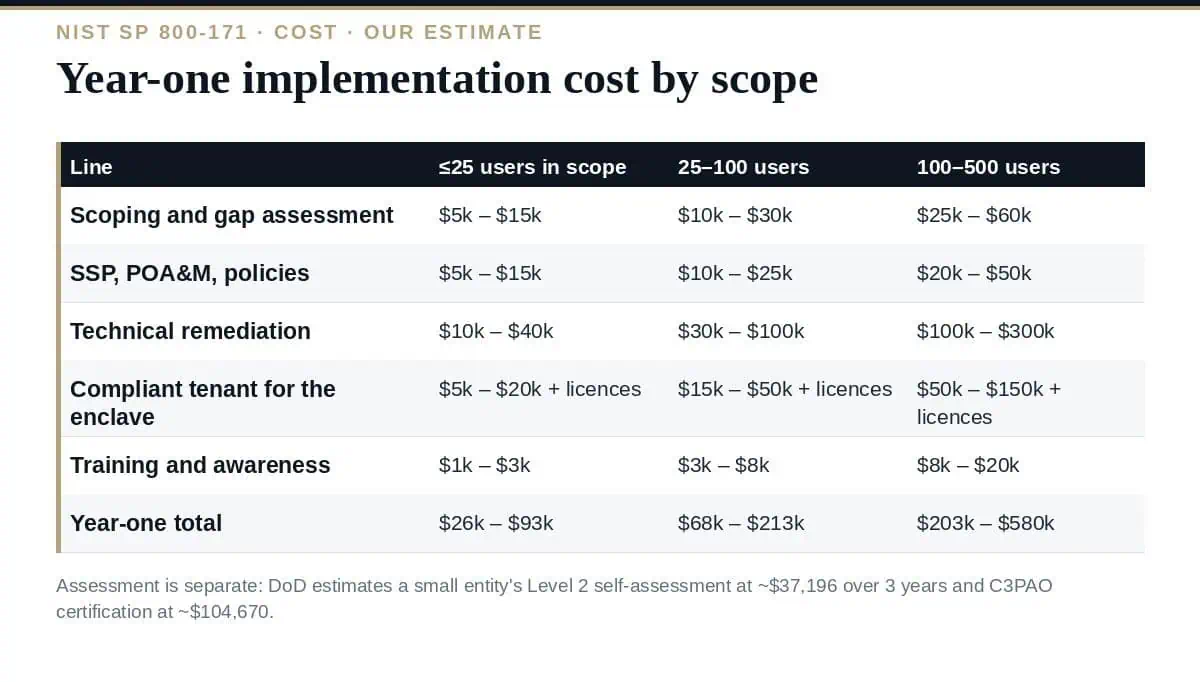
These are our estimates, not DoD figures, for reaching a full-implementation SPRS score of 110 from a typical commercial starting point — some controls in place, no CUI-specific program. Ranges assume US consultant rates and 2026 tooling prices; they exclude the assessment costs above.
| Cost line | Small enclave (≤25 users touching CUI) | Mid-size (25–100 users) | Larger scope (100–500 users) |
|---|---|---|---|
| Scoping and gap assessment (consultant or internal) | $5,000 – $15,000 | $10,000 – $30,000 | $25,000 – $60,000 |
| Documentation: SSP, POA&M, 14 family policies, procedures, evidence register | $5,000 – $15,000 or 15–30 internal staff days | $10,000 – $25,000 or 30–50 staff days | $20,000 – $50,000 or 50–90 staff days |
| Technical remediation: MFA, logging/SIEM, encryption, endpoint, configuration baselines, media controls | $10,000 – $40,000 | $30,000 – $100,000 | $100,000 – $300,000 |
| Compliant cloud tenant migration for the enclave (where CUI is in email and files) | $5,000 – $20,000 plus per-user licensing | $15,000 – $50,000 plus licensing | $50,000 – $150,000 plus licensing |
| Training and awareness | $1,000 – $3,000 | $3,000 – $8,000 | $8,000 – $20,000 |
| Year-one total (our estimate) | $26,000 – $93,000 | $68,000 – $213,000 | $203,000 – $580,000 |
| Ongoing per year: monitoring, reviews, annual affirmation, tooling, MSSP if used | $10,000 – $40,000 | $30,000 – $100,000 | $80,000 – $250,000 |
Two things move the NIST 800-171 compliance cost within these ranges. Scope discipline is the first: a company of 200 with 20 people who touch CUI can be a small enclave, and the difference between the first and third columns is the difference between an enclave and a whole-company scope. Our guide to CMMC scoping covers how the boundary is drawn. Existing maturity is the second: an organization with ISO 27001 or SOC 2 already has the access control, logging, incident response and policy skeleton, and its remediation line sits at the bottom of the range.
| Scenario | Assumptions | Year one (our estimate) | Then per year |
|---|---|---|---|
| Machine shop, 40 staff, 12 handle drawings marked CUI//SP-CTI | Enclave of 12 users on a compliant tenant; MSP runs it; templates for documentation; self-assessment | $40,000 – $80,000 including MSP onboarding | $25,000 – $50,000 MSP and tooling; self-assessment ~$12,400 per year in DoD’s 3-year figure |
| Engineering firm, 120 staff, 60 in scope | Company-wide MFA and logging already in place from ISO 27001; consultant-led gap and SSP; in-house IT | $70,000 – $150,000 | $40,000 – $90,000 |
| Prime’s subsidiary, 400 staff, 250 in scope, multiple sites | No enclave possible; SIEM and endpoint replacement; dedicated compliance lead; voluntary C3PAO assessment for a prime’s flow-down | $250,000 – $550,000 plus ~$31,000 assessor fee | $120,000 – $250,000 |
How much does NIST 800-171 compliance cost?
DoD estimates a small entity’s Level 2 self-assessment at about $37,196 over three years and third-party certification at about $104,670, with the assessor’s fee near $31,234. Implementation is separate and depends on scope: our estimate runs from roughly $26,000–93,000 in year one for a small enclave to $200,000–580,000 for a 100–500-user scope.
Are the DoD figures the whole cost?
No. They cover assessment, affirmation and related effort, on the assumption that the 110 requirements were implemented under DFARS 252.204-7012 already. Remediation, tooling and platform costs are additional.
What is the cheapest way to comply?
A small enclave: confine CUI to the fewest users and systems, put them on a compliant platform, document with templates, and self-assess honestly to the 800-171A objectives before spending on consultants.
Does an MSP make it cheaper?
It converts capital and staff time into a monthly fee and usually lowers year-one cost for a small enclave; over several years the total is similar. The organization still owns the SSP, the score and the affirmation.
Do I need a C3PAO assessment now?
Not by rule — CMMC Phase 2 has been suspended since 13 July 2026 and Level 2 self-assessments continue. Some primes still require certification in flow-downs; budget the fee only when a contract asks.
Budget NIST 800-171 compliance cost in two parts: the assessment and affirmation figures DoD has published, and the implementation figure that depends on the boundary you draw. Draw it tight, score yourself against the objectives first, reuse what you already have, and buy the compliant platform for the enclave rather than the company — the ranges above shrink from the top down in exactly that order.
The System Security Plan, the POA&M, the 14 control-family policies and the CUI scoping workbook that compress the documentation line are in the NIST SP 800-171 CUI Protection Toolkit, or start with the free templates.

September 20, 2026
September 20, 2026
September 19, 2026
September 19, 2026

September 19, 2026

