CART
An ergonomic risk assessment is the part of ISO 45001 hazard identification that most OH&S management systems do worst, because musculoskeletal disorders do not announce themselves with an incident: they accumulate over months of lifting, reaching, repeating and sitting until a worker is absent and a claim is open. ISO 45001:2018 clause 6.1.2.1 requires hazard identification to consider “human factors” and “how work is organized”, and clause 8.1.2 requires the hierarchy of controls to be applied to what is found; ergonomics is where both requirements are tested. Four assessment tools cover the great majority of workplaces — RULA, REBA, the NIOSH lifting equation and the HSE’s MAC — and choosing the right one for the task is most of the skill. This guide explains what each tool measures, when to use it, how its score becomes a risk rating, and how the assessment feeds the hazard register and the controls ISO 45001 expects.
Clause 6.1.2.1 lists what hazard identification must take into account, and three items on the list call for an ergonomic risk assessment: how work is organized, including workload and work hours; the design of work areas, processes, installations, machinery and equipment, operating procedures and work organization, “including their adaptation to the needs and capabilities of the workers involved”; and human factors. Clause 6.1.2.2 requires the methodology for assessing OH&S risks to be defined, which is where the tools below are named. Clause 8.1.2 requires controls to be chosen by the hierarchy — eliminate, substitute, engineering, administrative, PPE — and ergonomics is the field where the hierarchy is most often skipped, because “lift properly” training (administrative) is cheaper than a hoist (engineering). Our guide to the ISO 45001 self-assessment covers where these clauses are scored.
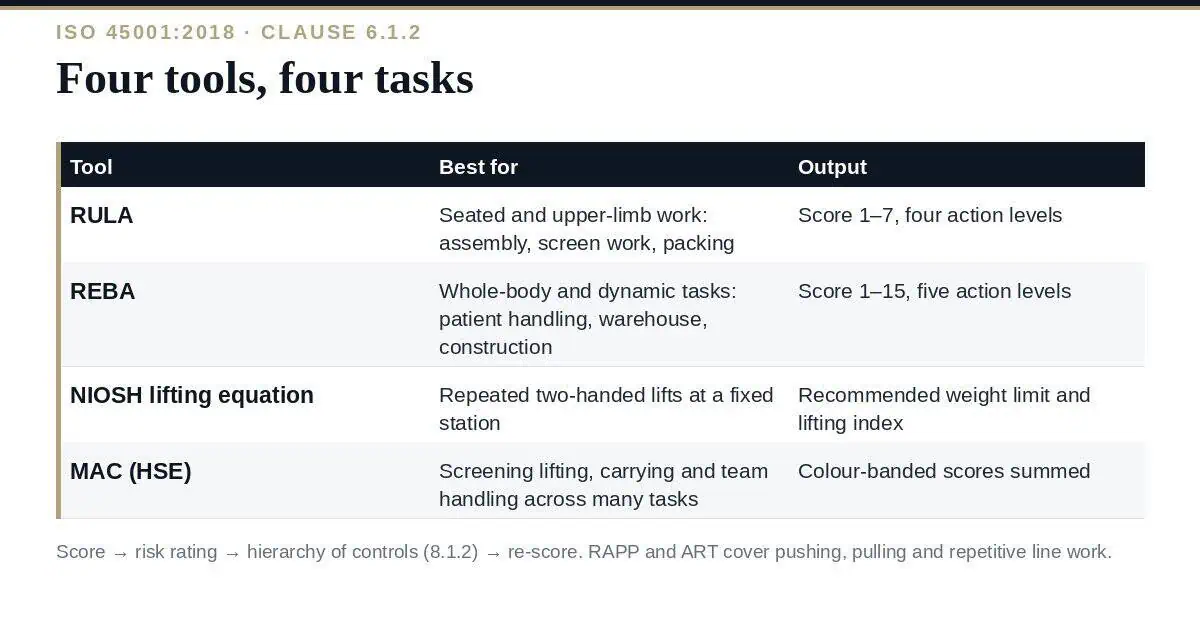
| Tool | Full name and origin | Assesses | Best for | Output |
|---|---|---|---|---|
| RULA | Rapid Upper Limb Assessment (McAtamney and Corlett, 1993) | Posture of the arms, wrists, neck and trunk plus muscle use and force | Seated and standing tasks dominated by upper-limb work: assembly, screen work, packing | Score 1–7 in four action levels |
| REBA | Rapid Entire Body Assessment (Hignett and McAtamney, 2000) | Whole-body posture including legs, with load, coupling and activity | Dynamic tasks with trunk and leg involvement: healthcare handling, warehouse, construction | Score 1–15 in five action levels |
| NIOSH lifting equation | Revised NIOSH Lifting Equation (Waters et al., 1993) | Two-handed lifting: horizontal and vertical distance, travel, asymmetry, frequency, coupling | Repeated symmetrical or near-symmetrical lifts in a defined workstation | Recommended weight limit and a lifting index (LI) |
| MAC | Manual Handling Assessment Charts (UK HSE, 2003, revised) | Lifting, carrying and team handling: load, distance, frequency, posture, grip, environment | Screening manual handling across many tasks quickly; a regulatory-recognized method in the UK | Colour-banded factor scores summed to a total |
RULA scores the posture of the upper arm, lower arm, wrist and wrist twist on one side and the neck, trunk and legs on the other, adjusts each for muscle use (static or repeated) and force, and combines them into a grand score from 1 to 7. Action levels: 1–2 acceptable; 3–4 investigate further; 5–6 investigate and change soon; 7 investigate and change immediately. It takes minutes per posture, needs only observation or a photograph, and is the right tool for seated work, bench assembly and any task where the load is light and the injury risk is in repetition and posture.
REBA extends the same logic to the whole body: trunk, neck and legs form one group, upper arms, lower arms and wrists the other, with adjustments for load, coupling (the quality of the grip) and activity (static holding, repetition, rapid change). The score runs 1 to 15 in five action levels from negligible to very high. It is the tool for tasks that RULA cannot see — lifting a patient, laying blocks, loading a van — where the legs and trunk carry the risk.
The revised equation starts from a load constant of 23 kg and multiplies it by six factors — horizontal, vertical, distance, asymmetry, frequency and coupling — each between 0 and 1, to give a recommended weight limit for the specific lift. Dividing the actual load by the limit gives the lifting index: below 1.0 is acceptable for most healthy workers; 1.0 to 3.0 places some workers at risk; above 3.0 places most workers at risk. It is precise, quantitative and narrow: two-handed lifts of stable loads, without carrying, in a defined position. It is the tool that justifies an engineering control in numbers, and it is unusable for one-handed, seated or dynamic lifts.
The HSE’s Manual Handling Assessment Charts score lifting, carrying and team-handling operations on a series of factors — load weight and frequency, hand distance from the lower back, vertical lift zones, trunk twisting and sideways bending, postural constraints, grip, floor surface, environment — each coloured green, amber, red or purple and given a numerical score, summed to a total that ranks tasks for action. It is fast, needs no equipment, covers carrying, and is the method UK inspectors use; its companion tools cover pushing and pulling (RAPP) and repetitive upper-limb tasks (ART). It is a screening tool: a high MAC score sends a task to REBA or NIOSH for the detailed assessment.
| Task | First tool | Then |
|---|---|---|
| Seated screen work; bench assembly; packing light items | RULA | Workstation redesign; no further tool usually needed |
| Patient handling; construction; warehouse picking with bending | REBA | MAC or NIOSH for the lifting elements |
| Repeated two-handed lifts at a fixed station | NIOSH lifting equation | REBA if posture is the issue rather than the load |
| Many manual handling tasks to screen; carrying; team lifts | MAC | REBA or NIOSH on the red and purple tasks |
| Pushing and pulling; repetitive upper-limb work on a line | RAPP; ART (HSE companions to MAC) | RULA for the postural element |
An ergonomic risk assessment score is not yet an OH&S risk. Clause 6.1.2.2 requires the assessment methodology to consider the hazard, the likelihood and the severity of harm, and the tools supply the first two — a RULA 7 or a lifting index above 3.0 is a high likelihood of harm — while severity comes from the outcome: musculoskeletal disorders are typically moderate to severe, long-duration and, for the organization, high-cost. Record the task, the tool, the score, the resulting risk rating and the controls chosen, with the hierarchy applied: eliminate the lift by delivering to point of use; substitute a lighter load or a smaller container; engineer with a hoist, a height-adjustable bench, a conveyor; administer with rotation, breaks and training; and provide PPE last, where it has any ergonomic relevance at all. Re-score after the control to evidence the reduction; a before-and-after REBA pair is the cleanest evidence of clause 8.1.2 an auditor will see.
What is an ergonomic risk assessment?
A structured assessment of the musculoskeletal risk in a task — posture, force, repetition, duration and load — using a recognized tool such as RULA, REBA, the NIOSH lifting equation or the HSE’s MAC, producing a score that is converted into a risk rating and controls.
Which tool should we use?
By task: RULA for upper-limb and seated work, REBA for whole-body and dynamic postures, the NIOSH equation for repeated two-handed lifts at a fixed station, MAC to screen manual handling across many tasks, with RAPP and ART for pushing, pulling and repetitive line work.
Does ISO 45001 require ergonomic assessment?
Clause 6.1.2.1 requires hazard identification to consider human factors, how work is organized and the adaptation of work to workers’ capabilities, and clause 8.1.2 requires the hierarchy of controls. Ergonomic assessment is how those requirements are met for musculoskeletal hazards.
What score is acceptable?
RULA 1–2 and REBA 1 are negligible; a NIOSH lifting index below 1.0 is acceptable for most workers; MAC green factors need no action. Anything above those bands needs investigation and, at the top of each scale, immediate change.
How often should tasks be reassessed?
On any change to the task, layout, load, equipment or shift pattern, after any musculoskeletal incident or complaint, and on a periodic cycle — annually for the high-scoring tasks — as part of the ongoing hazard identification clause 6.1.2.1 requires.
Run the ergonomic risk assessment task by task with the tool the task fits, involve the workers who do it, convert the score into a rated risk with the hierarchy of controls applied in order, and re-score after the control. That is clauses 6.1.2 and 8.1.2 of ISO 45001 met for the hazard that produces more lost time than any other, and it is the assessment an auditor will ask to see when the injury statistics say “manual handling”.
The clause-by-clause questionnaire that records whether hazard identification covers human factors and work organization and whether the hierarchy of controls is applied — with reference, verification and area-of-concern columns — is the ISO 45001 Self-Assessment Tool, or start with the free templates.

September 20, 2026
September 20, 2026
September 19, 2026

September 19, 2026

September 19, 2026

