

-
×
 Critical IT and Cybersecurity Indicators
1 × $39.00
Critical IT and Cybersecurity Indicators
1 × $39.00
Subtotal: $39.00
CART
 Critical IT and Cybersecurity Indicators
1 × $39.00
Critical IT and Cybersecurity Indicators
1 × $39.00 Subtotal: $39.00
FedRAMP certification cost is the number cloud providers most want and FedRAMP itself never publishes. The program charges no fee; every dollar goes to advisors, engineering, the independent assessor and the people who run the program afterwards, and the ranges vendors quote run from a low six figures to several million. What changed in 2026 is the structure of the spend. The FedRAMP Consolidated Rules for 2026, effective 4 July 2026, replaced Authorization with Certification, retired the System Security Plan and POA&M, introduced four Certification Classes that explicitly scale investment with agency demand, and made FedRAMP 20x a generally available path with its own cost profile. This guide breaks the cost into its components, gives labelled ranges for each, and explains which of the 2026 decisions — path, class, and impact level — move the total most.
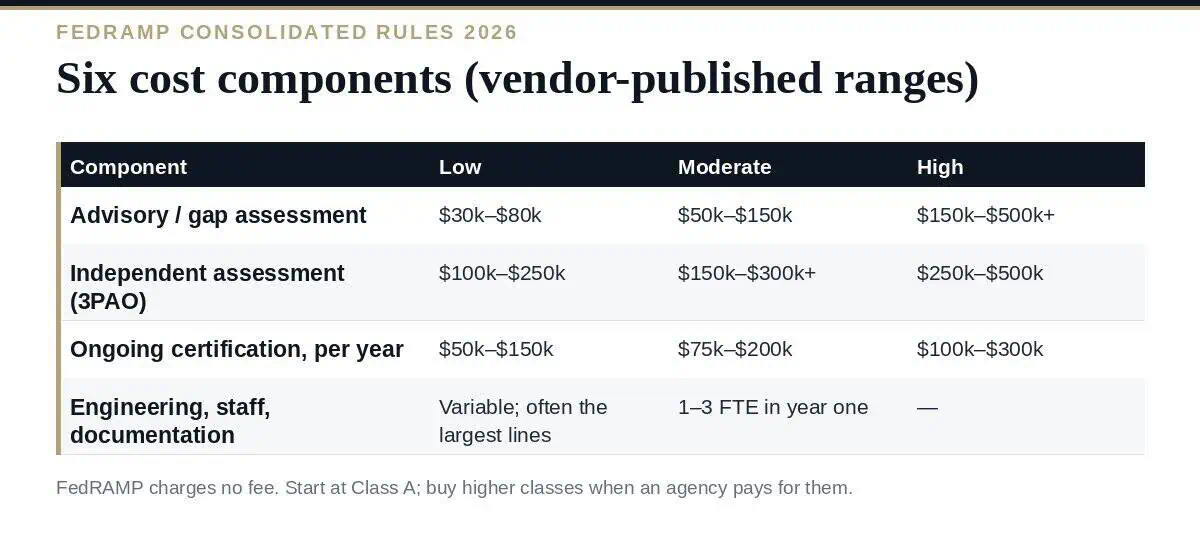
FedRAMP does not charge providers. Its own guidance on getting certified says the review team’s internal goal is an initial decision within 30 days of receiving an application, and that it cannot grant special considerations — there is no expedited fee because there is no fee. The costs sit in six places.
| Component | What it covers | Labelled range (vendor-published, 2025–2026) |
|---|---|---|
| Advisory and gap assessment | A FedRAMP advisor’s readiness review against the target rules or Rev5 controls | $30,000–$80,000 (Low); $50,000–$150,000 (Moderate); $150,000–$500,000+ including remediation (High) |
| Engineering and remediation | Boundary changes, FIPS-validated cryptography, logging, MFA, segmentation, SIEM, vulnerability tooling | Highly variable; secureframe describes Moderate remediation as easily reaching six figures |
| Documentation | The Certification Package Overview, Security Decision Record, Accepted Weaknesses List, Organizational Requirements and their JSON companions; or the Rev5 package | Internal effort or advisor time; commonly weeks to months of a compliance lead |
| Independent assessment | The 3PAO’s assessment of the package and the environment | $100,000–$250,000 (Low); $150,000–$300,000+ (Moderate); $250,000–$500,000 (High) |
| Program staff | The compliance and security engineers who own the certification | Typically one to three full-time equivalents in the first year |
| Ongoing certification | Quarterly Ongoing Certification Reports, vulnerability detection and response, significant change notifications, annual assessment activity | $50,000–$150,000 (Low); $75,000–$200,000 (Moderate); $100,000–$300,000 (High) per year, plus staff |
Source for the dollar ranges: secureframe’s FedRAMP cost guide, updated February 2026, which cites Coalfire and Schellman assessor pricing. Treat them as typical market bands, not quotes. The same guide puts the total first-year cost of a Rev5 certification at $250,000 to $2 million or more, which is consistent with what other advisors publish. Our own reading is that a Moderate certification for an existing SaaS product with a mature security program lands in the $500,000 to $1.5 million band in year one, and that the assessment is rarely the largest line — engineering and internal staff time usually are.
Both paths use the same NIST SP 800-53 Rev5 control baseline, but they evidence it differently. The Rev5 path is the documented-control model with an independent assessor testing each control. The 20x path is automation-first: the provider demonstrates Key Security Indicators through machine-readable evidence, with independent verification of the automation rather than a control-by-control walk. FedRAMP’s rules say 20x-specific responsibilities include “automated verification and validation of Key Security Indicators” and “metrics over time for Key Security Indicators”. The cost effect is a shift from assessor hours toward engineering: a provider that already has continuous compliance tooling spends less on the assessment and more on wiring evidence; one that does not has to build the tooling first. Secureframe notes 20x is “designed to significantly reduce costs” but that total expenses “are still emerging”. Do not budget 20x as cheaper until you have priced the automation.
The deadlines constrain the choice. New 20x applications have had to follow the 2026 rules since 4 July 2026; new Rev5 applications must follow them from 1 January 2027; the last new Rev5 application is accepted 11 June 2027; and every grace period expires on 1 February 2028, when non-compliant offerings lose certification with no extensions. A provider planning a Rev5 certification is now planning one that must be converted within the same budget cycle. Our guide to the FedRAMP compliance checklist for 2027 lays out the sequence.
The 2026 rules introduced Certification Classes, and they are the most direct cost lever in the program. FedRAMP describes them as “designed to be undertaken progressively where your investment can scale with agency interest and resource availability”, and states that “each FedRAMP Certification Class provides progressively more assurance, commitment, and alignment with diverse agency needs; this requires additional preparation, familiarity with the federal process, and investment at every stage”. The class page’s comparison table lists Cost as one of its rows, rising from A to D.
| Class | Who it is for (FedRAMP’s guidance) | What it adds to cost |
|---|---|---|
| Class A | Existing commercial products that already have a SOC 2 Type II and a mature security program; the recommended starting point | Lowest: many assurance rules are SHOULD or MAY; Quarterly Reviews optional; slower vulnerability timeframes |
| Class B | Providers with agency interest who need more assurance than A | Quarterly Reviews SHOULD be held; drift detection monthly; incident reports MUST be filed within class timeframes |
| Class C | Providers with active federal customers | Quarterly Reviews MUST be held; drift detection every 14 days; PAIN-5 initial incident report within 1 hour |
| Class D | Providers under contracts that require the highest commitment | Drift detection every 7 days; PAIN-5 initial incident report within 15 minutes; four or more verification methods and 18+ months of history |
FedRAMP is blunt about the ordering, and it is the clearest statement in the program about FedRAMP certification cost: “Be careful starting with FedRAMP Class C or Class D Certification!” — providers “generally should not go straight to” them “unless they have an existing contract with a government agency that requires this level of commitment”. The cost lesson is to certify at Class A and buy the higher class when a customer is paying for it, not before.
The third lever on FedRAMP certification cost is impact level. The impact level of the systems agencies put you in still drives the control count and therefore the assessment and engineering effort; the vendor ranges above are quoted by level for that reason. FedRAMP’s 2026 guidance is careful that classes “loosely align” with impact levels but are not the same thing — a Class A certification is not a Low certification. Most commercial SaaS targets Moderate; High is reserved for systems where a loss would have severe or catastrophic effect, and its assessment costs roughly double Moderate’s.
Does FedRAMP charge a fee?
No. FedRAMP charges providers nothing and offers no paid expedite. The cost is advisors, engineering, the independent assessor, internal staff and ongoing certification.
How much does a FedRAMP Moderate certification cost?
Vendor-published ranges put the first year at roughly $500,000 to $1.5 million, with the 3PAO assessment at $150,000–$300,000+ and annual ongoing certification at $75,000–$200,000. Engineering and staff time usually exceed the assessment.
Is FedRAMP 20x cheaper than Rev5?
It is designed to be, by replacing control-by-control assessment with automated Key Security Indicator evidence. Providers with continuous compliance tooling save assessor cost; providers without it pay for the tooling first. Published totals are still emerging.
What does Certification Class cost?
Higher classes add mandatory Quarterly Reviews, faster vulnerability detection and remediation, faster incident reporting and more verification history. FedRAMP recommends starting at Class A and moving up when an agency customer requires it.
How long does it take?
FedRAMP’s internal review target is 30 days from a complete application, with the clock stopped while waiting on the provider. The preparation and assessment before that typically takes six to eighteen months depending on the starting security posture.
Budget FedRAMP certification cost as a Class A, Moderate, single-path project in year one: advisory, engineering, a $150,000–$300,000 assessment, one to three people, and an ongoing certification line of $75,000–$200,000 a year that starts the day the certificate does. Then let agency demand, not ambition, decide when to buy a higher class.
The Certification Package Overview, Security Decision Record, Accepted Weaknesses List and Organizational Requirements templates, with their JSON companions, are in the FedRAMP Toolkit (52 templates for the Consolidated Rules 2026), or start with the free templates.

September 20, 2026
September 20, 2026
September 19, 2026

September 19, 2026

September 19, 2026