CART
Annex SL is the reason ISO 9001, ISO 14001, ISO 27001 and ISO 45001 all look the same on the page. It is not a standard you can buy or certify against. It is an instruction to the people who write standards, and it sits in the ISO/IEC Directives Part 1, the rulebook ISO applies to its own committees.
For anyone running more than one management system, it is the single most useful thing to understand about how ISO standards are built, because it is what makes an integrated management system possible at all.
Free gap assessment
Are you ready for the 2026 edition of ISO 9001?
Score yourself against the new edition, free, including the risk and opportunity split and the clause 10 renumbering that breaks converted checklists.
Run the free ISO 9001 gap assessment → or View premium report sample
Most articles still call this the High Level Structure, or HLS. That term was formally retired in 2021. The current name is the harmonized structure, usually shortened to HS, and it is what ISO’s own documents now use.
Nothing about the content changed when the name did, so the two terms describe the same ten clauses. If a consultant or a template still says HLS, it is dated language rather than a mistake. It is worth knowing the difference when you are reading anything written before 2021.
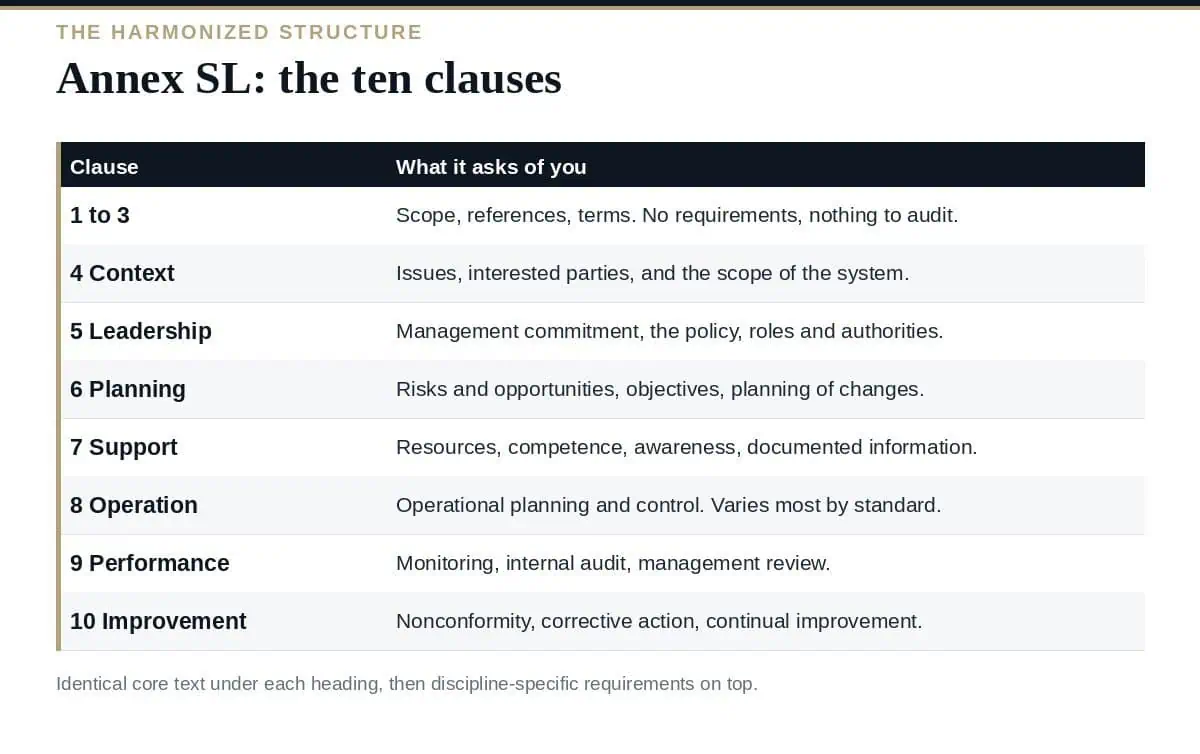
Every management system standard built on the harmonized structure uses this skeleton. The identical core text under each heading is word for word the same across standards, and each committee then adds its own discipline-specific requirements on top.
| Clause | What it asks of you |
|---|---|
| 1 to 3 | Scope, normative references, terms. No requirements here, and nothing to audit. |
| 4 Context | Internal and external issues, interested parties, and the scope of the system itself. |
| 5 Leadership | Top management commitment, the policy, and assigned roles and authorities. |
| 6 Planning | Risks and opportunities, objectives, and planning of changes. |
| 7 Support | Resources, competence, awareness, communication and documented information. |
| 8 Operation | Operational planning and control. The clause that varies most between standards. |
| 9 Performance evaluation | Monitoring and measurement, internal audit, management review. |
| 10 Improvement | Nonconformity, corrective action and continual improvement. |
Clause 6.3, planning of changes, arrived with the 2021 edition. It asks that changes to the management system be carried out in a planned manner rather than improvised. Standards revised since then carry it. Older editions do not, which is one reason two standards on the harmonized structure can still differ in their sub-clause numbering.
Climate change was added to clauses 4.1 and 4.2 in February 2024. Clause 4.1 now requires you to determine whether climate change is a relevant issue, and clause 4.2 gained a note that interested parties can have climate-related requirements. The text landed in roughly 31 management system standards at once, because that is how identical core text works. We cover what auditors actually look for in the ISO climate change amendment.
Annex SL is not universal, and assuming it is causes real problems during an integration project.
ISO 13485 deliberately did not adopt it. The medical devices committee kept the older clause 4 to 8 layout, on the reasoning that alignment with regulatory expectations mattered more than alignment with other ISO standards. So an organisation integrating ISO 13485 with ISO 9001 is mapping between two different structures, not merging one.
ISO 17025 and ISO 15189 sit outside it too. Both are conformity assessment standards rather than management system standards, so the harmonized structure was never intended to apply.
Even among standards that do use it, clause 10 is where numbering diverges. ISO 9001 runs 10.1 to 10.3, ISO 27001:2022 puts continual improvement at 10.1 and nonconformity at 10.2, and ISO 45001 folds incident investigation into 10.2. If you are building a cross-reference matrix, clause 10 is where it will break first.
The payoff of Annex SL is integration. One context analysis, one interested-parties register, one internal audit programme and one management review can satisfy several standards at once, because those clauses ask for the same thing in the same words. That is where the cost saving in an integrated management system actually comes from, and it is why a combined audit takes less time than two separate ones.
The limit is clause 8. Operational control is where each standard does its real work, and no amount of structural alignment merges the operational requirements of quality, environment and occupational health and safety.
The harmonized structure itself is published by ISO as part of the ISO/IEC Directives. If you are implementing more than one standard, the Integrated Management System Toolkit is built around these shared clauses, or start with the free ISO templates.
Verified against the ISO/IEC Directives Part 1 and the ISO/IAF joint communiqué of 22 February 2024. Position as at 6 September 2026.

October 23, 2026
October 22, 2026
October 22, 2026
October 22, 2026
October 22, 2026

