CART
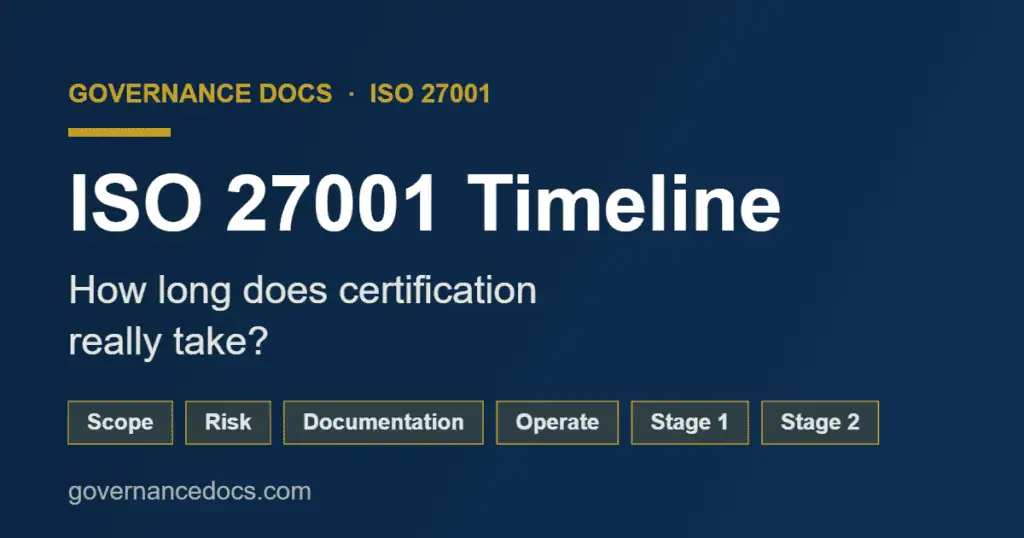
The ISO 27001 timeline usually runs 3 to 12 months from kickoff to certificate. A small, focused company that starts from prewritten documentation can be audit-ready in three to four months; larger or less-prepared organizations commonly need six to twelve. The single biggest reason you cannot go faster is not paperwork. It is that your information security management system (ISMS) has to actually run long enough to generate evidence, including at least one internal audit and one management review, before a certification body will complete its Stage 2 audit.
Below is a realistic, phase-by-phase breakdown of the ISO 27001 timeline: what stretches it, what shortens it, and how to reach certification without cutting corners.
Free gap assessment
Where do you actually stand against ISO 27001?
Score every management system clause and all 93 Annex A controls, free, and get a prioritised gap list back.
Treat the numbers below as typical ranges, not promises. Where you land depends on your size, how mature your security already is, and how much time your team can commit each week.
| Company profile | Typical time to certification |
|---|---|
| Startup or small team (under ~25 people in scope), well-prepared | 3 – 4 months |
| Small-to-mid company building the ISMS from scratch | 4 – 8 months |
| Mid-market (25 – 200 staff), broader scope | 6 – 10 months |
| Large or multi-site organization (200+ staff) | 9 – 12+ months |
Organizations that already hold SOC 2 or Cyber Essentials, or that run a mature security program, move toward the faster end because much of the documentation and many of the controls already exist.
A certification project measured against the requirements of ISO/IEC 27001:2022 moves through seven phases. The durations below assume a small-to-mid company with a dedicated owner.
| Phase | What happens | Typical duration |
|---|---|---|
| 1. Scope and plan | Define the ISMS scope, secure leadership sign-off, and assign an accountable owner | 2 – 4 weeks |
| 2. Gap analysis | Compare current practice against the standard to see what is missing | 1 – 3 weeks |
| 3. Risk assessment and treatment | Run a documented risk assessment (Clause 6.1.2), decide how to treat each risk, and draft the Statement of Applicability | 3 – 5 weeks |
| 4. Documentation and controls | Write your policies and procedures and implement the Annex A controls you selected | 4 – 12 weeks |
| 5. Operate, internal audit, management review | Let the ISMS run and produce records; complete at least one internal audit and one management review | 8 – 12+ weeks |
| 6. Stage 1 audit | The certification body reviews your documentation and readiness | Roughly 1 – 2 days on site, plus scheduling |
| 7. Stage 2 audit and decision | The auditor tests whether your controls work in practice; the certificate is issued if you pass | Usually 4 – 6 weeks after Stage 1 |
These phases overlap in practice. You will start writing documentation while you finish the risk assessment, which is why the total is shorter than adding every row.
Here is how those phases typically fall for a 30-person software company doing most of the work in-house:
Slip on ownership or leave the internal audit to the last minute, and the same project quietly becomes a nine-month one.
The standard sets no fixed minimum operating period, but you cannot certify a system that has existed for two weeks, because there are no records to sample. Certification bodies generally expect the ISMS to have operated for around three months before Stage 2, and they require Stage 2 to take place within six months of Stage 1.
Two records they will always ask for are at least one completed internal audit and one management review. This is the phase automation tools cannot skip, and it is why promises of certification “in a matter of weeks” rarely survive contact with a real auditor. Our guide to the ISO 27001 audit walks through exactly what an assessor checks at each stage.
Most of the variation between a four-month project and a twelve-month one comes down to five things:
Scope is the lever most teams underuse. Certifying only the part of the business that genuinely needs it means fewer controls to implement, less evidence to gather, and a shorter path to Stage 2. It also lowers the price, as our ISO 27001 certification cost breakdown explains.
You cannot skip the audit or the evidence period, but you can stop the avoidable delays that push projects past a year:
If documentation is your bottleneck, our ISO 27001 Toolkit provides 175 editable Word and Excel templates, including the policies, the risk assessment, and the mandatory Statement of Applicability an auditor expects. It lets you compress phases three and four instead of writing from scratch. Pair it with the ISO 27001 mandatory documents checklist to confirm nothing is missing before Stage 1.
Your certificate is valid for three years, provided you keep the ISMS running. Expect an annual surveillance audit in years one and two. Each is shorter than the initial audit but still a real review, and a full recertification audit at the end of year three restarts the cycle. Budget time for these the same way you would a renewal. For the full route from kickoff to certificate, see our step-by-step guide to getting ISO 27001 certified.
A well-prepared small company using prewritten documentation can reach certification in three to four months. If you are building the ISMS from scratch with a part-time owner, plan for four to eight months instead.
Realistically, no. Even with everything documented, your ISMS has to operate long enough to produce evidence, including at least one internal audit and one management review, before the Stage 2 audit. Certification bodies generally expect around three months of operating records.
Typically four to six weeks. The gap gives you time to close any issues Stage 1 surfaces and gather more evidence. Certification bodies usually require Stage 2 to happen within six months of Stage 1.
Three years, as long as you pass annual surveillance audits and keep the ISMS running. A full recertification audit at the end of year three renews it for another three-year cycle.
It shortens the documentation phase, which is often the longest part of the build, by giving you ready-to-edit policies and registers. It cannot shorten the operating-evidence period or the two-stage audit, so treat it as a way to reach Stage 1 sooner, not a shortcut to the certificate.
Map these phases onto your own calendar early, protect the operating-evidence period, and the ISO 27001 timeline becomes predictable rather than stressful.

September 25, 2026
September 24, 2026
September 24, 2026
September 24, 2026
September 24, 2026

