CART
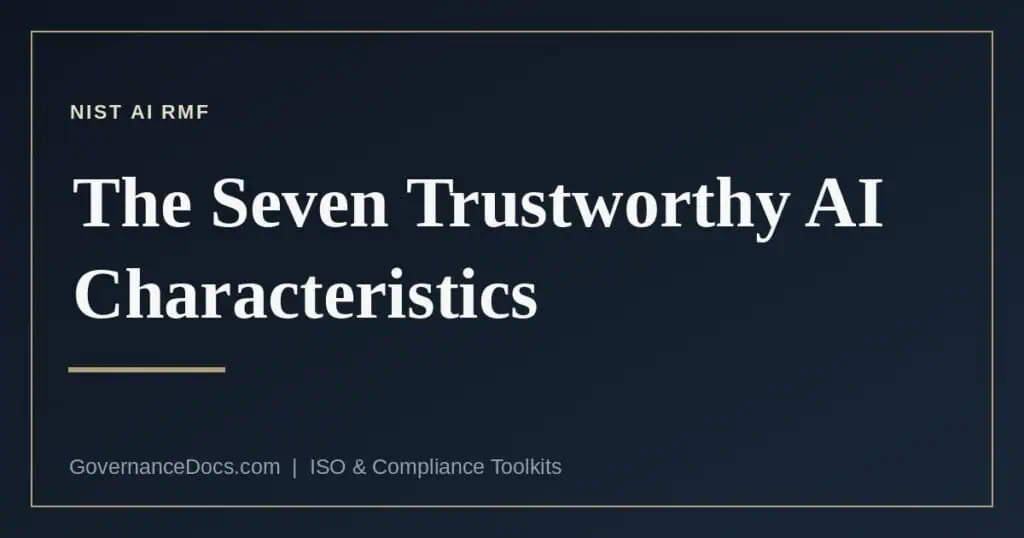
The seven trustworthy AI characteristics in the NIST AI Risk Management Framework are the closest thing AI governance has to a shared vocabulary: valid and reliable; safe; secure and resilient; accountable and transparent; explainable and interpretable; privacy-enhanced; and fair with harmful bias managed. They appear in NIST’s Generative AI Profile as the tag on every risk, in the Playbook as the thing MEASURE 2 evaluates, and — under other names — in ISO/IEC 42001’s Annex C and the EU AI Act’s high-risk requirements.
This guide explains what each characteristic means in NIST’s own terms, how they relate to each other, the trade-offs the framework says you will face, and how to turn seven adjectives into things you can measure and evidence.
Free gap assessment
How much of ISO 42001 could you evidence today?
Score every clause and Annex A control of the AI management standard, free, and see where the programme really sits.
Run the free ISO 42001 gap assessment → or View premium report sample
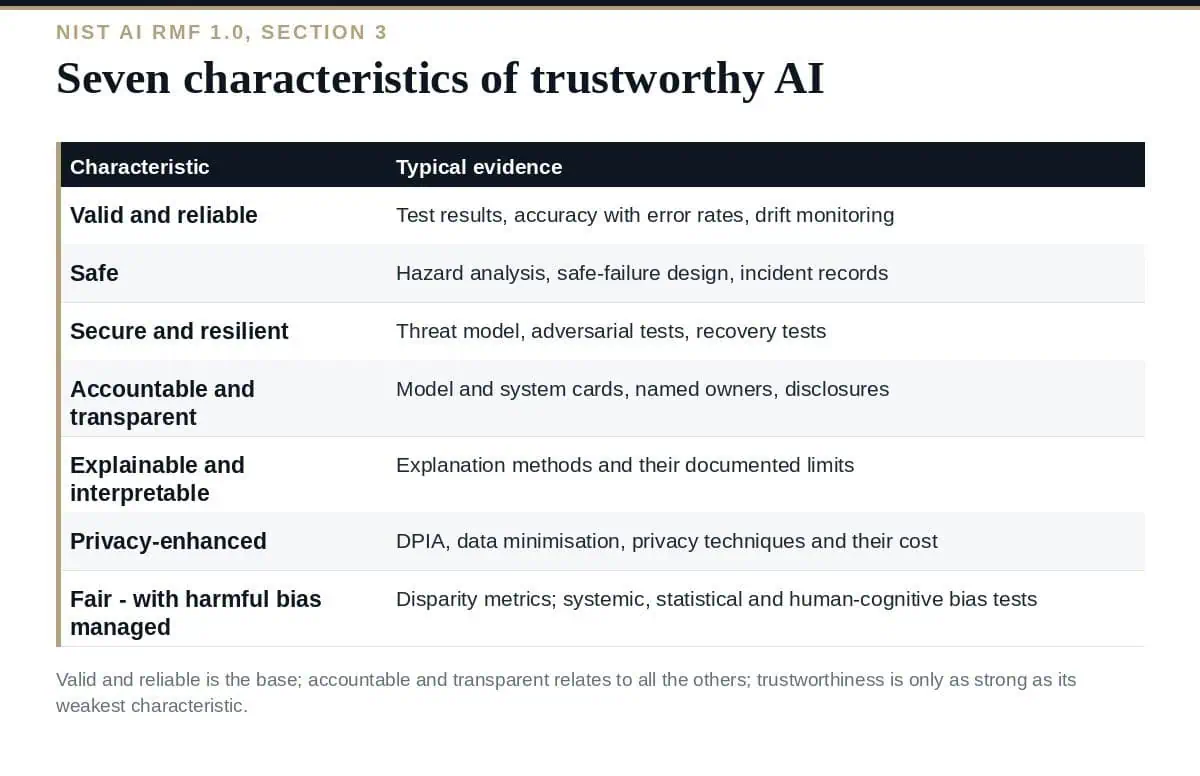
| Characteristic | What NIST means by it | Typical evidence |
|---|---|---|
| Valid and reliable | Validity: objective evidence the system meets the requirements of its intended use (drawing on ISO 9000). Reliability: performs as required, without failure, over time under given conditions (ISO/IEC TS 5723:2022). Accuracy, robustness and generalisation sit here | Test results on held-out and out-of-distribution data; accuracy with false-positive and false-negative rates; drift monitoring |
| Safe | Does not, under defined conditions, lead to a state in which human life, health, property or the environment is endangered (ISO/IEC TS 5723:2022). Risks of serious injury or death get the most urgent treatment | Hazard analysis; safe-failure and human-intervention design; incident records; deployer guidance |
| Secure and resilient | Resilient: withstands unexpected adverse events and returns to normal function. Secure: maintains confidentiality, integrity and availability, including against adversarial use, data poisoning and model or data exfiltration | Threat model; adversarial test results; access controls on endpoints; recovery tests |
| Accountable and transparent | Transparency: information about the system and its outputs is available to those interacting with it, tailored to lifecycle stage and role. Accountability presupposes transparency and rests on defined roles | Model and system cards; disclosure at point of use; named owners; decision records |
| Explainable and interpretable | Explainability: a representation of the mechanisms behind the system’s operation. Interpretability: the meaning of outputs in the context of their designed purpose | Explanation methods and their limits; user-facing rationale; documentation of what cannot be explained |
| Privacy-enhanced | Norms and practices safeguarding autonomy, identity and dignity — freedom from intrusion, limits on observation, agency over disclosure (the NIST Privacy Framework) | DPIA or equivalent; data minimisation; privacy-enhancing techniques and their accuracy cost |
| Fair — with harmful bias managed | Equality and equity concerns, addressed by managing harmful bias and discrimination. NIST names three bias categories: systemic, computational and statistical, and human-cognitive. Mitigating bias does not by itself make a system fair | Disparity metrics across groups; bias testing across the three categories; review of decision thresholds |
The framework does not present the trustworthy AI characteristics as a flat list. In its figure of the characteristics, valid and reliable is drawn as the base — a necessary condition for trustworthiness — and accountable and transparent is drawn as a vertical box because it relates to all the others. The remaining five sit between. The reading is practical: a system that is not valid cannot be trusted regardless of its other properties, and no property can be assured without the transparency to see it and the accountability to answer for it.
Two further statements from NIST matter for how you use the set. Trustworthiness is a social concept that ranges across a spectrum and is only as strong as its weakest characteristic. And creating trustworthy AI requires balancing the characteristics based on the system’s context of use — rarely do all apply equally in every setting, and some will matter more than others in any given situation.
Free AI risk assessment
Which of your AI systems could harm people, or you?
List your AI systems, models and data, pick from 38 AI risk scenarios, rate them for the people affected and for you, and plan treatment with ISO 42001 Annex A controls. You get a heat map, a process score and the findings an auditor would raise, free.
Run the free AI risk assessment → or View premium report sample
The framework names the tensions between trustworthy AI characteristics rather than pretending they do not exist:
The governance implication is that a trade-off decision is itself an artefact. Record which characteristic was favoured, for which system, why, who decided, and what the residual risk is. GOVERN 1.3’s risk-tolerance statement is what those decisions are judged against; MANAGE 1.4’s residual-risk documentation is where they land.
MEASURE 2 of the Core asks that AI systems are evaluated for trustworthy AI characteristics, and its subcategories follow the seven in order — accuracy and reliability, safety, security and resilience, transparency and accountability, explainability, privacy, fairness and bias. The working method:
Our guide to NIST AI RMF implementation places this inside the eight-step programme.
| NIST characteristic | ISO/IEC 42001 Annex C objective | EU AI Act high-risk requirement |
|---|---|---|
| Valid and reliable | Robustness; availability and quality of training and test data | Art 15 accuracy and robustness; Art 10 data governance |
| Safe | Safety | Art 9 risk management (risks to health and safety); Annex I product safety law |
| Secure and resilient | Security | Art 15 cybersecurity and resilience |
| Accountable and transparent | Accountability; transparency and explainability | Art 13 transparency to deployers; Art 50 transparency to people; Art 17 QMS |
| Explainable and interpretable | Transparency and explainability | Art 13 instructions for use; Art 14 human oversight (understanding outputs) |
| Privacy-enhanced | Privacy | Art 4a (which replaced Art 10(5) in July 2026) — bias-detection processing of special-category data, within GDPR |
| Fair — with harmful bias managed | Fairness | Art 10 examination for possible biases; Art 27 fundamental rights impact assessment (where required) |
The mapping is why the seven trustworthy AI characteristics are a good spine for a multi-framework programme: measure each one once and cite the measurement to whichever regime is asking. See ISO 42001 vs NIST AI RMF for the management-system side.
NIST states that AI RMF 1.0 is being revised as part of the White House AI Action Plan, which directed the removal of references to misinformation, diversity, equity and inclusion, and climate change. No revised framework had been published as of September 2026, so the seven characteristics above remain the current text. Whatever the revision changes, the underlying properties — a model that works, does not hurt people, cannot be trivially attacked, can be explained and answered for — are the ones customers and regulators will keep asking about, so measuring them now is not wasted work.
How many trustworthy AI characteristics does NIST define?
Seven: valid and reliable; safe; secure and resilient; accountable and transparent; explainable and interpretable; privacy-enhanced; and fair with harmful bias managed.
Do all seven apply to every AI system?
No. NIST says trade-offs are usually involved and that rarely do all characteristics apply in every setting. Decide the weighting per system and record it.
Which characteristic matters most?
Valid and reliable is described as the necessary condition and drawn as the base of the others. Beyond that, context decides — safety dominates where life or health is at stake.
Is ‘fair’ the same as ‘unbiased’?
No. NIST states that systems in which harmful biases are mitigated are not necessarily fair. Bias management is one input to fairness, which also depends on context and on decisions about equality and equity.
How do the trustworthy AI characteristics relate to the EU AI Act?
The Act does not use the list, but its high-risk requirements — accuracy, robustness, cybersecurity, transparency, human oversight, data governance — cover the same properties. Measurements made against the seven characteristics are reusable evidence for those articles.
Use the seven trustworthy AI characteristics as the axes of every AI evaluation you run: decide the weighting per system, pick metrics you can compute, set thresholds from your tolerance statement, record the trade-offs and the limits, and monitor after deployment. Validity is the floor, transparency is the frame, and the rest is a balance you have to justify — which is exactly what an assessor, a customer or a regulator will ask you to do.
Evaluation templates built around the seven characteristics, with model and system card formats, are in the NIST AI RMF Toolkit (36 templates), or start with the free templates.

October 11, 2026
October 11, 2026

October 11, 2026

October 11, 2026

October 11, 2026

