CART
NIST CSF vs ISO 27001 is the comparison every security programme makes when a customer asks for one and the board has heard of the other — and the two are different kinds of thing that map to each other well. The NIST Cybersecurity Framework 2.0, published on 26 February 2024, is a voluntary framework of outcomes: six Functions — Govern, Identify, Protect, Detect, Respond, Recover — 22 Categories and 106 Subcategories, with Tiers 1 to 4 describing governance rigour and Profiles describing an organisation’s current and target state; nobody certifies to it.
ISO/IEC 27001:2022 is a certifiable management-system standard: clauses 4 to 10 that an accredited certification body audits, and 93 Annex A controls selected through a risk assessment and a Statement of Applicability. The CSF describes what a good programme achieves; ISO 27001 specifies how a management system is run and proves it with a certificate. This guide sets the two side by side on five differences, maps the six Functions to the ISO clauses and Annex A themes, explains which to adopt first for four situations, and describes how organisations run one programme that reports in CSF and certifies to ISO.
Free gap assessment
What does your CSF 2.0 Current Profile look like?
Score all 106 subcategories across the six functions, free, including the 31 under Govern that version 1.1 never asked about.
Run the free NIST CSF gap assessment → or View premium report sample
NIST CSF 2.0 replaced CSF 1.1 in 2024, adding the Govern Function and widening the audience from critical infrastructure to all organisations. Each Subcategory is an outcome — “the organization’s cybersecurity risk management strategy is established”, “incidents are contained” — not a control, and the framework supplies Informative References that map outcomes to controls in ISO 27001, NIST SP 800-53, the CIS Controls and others. Tiers characterise how an organisation governs and manages risk, from Partial (1) to Adaptive (4); Profiles record the Current and Target selection of outcomes. Our guide to NIST CSF 2.0 vs 1.1 covers the 2024 changes; NIST CSF Tiers covers the four levels.
ISO/IEC 27001:2022 specifies requirements for an information security management system: context, leadership, planning, support, operation, performance evaluation and improvement in clauses 4 to 10, with risk assessment and treatment in 6.1 and the Statement of Applicability in 6.1.3, and Annex A’s 93 controls — 37 organizational, 8 people, 14 physical, 34 technological. Amendment 1 of 2024 added climate change as a context consideration. Certification is by accredited bodies, on a three-year cycle with annual surveillance.
Free ISO 27001 risk assessment
Which of your risks sit above your appetite line?
Set your own risk criteria, pick from 61 information security risk scenarios, rate likelihood and impact, and decide how to treat each one. You get a heat map, a process score and the findings an auditor would raise, free.
Run the free risk assessment → or View premium report sample
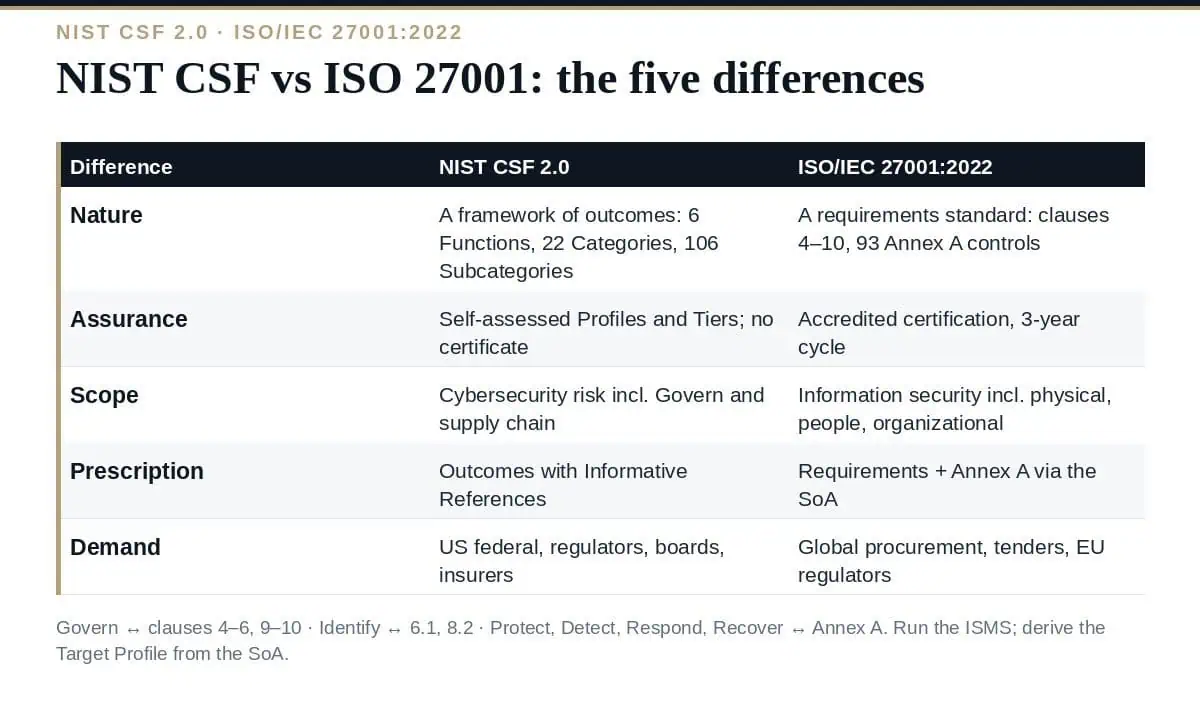
| Difference | NIST CSF 2.0 | ISO/IEC 27001:2022 |
|---|---|---|
| 1. Nature | A framework of outcomes for describing and improving a programme | A requirements standard for a management system |
| 2. Assurance | Self-assessed Profiles and Tiers; no certification scheme | Accredited third-party certification; a certificate customers verify |
| 3. Scope | Cybersecurity risk, with Govern covering strategy, roles, policy, oversight and supply chain | Information security in all forms — including physical, people and organizational controls |
| 4. Prescription | None: outcomes with Informative References to controls elsewhere | Requirements in clauses 4–10; controls in Annex A selected through the SoA with justification |
| 5. Demand | US federal expectation; sector regulators; boards and insurers as a vocabulary | Global procurement, tenders, regulators (NIS2, DORA evidence), customers who want a certificate |
The first NIST CSF vs ISO 27001 differences are about what each produces. The CSF answers “what should be true of our programme, and how far along are we?” — a Target Profile and a Tier. ISO 27001 answers “does a management system exist, does it meet the requirements, and can an independent auditor confirm it?” — a certificate. A CSF Profile is a management tool; an ISO certificate is a market instrument. Our guide to the NIST CSF audit checklist covers how CSF outcomes are tested in the absence of a certification scheme.
The CSF’s Govern Function reaches into strategy and supply chain risk management in a way ISO 27001’s clauses touch more lightly; ISO 27001’s Annex A reaches into physical security, HR and legal controls the CSF treats as outcomes to be achieved by whatever means. Neither is a subset of the other.
Neither prescribes technical controls in detail — ISO 27002 gives guidance and the CSF gives references — but ISO 27001 requires the organisation to decide and justify every Annex A control in the SoA, which is a discipline the CSF leaves to the Profile.
A US customer, regulator or insurer asks whether you follow the CSF; a European or global customer asks for the ISO 27001 certificate. Most organisations selling internationally end up holding the certificate and describing the programme in CSF terms.
| CSF 2.0 Function | ISO 27001:2022 clauses | Annex A themes and examples |
|---|---|---|
| Govern (GV) | 4 Context; 5 Leadership; 6 Planning; 7.1–7.4 Support; 9 Performance evaluation; 10 Improvement | 5.1 Policies; 5.2 Roles; 5.4 Management responsibilities; 5.19–5.23 Supplier relationships; 5.31 Legal requirements; 5.35 Independent review |
| Identify (ID) | 6.1.2 Risk assessment; 8.2 Risk assessment in operation; 9.1 Monitoring; 10.1 Improvement | 5.9 Inventory of assets; 5.12 Classification; 8.8 Technical vulnerabilities; 5.7 Threat intelligence |
| Protect (PR) | 6.1.3 Risk treatment; 7.2–7.3 Competence and awareness; 8.1 Operational control | 6.3 Awareness; 5.15–5.18 Access control; 8.2–8.5 Privileged access, restriction, authentication; 8.24 Cryptography; 8.9 Configuration; 8.13 Backup; 7.x Physical controls |
| Detect (DE) | 9.1 Monitoring, measurement, analysis and evaluation | 8.15 Logging; 8.16 Monitoring activities; 8.7 Malware; 5.24 Incident planning |
| Respond (RS) | 8.1 Operational control; 10.1 Nonconformity and corrective action | 5.24–5.28 Incident management planning, assessment, response, learning, evidence; 6.8 Event reporting |
| Recover (RC) | 8.1; 10.1 | 5.29 Security during disruption; 5.30 ICT readiness for business continuity; 8.13 Backup; 8.14 Redundancy |
NIST’s own Informative References in the CSF 2.0 tool map each Subcategory to ISO 27001:2022 controls; the table above is the Function-level summary. Our guide to NIST CSF to 800-53 mapping covers the other mapping most organisations need.
| Situation | Start with | Then |
|---|---|---|
| Selling internationally; customers want a certificate | ISO 27001 | Describe the ISMS as a CSF Profile for US customers and the board |
| US organisation; board, regulator or insurer speaks CSF; no certificate demanded | NIST CSF 2.0 Current and Target Profiles | ISO 27001 when a contract requires it — the Profile is most of the gap analysis |
| Regulated in the EU (NIS2, DORA) | ISO 27001 | CSF as the risk-management vocabulary if the board prefers it |
| Small organisation building a programme from nothing | CSF Govern and Identify outcomes to frame; a control set such as CIS IG1 to act | ISO 27001 when the programme is mature enough to audit |
What is the difference between NIST CSF and ISO 27001?
NIST CSF 2.0 is a voluntary framework of cybersecurity outcomes — 6 Functions, 22 Categories, 106 Subcategories, with Tiers and Profiles — that nobody certifies to. ISO/IEC 27001:2022 is a certifiable management-system standard with clauses 4–10 and 93 Annex A controls selected through a Statement of Applicability. The CSF describes what a programme achieves; ISO 27001 specifies and certifies how the system is run.
Can you be certified to NIST CSF?
No. There is no accreditation scheme or certificate for the CSF; organisations self-assess Profiles and Tiers, and may have them reviewed by a third party without any formal recognition. ISO 27001 certification is by accredited bodies.
Do they map to each other?
Closely. NIST publishes Informative References mapping every CSF 2.0 Subcategory to ISO 27001:2022 controls; at Function level, Govern maps to ISO clauses 4–6 and 9–10, Identify to 6.1 and 8.2, and Protect, Detect, Respond and Recover to Annex A themes.
Which should we choose?
The one your customers and regulators ask for: ISO 27001 where a certificate is demanded or EU regulation applies; CSF where US boards, regulators or insurers use it as a vocabulary. Most international organisations hold the certificate and report in CSF terms.
Is ISO 27001 harder?
It requires a management system that is audited every year — internal audit, management review, corrective action — which the CSF does not. The CSF’s Govern Function asks for strategy and supply chain outcomes that ISO 27001 addresses more lightly.
Settle NIST CSF vs ISO 27001 by what each is for: ISO 27001 is the system and the certificate, the CSF is the description and the vocabulary, and NIST’s own references join them — so run the ISMS, derive the Target Profile from the Statement of Applicability, measure once, and report the certificate and the Tier together.
The CSF 2.0 Profile workbook with the ISO 27001:2022 mapping per Subcategory, the Tier assessment, and the policies organised by Function are in the NIST CSF Toolkit, or start with the free templates.

October 11, 2026
October 11, 2026

October 11, 2026
October 11, 2026
October 11, 2026

