CART
NIST 800-53 vs ISO 27001 is a comparison between two things that are not the same kind of document, which is why organisations that have one keep being asked for the other. NIST SP 800-53 Revision 5 is a control catalogue — twenty families, more than a thousand controls and enhancements, with baselines in SP 800-53B and assessment procedures in SP 800-53A — that US federal regimes such as FISMA and FedRAMP select from; nobody is “certified to 800-53”.
ISO/IEC 27001:2022 is a certifiable management-system standard — clauses 4 to 10 plus 93 Annex A controls in four themes — audited by accredited certification bodies worldwide on a three-year cycle. This guide sets the two side by side on five differences, shows where they overlap and how NIST’s own OLIR mapping connects them, explains which to adopt first for four common situations, and describes how an organisation that needs both runs them from one control set.
Free gap assessment
Where do you actually stand against ISO 27001?
Score every management system clause and all 93 Annex A controls, free, and get a prioritised gap list back.
Run the free ISO 27001 gap assessment → or View premium report sample
NIST SP 800-53 Rev 5, Security and Privacy Controls for Information Systems and Organizations, was published in September 2020 and is now maintained by patch release — 5.1.1 and, from 27 August 2025, 5.2.0. It is a catalogue: the controls are written as outcomes with no entity named, so that any organisation can use them, and the selection process lives elsewhere — the low, moderate, high and privacy baselines in SP 800-53B, tailoring guidance in the same document, and the assessment procedures in SP 800-53A Rev 5. Our guide to NIST SP 800-53 covers the publication set and Release 5.2.0.
ISO/IEC 27001:2022 specifies requirements for an information security management system: context, leadership, planning, support, operation, performance evaluation and improvement in clauses 4 to 10, with the security-specific content in clause 6.1 risk assessment and treatment, the Statement of Applicability under 6.1.3, and Annex A’s 93 controls — 37 organizational, 8 people, 14 physical and 34 technological. Amendment 1 of 2024 added climate change as a context consideration. Certification is to the clauses; Annex A controls are selected through the SoA.
Free ISO 27001 risk assessment
Which of your risks sit above your appetite line?
Set your own risk criteria, pick from 61 information security risk scenarios, rate likelihood and impact, and decide how to treat each one. You get a heat map, a process score and the findings an auditor would raise, free.
Run the free risk assessment → or View premium report sample
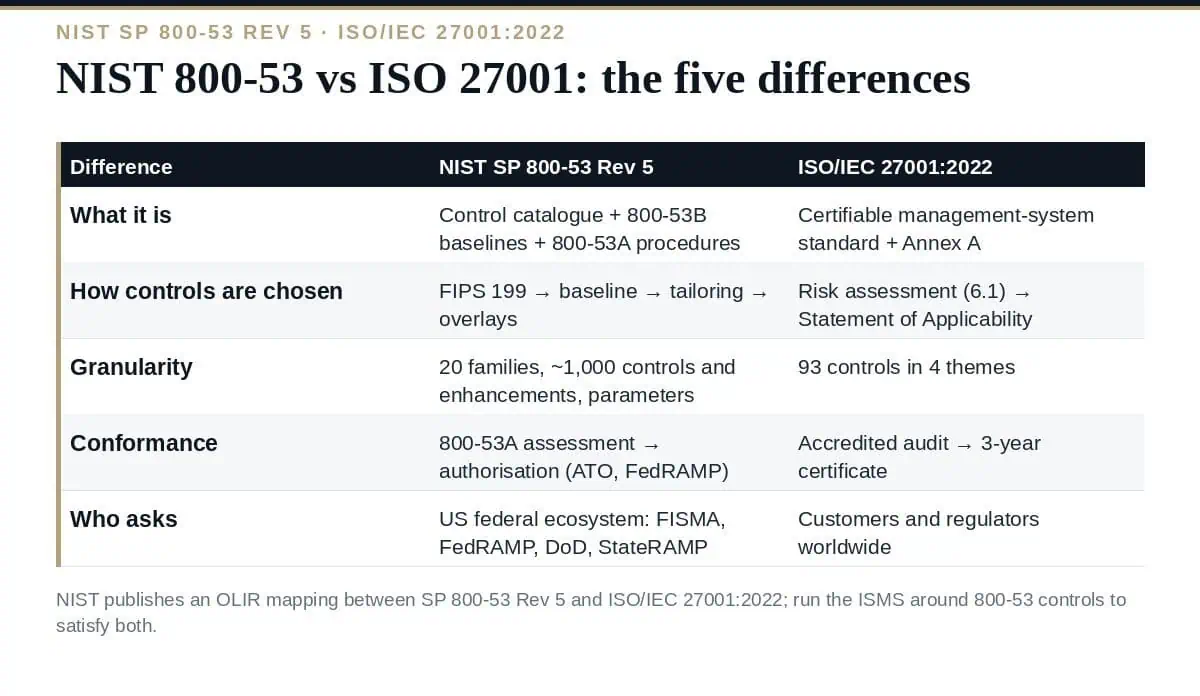
| Difference | NIST SP 800-53 Rev 5 | ISO/IEC 27001:2022 |
|---|---|---|
| 1. What it is | A control catalogue with separate baseline, tailoring and assessment publications | A certifiable management-system standard with a control annex |
| 2. How controls are chosen | Categorise the system (FIPS 199), pick the 800-53B baseline, tailor with recorded justification, apply overlays | Assess risk under clause 6.1, select controls from Annex A or elsewhere, justify inclusions and exclusions in the Statement of Applicability |
| 3. Granularity | Around 1,000 controls and enhancements with organization-defined parameters; a control can be assessed to a determination statement | 93 controls stated as outcomes; ISO 27002 gives implementation guidance |
| 4. How conformance is shown | Assessment under 800-53A (examine, interview, test) leading to an authorisation decision — FedRAMP, an agency ATO, a CMMC or StateRAMP assessment | Stage 1 and stage 2 audits by an accredited certification body, a certificate valid three years with annual surveillance |
| 5. Who asks for it | US federal agencies and their suppliers; FedRAMP, FISMA, DoD, StateRAMP, and regimes derived from it such as 800-171 | Customers, regulators and partners worldwide; tender prerequisites; NIS2 and DORA evidence in the EU |
The first NIST 800-53 vs ISO 27001 difference is structural. 800-53 tells you what a control is and, through 800-53B, which apply at your impact level. It says nothing about management review, internal audit or continual improvement as system requirements — those exist as controls (CA-2, CA-7, PM-4) rather than as the frame. ISO 27001 is the frame: it requires the organisation to run a system, and the controls are what the system selects.
800-53 starts from a baseline and asks you to justify departures; ISO 27001 starts from a risk assessment and asks you to justify selections. The two arrive at similar control sets for similar systems, but the evidence trail is inverted, and an assessor from each world will look for the document the other does not produce. Our guide to NIST 800-53 tailoring covers the five tailoring actions; the ISO equivalent is the SoA.
Annex A control 8.5, secure authentication, is one control. 800-53 covers the same ground across IA-2 with its enhancements, IA-5, IA-8, IA-11 and their parameters. That granularity is why 800-53 is the catalogue that other frameworks map into, and why implementing it from an ISO baseline takes real work: the ISO control is a heading, the 800-53 controls are the specification.
There is no 800-53 certificate. Conformance is assessed under 800-53A and results in an authorisation to operate by whoever owns the risk, or a FedRAMP or StateRAMP authorisation. ISO 27001 produces a certificate from an accredited body that a customer can verify on a register. The commercial consequence is that ISO 27001 travels; an 800-53 assessment report is read by the regime that commissioned it.
800-53 is demanded by the US federal ecosystem; ISO 27001 by everyone else and increasingly by that ecosystem too. Our guide to NIST 800-171 vs 800-53 covers the derivative most defence suppliers meet first.
Set NIST 800-53 vs ISO 27001 control by control and the substantive overlap is large. Access control, cryptography, logging, incident response, supplier security, business continuity, physical security and awareness appear in both, and NIST publishes an OLIR informative reference mapping SP 800-53 Rev 5 to ISO/IEC 27001:2022, which is the honest starting point for “we have ISO 27001, what is left?
The answer is usually: the parameters (800-53’s organization-defined values that Annex A never asks for), the PM family (programme-level controls with no Annex A equivalent), the PT privacy family, the SR supply chain family beyond Annex A 5.19–5.23, and the depth of the technical families — SC and SI in particular. Our guide to the NIST 800-53 control families covers all twenty.
| ISO 27001:2022 element | Nearest 800-53 Rev 5 element | Gap when moving ISO → 800-53 |
|---|---|---|
| Clause 6.1 risk assessment and treatment | RA-3, RA-7, PM-9; 800-53B baseline selection | Baseline and tailoring record |
| Statement of Applicability | System security plan (PL-2) and tailoring documentation | Parameter values per control |
| Clause 9.2 internal audit | CA-2 control assessments, CA-7 continuous monitoring | 800-53A-style assessment procedures and findings |
| Annex A 5.19–5.23 supplier relationships | SR family (SR-1 to SR-12), SA-9 | Supply chain risk management plan |
| Annex A 8.15–8.17 logging, monitoring, clock | AU family, SI-4 | Retention, review frequency and content parameters |
| No equivalent | PM family, PT family | Programme management and privacy controls from scratch |
| Situation | Start with | Why |
|---|---|---|
| Selling to US federal agencies or as a FedRAMP CSP | 800-53 at the relevant baseline | The regime selects from it; ISO 27001 can be layered on for commercial customers |
| DoD supplier handling CUI | 800-171 (derived from 800-53 moderate) | CMMC assesses 800-171; the full catalogue is not required |
| Commercial SaaS with global customers | ISO 27001 | Certificate is what procurement asks for; map to 800-53 when a federal deal appears |
| EU-regulated entity (NIS2, DORA) | ISO 27001 | Recognised by supervisors; 800-53 adds nothing they ask for |
| Already have one and now need the other | Keep the control set, add the missing evidence | Use the OLIR mapping; run the ISMS around the 800-53 controls or tailor from the ISO risk register |
Is NIST 800-53 a certification like ISO 27001?
No. 800-53 is a control catalogue; conformance is assessed under SP 800-53A and results in an authorisation decision (agency ATO, FedRAMP, StateRAMP), not a certificate. ISO 27001 is certifiable by accredited bodies.
Does ISO 27001 certification satisfy NIST 800-53?
Not by itself. NIST’s OLIR mapping shows substantial overlap, but 800-53 adds organization-defined parameters, the PM and PT families, supply chain depth and the technical granularity Annex A does not specify. An ISO-certified organisation typically closes those gaps rather than starting over.
How many controls does each have?
ISO 27001:2022 Annex A has 93 controls in four themes (37 organizational, 8 people, 14 physical, 34 technological). 800-53 Rev 5 has twenty families with around a thousand controls and enhancements; the number that applies depends on the 800-53B baseline and tailoring.
Which is harder to implement?
800-53 at the moderate or high baseline, because of the control count, the parameters and the assessment depth. ISO 27001 is harder to run, because it requires a functioning management system audited every year.
Is there an official NIST 800-53 to ISO 27001 mapping?
Yes. NIST publishes an OLIR informative reference between SP 800-53 Rev 5 and ISO/IEC 27001:2022, and the 800-53 Rev 5 catalogue itself is available in OSCAL for tooling.
Treat NIST 800-53 vs ISO 27001 as catalogue versus management system rather than as rivals: the catalogue is the finer control library and the standard is the certifiable frame, and an organisation that needs both should run the ISO system around 800-53 controls, keep one risk register, and write the Statement of Applicability in 800-53 identifiers — so that the federal assessor and the ISO auditor read the same evidence from different columns.
The family-by-family policy set, the control implementation matrix with parameter values, the tailoring record and the ISO 27001 crosswalk are in the NIST SP 800-53 Security Controls Toolkit, or start with the free templates.

October 12, 2026
October 12, 2026
October 12, 2026

October 12, 2026
October 12, 2026

