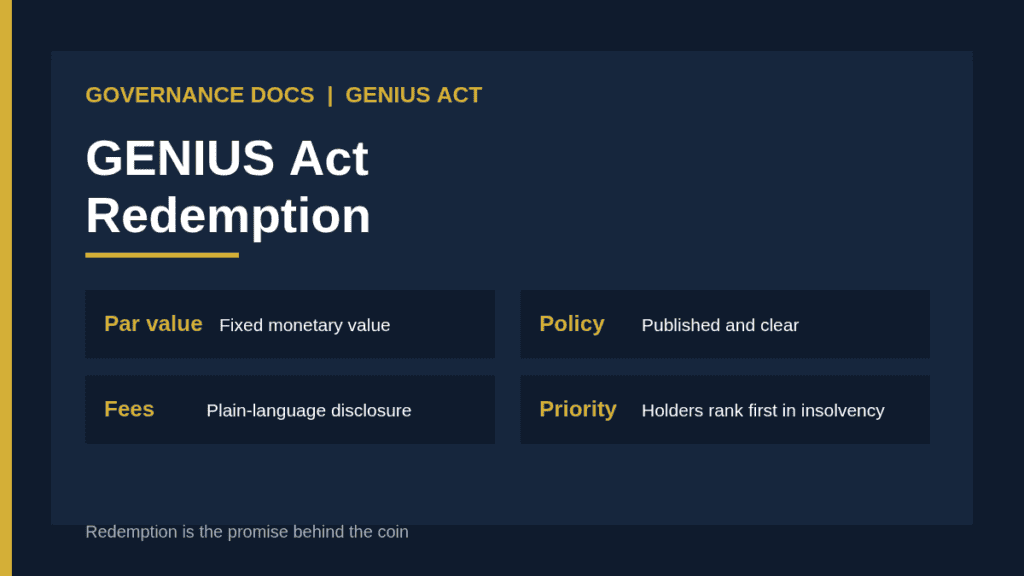
GENIUS Act redemption is the obligation of a permitted payment stablecoin issuer to convert, redeem or repurchase its stablecoin for a fixed amount of monetary value, and to publish a clear policy explaining how holders can do so in a timely way. It is the promise that gives a payment stablecoin its meaning, and it is one of the parts of the law that regulators are now turning into detailed rules.
This guide explains what the statute says about redemption, what the OCC’s proposed rule adds on timing and disclosure, how redemption connects to reserves and insolvency priority, and what issuers and their partners should prepare now. It reflects the public sources listed below, and rules that are still proposed may change, so confirm the current status before you rely on it. It is general information and not legal advice.
What the GENIUS Act says about redemption
The GENIUS Act was enacted on 18 July 2025. It defines a payment stablecoin as a digital asset designed to be used as a means of payment, whose issuer is obligated to convert, redeem or repurchase it for a fixed amount of monetary value. Summaries of the law from major law firms describe several redemption-related requirements.
Topic
Requirement (summarized)
Par redemption
Issuers must be able to redeem at a fixed monetary value
Redemption policy
Publicly disclose a policy with clear procedures for timely redemption
Fees
Disclose fees for purchase and redemption in plain language, with notice before changes
Reserves
Back outstanding coins at least one to one with permitted reserve assets
Transparency
Publish the monthly composition of reserves
Yield
No interest or yield to holders from the issuer
Insolvency
Priority for holders if reserves fall short
The statute requires timely redemption but, according to these summaries, sets no fixed number of days. Timing is left to the rules of the agencies. The statutory effective date is the earlier of 18 months after enactment, which is 18 January 2027, or 120 days after final implementing regulations. Our note on the GENIUS Act effective date covers the timeline.
The OCC proposal on GENIUS Act redemption
The Office of the Comptroller of the Currency published a proposed rule in the Federal Register on 2 March 2026, with comments due on 1 May 2026. The proposal would apply to OCC-regulated issuers, including national banks, federal branches, federal qualified nonbank issuers and certain foreign issuers. You can read it in the Federal Register.
According to a law firm summary of the proposal, it would require a public redemption policy and set timing and disclosure expectations for it:
Standard timing. Redemption within two business days of a holder’s request.
Stress extension. Up to seven calendar days if redemption requests within 24 hours exceed 10% of the coins outstanding.
Fee notice. At least seven calendar days’ notice before fees change.
Disclosure content. The issuer’s name and redemption obligation, a link to the monthly reserve reports, all purchase and redemption fees, and clear instructions on how to redeem.
These are proposals. Final rules may differ, and other agencies, including the FDIC, NCUA, the Federal Reserve and Treasury, have their own proposals and responsibilities. Check the final text that applies to your type of issuer. The sources reviewed for this guide did not show final redemption rules, so treat the timing figures as proposals.
How GENIUS Act redemption connects to reserves
A redemption promise only works if the assets are there to meet it. The statute requires reserves of at least one to one, held in permitted assets, which summaries describe as items such as Federal Reserve balances and currency, insured deposits, short-dated Treasury securities, overnight repurchase agreements, certain money market funds and tokenized versions of those assets. Reserve reports are published monthly and are examined by a registered public accounting firm, with certification by senior officers. Read our guide to GENIUS Act reserve requirements for the detail. A redemption process and a liquidity plan need to be designed together, because a queue of requests turns reserve composition into a practical question about how quickly assets can be converted into cash.
Insolvency priority and GENIUS Act redemption
The law also creates a priority for stablecoin holders. Summaries say that if reserves prove insufficient in an issuer’s insolvency, holders have priority claims over other creditors, including administrative expenses under bankruptcy law. This is a strong protection and it makes the accuracy of your reserve reporting more important. A holder who redeems promptly gets par value, and a holder caught in a failure is protected by the priority rule, so the redemption process is at the center of the customer promise.
A worked example
The following is a hypothetical illustration, based on the proposal as described above. A nonbank issuer has 1 billion coins outstanding. On a quiet day a wallet provider submits a redemption request for 5 million coins and the issuer pays out within one business day, well inside the proposed two-day limit. During a market shock, holders request redemptions of 120 million coins in 24 hours, which is 12% of the supply and above the 10% trigger. Under the proposal the issuer could extend the time to redeem to up to seven calendar days, and its policy should explain that in advance. The issuer publishes a notice, keeps queuing rules fair and continues to report the reserve composition. Had the policy not mentioned the extension, the issuer would have had no basis to use it.
Preparing your GENIUS Act redemption process
Write the policy. State who can redeem, how, the timing, fees, minimums if any, and how requests through intermediaries are handled.
Design the operations. Set up identity verification, sanctions checks and payout routes that work within the timing you expect to be required.
Model liquidity. Test how quickly reserve assets can be turned into cash under heavy redemption, and keep buffers.
Plan for indirect holders. Decide how holders who bought through exchanges or wallets can redeem, and how they will be treated.
Disclose clearly. Publish the policy, fees and reserve reports in plain language on your website.
Prepare for stress. Write and rehearse a playbook for surges in requests, outages and communications.
Connect to compliance. Redemptions raise money laundering and sanctions questions, so link the process to the controls described in our guide to GENIUS Act AML requirements.
Working with exchanges and wallets on redemption
Most holders will not deal with the issuer directly. They will buy and hold through exchanges, brokers and wallet providers. The OCC proposal itself asks for comment on how indirect requests from non-customer holders should be handled, which shows the point is unsettled. Whatever the final rule says on redemption, agree with your distribution partners, in writing and with clear cut-off times, how requests are passed on, who verifies identity, what the cut-off times are and how failures are escalated. Test them with real transactions before launch, so that a holder at the end of a long chain is not left waiting for a payout.
Common GENIUS Act redemption mistakes to avoid
Vague policy language. Terms like “as soon as practicable” without a timeline invite regulatory challenge.
Hidden fees. Fees that appear only at the point of redemption conflict with plain-language disclosure.
Ignoring intermediaries. Assuming all holders are direct customers when many will hold through third parties.
Liquidity blind spots. Reserve assets that are permitted but cannot be sold quickly enough in a stress.
Weak controls on payouts. Fast redemption without sanctions and fraud checks is a risk.
No operational testing. A policy that has never been run through a mock surge.
Documenting your GENIUS Act redemption program
Regulators and partners will ask for the redemption policy, operating procedures, liquidity analysis, stress playbook, fee schedule and evidence of testing. The GENIUS Act Toolkit supplies stablecoin compliance templates that you can adapt to your business model and charter type. For a full overview of who is covered, see our guides to the permitted payment stablecoin issuer and the GENIUS Act compliance requirements.
GENIUS Act redemption FAQ
Must a stablecoin issuer redeem at par?
The law defines a payment stablecoin by the issuer’s obligation to convert, redeem or repurchase for a fixed amount of monetary value, and it requires issuers to publish a redemption policy for timely redemption.
How fast must redemptions be paid?
The statute says timely and does not give a number of days. The OCC proposed two business days, with an extension of up to seven calendar days after a surge. Check whether the rule has been finalized.
Can the issuer charge redemption fees?
Fees must be disclosed in plain language, and changes need advance notice. The OCC proposal asks for seven calendar days’ notice and seeks comment on fee limits.
What happens if the issuer fails?
Summaries of the Act say holders receive priority over other claims, including administrative expenses, if reserves are insufficient.
When does the GENIUS Act take effect?
On the earlier of 18 January 2027 or 120 days after the final implementing regulations, according to law firm summaries of the Act.