CART

The GENIUS Act effective date is 18 January 2027, and it is not a filing deadline. It is the day from which only a permitted payment stablecoin issuer may issue a payment stablecoin in the United States. Public Law 119-27 was signed on 18 July 2025, gave the regulators a year to write the rules, and gave the market eighteen months to be ready. The regulators missed their year. The market does not get to miss its eighteen months.
This is a GENIUS Act effective date timeline, not a summary of the Act. It sets out how section 20 fixes the date, why the missed rulemaking deadline does not move it, which other dates the Act attaches to which people, and what has to be finished before 18 January 2027 rather than on it.
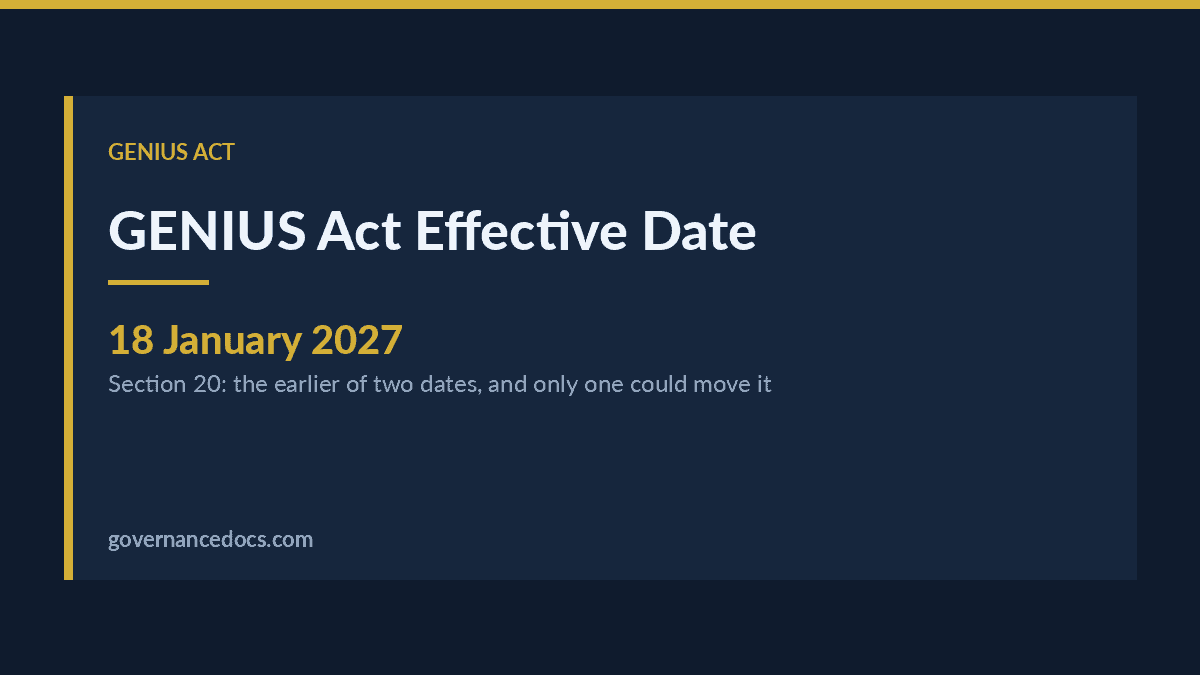
Section 20 is one sentence. The Act, and the amendments it makes to other statutes, take effect on the earlier of two dates: the date that is 18 months after enactment, or the date that is 120 days after the primary Federal payment stablecoin regulators issue any final regulations implementing the Act.
Eighteen months after 18 July 2025 is 18 January 2027. For the second limb to matter, a final rule would have had to publish by about 20 September 2026, so that 120 days later fell before 18 January 2027. No final rule did. On the day this was written the Federal Register held eighteen GENIUS Act documents from the OCC, the FDIC, the NCUA, FinCEN, OFAC, the Federal Reserve and Treasury, and every one of them was a proposed rule. So the first limb governs and the GENIUS Act effective date is 18 January 2027.
Section 20 is asymmetric. A quick final rule could have brought the date forward. Nothing in the section can push it back. A late rule, a re-proposed rule, a rule under litigation: none of them touch the date. The enrolled text is on govinfo if you want to read section 20 for yourself.
Section 13(a) required each primary Federal payment stablecoin regulator, the Secretary of the Treasury and each State payment stablecoin regulator to promulgate implementing regulations within one year of enactment, through notice-and-comment rulemaking. That deadline was 18 July 2026.
What arrived by then was a set of proposals. The OCC proposed its implementing rule in March 2026, the FDIC in April, FinCEN and OFAC the anti-money laundering and sanctions rule in April and a customer identification rule in June, the NCUA twice, and Treasury the State similarity principles in April and its section 3 issuance rule in August. Every one has a comment period; none had become final.
The practical consequence is the one the Act’s drafters presumably intended: an issuer cannot wait for the rules. The statute already contains the reserve standard, the redemption duty, the monthly reporting cycle, the six Bank Secrecy Act elements and the lawful-order condition. A program built on the statute now is a program that adopts the final rules when they land. A program that waits for the rules is late on the GENIUS Act effective date.
The Act anchors most of its dates to enactment. A few anchor to the GENIUS Act effective date itself. The table keeps them apart, because the two anchors are eighteen months apart.
| Date | What happens | Provision | Who it binds |
|---|---|---|---|
| 18 July 2025 | Enactment | – | – |
| 14 January 2026 | Cut-off for a State to have a prudential digital-asset regime in effect and earn an expedited certification | Section 4(c)(7) | State regulators |
| 18 July 2026 | Statutory deadline for implementing regulations (missed) | Section 13(a) | Regulators |
| 18 July 2026 | SCRC interpretive rule on non-financial public companies due | Section 4(a)(12)(D) | SCRC |
| 18 January 2027 | The Act takes effect; issuance without permitted status becomes unlawful | Section 20; section 3(a) | Issuers |
| 18 January 2027 | Safe harbor window for pending applications opens | Section 5(f) | Applicants |
| 17 July 2027 | Regulators report to Congress confirming the regulations promulgated | Section 13(c) | Regulators |
| 18 January 2028 | State regulators’ initial certifications due; latest end of any safe harbor | Section 4(c)(4)(A); section 5(f) | State regulators; applicants |
| 18 July 2028 | Digital asset service providers may no longer offer or sell a stablecoin a permitted issuer did not issue | Section 3(b)(1) | Exchanges and platforms |
| 18 July 2028 | FinCEN guidance on issuer illicit-activity standards and blockchain monitoring due | Section 9(d) | FinCEN |
Two of those rows are the ones that matter to a business, and they attach to different businesses.
The first headline date is the issuer’s. From 18 January 2027, section 3(a) makes it unlawful for any person other than a permitted payment stablecoin issuer to issue a payment stablecoin in the United States. Section 3(f) attaches a criminal penalty to knowing participation of up to $1,000,000 per violation and five years, and section 6(b)(5)(A) adds a civil penalty of up to $100,000 for each day of issuance in violation. That is the date an issuer works back from.
The second is the exchange’s. Section 3(b)(1) provides that beginning three years after enactment, a digital asset service provider may not offer or sell a payment stablecoin to a person in the United States unless a permitted issuer issued it. That is 18 July 2028. A platform reading the GENIUS Act effective date as its own listing deadline is eighteen months early on that provision; an issuer reading the 2028 date as its own is eighteen months late.
One exception to the exchange’s comfort: section 3(b)(2) prohibits a service provider from making available a foreign issuer’s stablecoin unless that issuer can and will comply with lawful orders, and section 8 lets Treasury designate a noncompliant foreign issuer and bar secondary trading. Neither waits for 2028. The three types of permitted issuer and the foreign-issuer route are a separate question from the date.
Section 5(f) allows the primary Federal payment stablecoin regulators to waive the application of the Act’s requirements for a period not exceeding 12 months from the effective date, for two classes of applicant: a subsidiary of an insured depository institution whose parent has an application pending for it on the effective date, and a Federal qualified issuer applicant with a pending application on the effective date.
Three things follow. The application has to be pending on the GENIUS Act effective date, which means filed and undecided, and the safer reading is substantially complete. The waiver is discretionary: “may waive” is the regulator’s choice, not the applicant’s right. And twelve months is the ceiling, so a waiver runs at most to 18 January 2028 and may run shorter.
The safe harbor is a bridge for an applicant already in the queue. It is not a reason to file late, and an existing issuer that intends to rely on it needs to have asked for it before the GENIUS Act effective date, not after.
Section 5(d) gives the application its own clocks, and they run from events rather than dates. The regulator has 30 days from receipt to say whether an application is substantially complete. It then has 120 days from substantial completeness to decide, and if it does not decide in time the application is deemed approved under section 5(d)(3). So the latest sensible filing date is about 150 days before 18 January 2027, which is mid-August 2026, and an applicant filing after that is planning to rely on section 5(f) whether it says so or not.
The work before filing is the larger part. The reserve requirements have to be operating, not drafted: eligible assets at eligible custodians, a daily coverage figure, a rehearsed month-end. The redemption policy has to be published, because section 5(c)(4) makes it an application factor. The Bank Secrecy Act program needs a designated officer and a risk assessment. And the token contract on every chain has to be able to seize, freeze, burn and prevent transfer, because section 4(a)(6)(B) makes that a condition of issuing. None of it is a document exercise, and all of it takes longer than the time left before the GENIUS Act effective date suggests.
Approval starts new clocks. The first anti-money laundering and sanctions certification under section 5(i) is due within 180 days of approval and annually thereafter, and failure to submit it is a ground for revoking approval. The monthly reserve report, its examination by a registered public accounting firm and the CEO and CFO certification start with the first month-end. A State qualified issuer that crosses $10 billion has 360 days to transition to Federal oversight or must stop issuing. The GENIUS Act effective date is the start of the obligations, not the end of the project.
Not by anything in the Act. Section 20 makes the date the earlier of 18 months after enactment and 120 days after any final regulation. A final rule could only have brought it forward, and none published in time to do so. Only new legislation could move 18 January 2027.
No. Section 13(a) required regulations within a year; section 20 fixes the effective date independently. The statutory requirements in section 4 apply from 18 January 2027 whether or not the implementing rules are final, and section 5(a)(2) required the regulators to accept applications before the rulemaking deadline in any case.
If it has a substantially complete application pending and the regulator grants a section 5(f) waiver, it may continue under the waiver for up to 12 months. If not, issuing a payment stablecoin in the United States from that date is unlawful under section 3(a), with the penalties in section 3(f) and section 6(b)(5)(A). Redeeming existing stablecoins is a separate question on which counsel should be asked.
No. It is the date in section 3(b)(1) from which a digital asset service provider may no longer offer or sell a stablecoin that a permitted issuer did not issue. It binds exchanges and platforms. Issuers are bound by the GENIUS Act effective date eighteen months earlier.
The gap between reading section 20 and operating on 18 January 2027 is roughly a hundred and twenty documents: the reserve policy and the eligible-asset standard, the redemption policy, the monthly report and the certification that goes with it, the six BSA elements, the lawful-order procedure, the application file and the clocks. Our GENIUS Act Toolkit is 126 editable templates organised on the Act’s own section structure, built on the enrolled statute with every proposed rule tracked and none stated as binding. The full list of section 4 requirements is the place to start once the date is in the diary.

October 11, 2026

October 11, 2026

October 11, 2026

October 11, 2026

October 11, 2026

