Gap assessment prioritization is the step that turns a long list of findings into an ordered plan. A typical assessment against a framework such as ISO 27001, the GDPR or a sector regulation produces dozens or hundreds of gaps, and no organization can fix them all at once. Without a sound way of ranking them, teams either start with the easiest items and leave serious exposure open, or try everything in parallel and finish nothing.
This guide explains how to prioritize gaps: which factors to weigh, how to score them, how to handle dependencies and quick wins, how to group work into waves, and how to present the result so that leaders can approve resources and track progress.
Why gap assessment prioritization matters
The value of an assessment lies in what changes afterwards. If everything is labelled high priority, nothing is. A clear ranking lets you defend choices to auditors, regulators and the board, keeps effort focused where it reduces most risk, and shows progress in a form that non-specialists can follow. It also protects the team from ad hoc requests to fix whatever was mentioned in the last meeting.
Prioritization follows from good scoring of the gaps themselves. Our guide to gap assessment scoring explains how to rate each requirement, and the guide to gap assessment evidence shows how to make sure the ratings rest on proof.
Factors to weigh in gap assessment prioritization
Use a small, stable set of factors, and define each one so that different assessors apply it in the same way.
Factor
Question to ask
Example of a high rating
Risk exposure
What harm could result while the gap remains?
Unencrypted personal data on portable devices
Legal or regulatory exposure
Does the gap breach a binding requirement or a contract?
No lawful basis recorded for a core processing activity
Certification or audit impact
Would it cause a major nonconformity?
No internal audit program in an ISO management system
Likelihood of exploitation or detection
How likely is it to be exploited, or noticed by an auditor or regulator?
Internet-facing system with no multi-factor authentication
Effort and cost
What will it take to close?
Low for a policy update, high for a system replacement
Dependencies
Does other work rely on this?
Asset inventory needed before risk assessment
Scoring gaps for priority
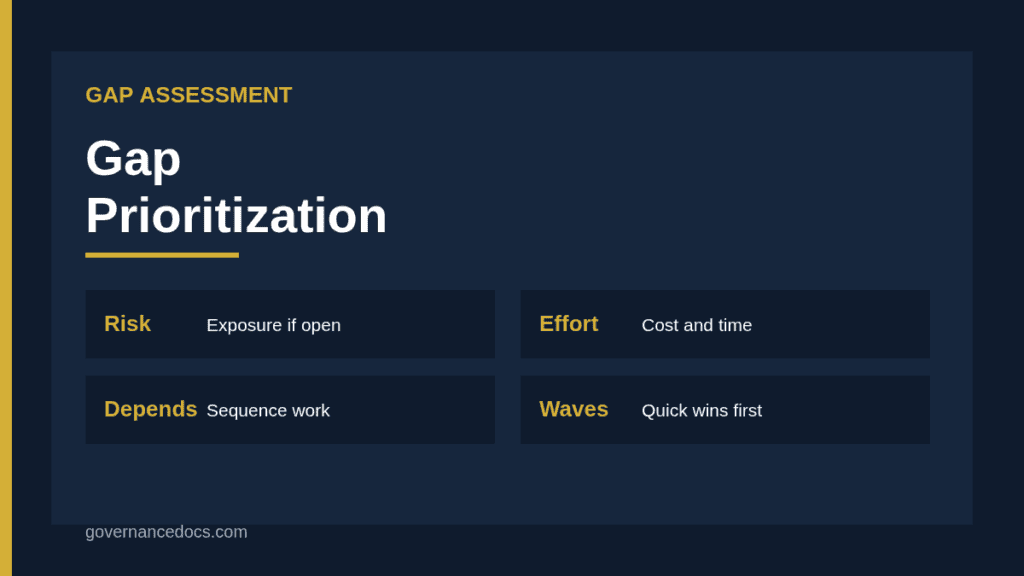
A simple method scores each gap for risk on a scale of one to five, and for effort on a scale of one to five, then produces a ranking with risk as the main driver and effort used to order items of similar risk. Some teams compute a ratio of risk reduction to effort. Whichever you choose, keep it simple enough to explain in a sentence and consistent enough to repeat.
Rate risk. Combine risk exposure, legal exposure and audit impact. Take the highest of the three as the score, so that a single serious dimension is not averaged away.
Rate effort. Use bands such as days, weeks, months and more than a quarter, together with cost.
Adjust for dependencies. Raise the priority of an item that blocks many others.
Review with owners. Ask owners to challenge scores they think are wrong and record the reasoning.
Freeze the ranking. Agree it, date it and rerun it only at defined intervals.
Use the maximum, not the average
Averages hide critical gaps. A gap with a very high legal exposure and a low audit impact should not average out to medium. Taking the highest rating among the risk dimensions keeps serious gaps visible. The same applies at the framework level: a domain that looks fine on average may contain one severe gap that deserves early attention.
Balancing quick wins and major projects
A prioritization matrix with risk on one axis and effort on the other creates four groups. High risk with low effort are quick wins to do immediately. High risk with high effort are major projects that need funding and a plan. Low risk with low effort are housekeeping items to batch. Low risk with high effort should be questioned, since they may be deferred or accepted with a recorded reason.
Quick wins matter for another reason: they build momentum and show progress. Do not, however, let them crowd out major projects that address the real exposure. Start those in parallel, since they take longer to complete and often need budget approval.
Sequencing by dependencies in gap assessment prioritization
Some gaps cannot be closed until others are. You cannot assess risks without an asset inventory, or complete a records of processing without knowing the systems involved. Map the dependencies, then order the work so that foundations come first. A simple list of predecessor items for each gap is usually enough, and it helps to spot a small number of foundational items, such as governance roles, an inventory and a risk method, that unlock many others.
The NIST Cybersecurity Framework 2.0 offers a useful idea here: compare a current profile with a target profile to identify gaps, then prioritize actions to move from one to the other. You can read about it on the NIST Cybersecurity Framework page. The same current-versus-target logic works for any framework.
Grouping gaps into remediation waves
Group ranked gaps into waves of work that the organization can absorb, commonly aligned with quarters. The first wave holds the critical exposures and the quick wins. Later waves hold larger projects and lower-risk items. Limit each wave to what the owners can deliver, and check the capacity of the teams involved, since the same few people are often responsible for many items. Our guide to the gap analysis remediation plan shows how to turn the waves into a plan with owners, dates and closing evidence.
Handling gaps you decide not to close
Not every gap will be closed. Some are not worth the cost, some do not apply to your context, and some will wait for a system replacement. Record these decisions formally, with a reason, an approver, compensating controls and a review date. This is risk acceptance, not neglect, and a documented decision is much easier to defend than a silent omission. Regulatory requirements generally cannot be accepted away, so check with legal or compliance before deferring anything mandatory.
Reporting gap assessment prioritization to leaders
Present a one-page summary: the number of gaps by priority, the top ten exposures, the wave plan with owners and dates, resource needs, and how the assessment ranking will be reviewed. Show progress as gaps closed by priority tier, not only as a total count, since closing fifty minor items is not the same as closing five critical ones. Include the accepted gaps so that leaders see the full picture. For a framework-specific example, see our guides to ISO 27001 gap assessment, GDPR gap analysis and ISO 22301 gap analysis.
A short worked example
A company assesses itself against ISO 27001 and finds 62 gaps. Scoring shows nine with high risk, of which four are quick wins such as enabling multi-factor authentication on remote access and approving an overdue policy. Two are foundational: there is no complete asset inventory and no defined risk method. The team schedules the quick wins and the two foundational items in the first wave, places supplier assurance and logging improvements in the second, and defers a low-risk documentation item with a recorded reason. The board approves the plan, and a monthly report shows progress by priority tier.
Common mistakes in gap assessment prioritization
Teams often rank by effort alone, treat all findings of a certain type as equal, ignore dependencies, set priorities once and never update them, fail to record deferred items and report progress as a raw count. Another mistake is letting the loudest stakeholder set the order. A written method, applied by more than one person and reviewed with owners, is the best defence against all of these.
Using a ready structure
If you want a starting point, the Gap Assessment Report and Workbook provides a structured report, scoring and a working register where priority, effort, owner and wave can be recorded for every gap. Whichever tool you use, make gap assessment prioritization a repeatable step with written criteria, so that resources always go to the gaps that matter most.
Gap assessment prioritization FAQ
How do I decide which gaps to fix first?
Rank them by risk, including legal and audit exposure, then use effort and dependencies to order items of similar risk. Do quick wins early, and start major projects in parallel.
Should I use the average of several scores?
Prefer the highest score among risk dimensions, so that a severe gap in one dimension is not averaged away by lower ratings elsewhere.
Can we choose not to close a gap?
Yes for most gaps, if the decision is recorded with a reason, an approver, compensating controls and a review date. Mandatory legal requirements generally cannot be accepted away.
How often should priorities be reviewed?
Review them at defined points, such as each quarter or when a major incident, regulation or business change occurs, so that the plan reflects current exposure.
Who should approve the ranking?
A senior sponsor with authority over resources should approve it, after review by the owners and the compliance or risk function, and the decision should be recorded.