CART
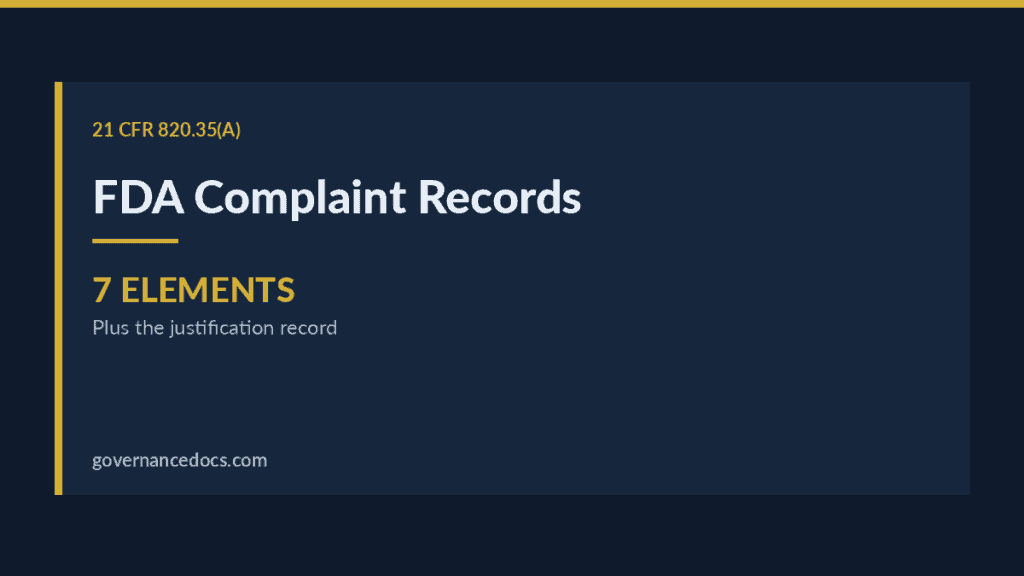
FDA complaint records are one of the few places where 21 CFR Part 820 tells you exactly what to write down. Section 820.35(a) names seven data elements, and it names them because complaint handling is where quality problems first become visible and where an investigator can test completeness by counting.
This guide covers the seven elements, when an investigation is required, the justification record almost nobody has, and how complaint records connect to medical device reporting.
Free gap assessment
How much of ISO 13485 could you evidence today?
Score clauses 4 to 8, free, with the FDA QMSR and EU MDR duties kept separate so you can see what is the standard and what is the regulator.
Run the free ISO 13485 gap assessment → or View premium report sample

Section 820.35(a) applies in addition to ISO 13485 Clause 8.2.2. It requires the following to be recorded:
| # | Data element |
|---|---|
| 1 | The name of the device |
| 2 | The date the complaint was received |
| 3 | Any unique device identifier (UDI) or universal product code (UPC), and any other device identification |
| 4 | The name, address and phone number of the complainant |
| 5 | The nature and details of the complaint |
| 6 | Any correction or corrective action taken |
| 7 | Any reply to the complainant |
These apply to complaints that must be reported to FDA under Part 803, complaints the manufacturer determines must be investigated, and complaints investigated regardless of those requirements.
The single most useful change most organisations can make to their FDA complaint records is structural: seven discrete fields rather than a free-text box that theoretically contains everything.
An investigator sampling for completeness cannot credit what is not findable. A narrative that mentions the complainant’s phone number somewhere in paragraph three is not obviously compliant, and proving it record by record is slow and unconvincing. Seven labelled fields make a missing element visible immediately — to you, before anyone else looks.
Anonymous complaints happen. A complaint arriving through a distributor may carry no contact details at all. Record that the element is unavailable and why, rather than leaving the field blank. A blank field and an unavailable field look identical to an investigator, and only one of them is defensible.
Records of review, evaluation and investigation are required for any complaint involving the possible failure of a device, labeling or packaging to meet any of its specifications.
Two things in that sentence are routinely missed.
The trigger is possible failure, not confirmed failure. A complaint that turns out to be unfounded still required investigation if failure was possible on the information available at the time. Deciding retrospectively that no investigation was needed because nothing was wrong inverts the test.
It reaches labeling and packaging, not only the device. A complaint that a unit arrived mislabelled, or in the wrong packaging, is squarely inside the requirement. This is the limb most often overlooked, because complaint processes tend to be designed around device performance and route packaging issues to logistics.
Section 820.35(a) allows you not to investigate: if an investigation has already been performed for a similar complaint, another is not necessary. But it requires the manufacturer to maintain records documenting the justification for not performing such investigation.
That record exists in very few sets of FDA complaint records. Without it, a perfectly legitimate decision is indistinguishable from an omission — and an investigator sampling complaints closed without investigation will ask for it by name.
The similarity ground is legitimate and useful, and it is also the easiest route to a systematic failure — a series of individually reasonable decisions can suppress a signal entirely.
Count them. Track how many complaints have been closed against each reference investigation, and set a threshold past which you re-open the investigation regardless of individual similarity. Volume is itself information: twenty complaints closed against one investigation from eighteen months ago is a trend, not twenty coincidences.
Complaint handling and medical device reporting are separate obligations running on separate clocks, and confusing them is the commonest failure in this area.
| Clock | Starts | Governed by |
|---|---|---|
| Reporting | When any employee becomes aware of information reasonably suggesting a reportable event | 21 CFR Part 803 |
| Investigation | When the complaint is received | ISO 13485 Clause 8.2.2 and 820.35(a) |
Triage FDA complaint records for reportability on receipt, not on conclusion. A complaint may be reported before the investigation finishes, and frequently must be. Allowing a thorough investigation to consume a short reporting deadline is the least defensible failure mode available, because the fix costs nothing.
Note also who starts the clock: any employee. If a field engineer hears about a serious injury on a Friday and mentions it to quality on Monday, the clock started Friday. That makes internal escalation a compliance control, not an administrative preference.
A process that only captures what arrives through a designated mailbox will understate complaints, and the gap shows the moment somebody compares datasets. Capture from every route: direct contact, distributors, field engineers, sales, servicing records, literature, social media and regulator enquiries.
Servicing records deserve particular attention. A service visit that reveals a device failed to meet its specifications is a complaint, whether or not anyone used that word. Route servicing records through complaint triage and record the routing decision — organisations that treat servicing and complaints as separate systems routinely understate their complaint volume, and the discrepancy is visible to anyone holding both datasets.
At a defined frequency, reconcile complaints, servicing records and MDR submissions against each other. Investigate any complaint alleging death or serious injury with no corresponding reportability decision, and any servicing record showing a specification failure with no complaint reference.
This is the analysis an investigator will perform if you have not, and it is far better to arrive at the finding first.
Three habits separate a complaint file that survives inspection from one that does not.
The record is contemporaneous. Fields are completed when the information arrives, not reconstructed at closure. A record where every field carries the same date as the closure entry invites the question of when it was actually written.
The investigation answers the complaint. It is common to find an investigation that establishes the device met specification without addressing what the complainant actually described. Both belong in the record: what was alleged, and what was found.
Closure is evidenced. Where corrective action was taken, the record shows what and when. Where none was taken, it shows the reasoning. “No action required” with nothing behind it is the most common weak entry in any complaint file.
Sample your own FDA complaint records monthly against the seven elements and record the result. A persistent gap in one field is a process failure, and correcting individual records quietly conceals it — raise it as a nonconformity instead.
Yes. If the device is distributed in the United States, a complaint about it is in scope wherever it is received. Ensure non-US sites and distributors route complaints into the process within a defined time, and audit that they do — delay in a distributor’s hands does not extend the reporting clock.
Not usually. A complaint alleges deficiencies in identity, quality, durability, reliability, usability, safety or performance after release for distribution. A user asking how to operate the device is not complaining — but a user asking how to operate it because it behaved unexpectedly may well be, and the safer practice is to record and triage rather than to filter at intake.
ISO 13485 Clause 4.2.5 requires records to be retained for at least the lifetime of the device as defined by the manufacturer, and for any longer period required by other applicable requirements — which for reportable events includes Part 803. Record the device lifetime that drives your retention period; a schedule with no stated basis is hard to defend.
Then both obligations run. Part 803 reporting and Part 806 corrections and removals are separate, with separate criteria, deadlines and submissions. Satisfying one does not satisfy the other. Run both and cross-reference the records.
Complaint records sit inside the wider record supplements in 21 CFR Part 820 section by section, and the FDA layer they belong to is covered in the FDA QMSR guide. Complaint handling is a named inspection element — see QMSR inspection for how it is examined.
The regulation text, including 820.35 in full, is on eCFR at 21 CFR Part 820.
Our FDA QMSR Toolkit includes a complaint register with a column per mandatory data element, so a missing field is visible rather than buried, along with the complaint record procedure, the investigation justification record and the MDR reportability decision tree. The justification record in particular is the document most quality systems discover they need only when an investigator asks for it.

October 11, 2026
October 11, 2026
October 11, 2026
October 11, 2026

October 11, 2026

