CART
The Cloud Controls Matrix is the control framework behind every CSA STAR entry, and it moved in January 2026. CCM v4.1 succeeded the v4.0 line, the CAIQ moved with it, and a submission built on the older version now has a transition timeline attached to it.
This guide covers what the Cloud Controls Matrix is, what the CAIQ does with it, what the v4.1 release changes for a STAR submission, and how to answer it without producing a document your own customers can disprove.
Free gap assessment
Where do you actually stand against ISO 27001?
Score every management system clause and all 93 Annex A controls, free, and get a prioritised gap list back.
Run the free ISO 27001 gap assessment → or View premium report sample
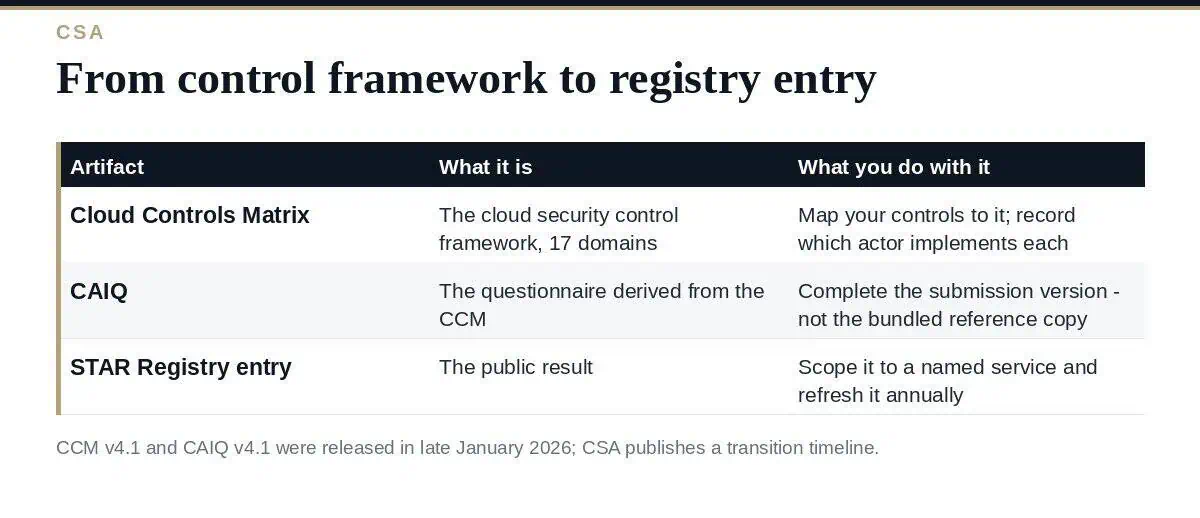
The Cloud Controls Matrix is the Cloud Security Alliance’s cybersecurity control framework for cloud computing, organized into seventeen security domains covering everything from identity and access management to interoperability, logging and supply chain. Its distinguishing feature is not the control text but the shared responsibility dimension: the framework asks which actor — cloud service provider or cloud service customer — implements each control.
Its companion is the Consensus Assessments Initiative Questionnaire. The CAIQ turns the control objectives into yes/no questions a provider answers, and a completed CAIQ is what gets submitted to the public STAR Registry. The two ship together, and the version numbers move together: CCM v4.1 and CAIQ v4.1.
A trap worth naming early, because it costs weeks. The bundled CCM and CAIQ spreadsheet is a reference document. STAR submissions use the submission version of the CAIQ. Teams that complete the reference workbook discover this at the point of upload, having answered several hundred questions in the wrong file.
CCM v4.1 was released in late January 2026 as the successor to the v4.0 line, and CSA published a transition timeline alongside it. Three practical consequences:
The numbers behind that, taken from CSA’s own v4.1 release and its CAIQ change analysis: the control count rises from 197 to 207 across the same 17 domains, and the CAIQ from 261 to 283 question IDs. The Infrastructure & Virtualization Security domain (IVS) becomes Infrastructure Security (I&S), with its nine controls renumbered I&S-01 to I&S-09. Twenty controls are new by identifier — among them API security (AIS-08), datacentre metrics and operations resilience (DCS-17, DCS-18), audit-log sanitisation for customers (LOG-08), incident records management and points of contact (SEF-09, SEF-10), a supply-chain policy and a service bill of materials (STA-01, STA-09), and threat analysis and threat response (TVM-04, TVM-10) — and one is dropped (the old IAM-12). The trap is the renumbering that the new controls cause: in six domains (DCS, IAM, LOG, SEF, STA and TVM) the identifiers below an inserted control keep their numbers and the ones above shift, so old DCS-07 is now DCS-08, old IAM-16 is IAM-15, old LOG-08 is LOG-09, old SEF-08 is SEF-10 and old TVM-09 is TVM-11. A crosswalk that carries v4.0 identifiers into a v4.1 submission points at the wrong control roughly one time in three in those domains. On dates: new STAR assessments must use v4.1 from July 2027, and existing registrations need to be on v4.1 by January 2028.
The version you answered against is part of your public position. When a customer’s due-diligence team reads your registry entry, “CAIQ v4.1, submitted March 2026” tells them something; “CAIQ” alone does not.
The registry is public and permanent, which changes the incentives. Four rules keep an entry defensible:
Where the full questionnaire is stalling a small team, the Lite variants exist for exactly that reason — a submitted Lite entry beats an unfinished full one, and it can be upgraded later.
The CCM overlaps heavily with frameworks most cloud providers already run, and the overlap is the point rather than duplication:
The efficient pattern is one control library mapped outward to each of these, with the CCM version recorded in the mapping. Then a version change is a mapping update rather than a re-answer.
What is the current version of the Cloud Controls Matrix?
CCM v4.1, released in late January 2026, with CAIQ v4.1 as its companion questionnaire. CSA publishes a transition timeline for entries on earlier versions.
What is the difference between the CCM and the CAIQ?
The CCM is the control framework; the CAIQ turns those controls into questions a provider answers. You submit the CAIQ, not the CCM.
How many domains does the CCM cover?
Seventeen security domains, spanning governance, technical and supply chain areas of cloud service delivery.
Is a STAR Level 1 submission free?
Level 1 is a self-assessment and is free to submit. Level 2 involves an assessment by an approved firm against an underlying certification.
Do we have to redo everything for v4.1?
Not everything. The 17 domains and most control titles are unchanged, so implementation narratives carry over. What must be redone is the identifier layer: the DCS, IAM, LOG, SEF, STA and TVM domains were renumbered, IVS became I&S, 20 controls and 22 CAIQ questions are new, and every crosswalk built on v4.0 identifiers needs re-keying before it is trusted. New submissions should be built on v4.1 rather than the version you started drafting.
Treat the Cloud Controls Matrix as the control framework and the CAIQ as its public face. Start new work on v4.1, check CSA’s transition timeline against your refresh date, scope the entry to a named service, and answer the shared-responsibility question honestly — the registry is permanent and a generous answer becomes a discoverable liability. Then map the CCM to the certifications you already hold once, with the version recorded, so the next release is an afternoon rather than a project.
Update, 11 September 2026: our own CSA STAR Cloud Security Toolkit was rebuilt for v4.1 this month — 207 controls across 17 domain implementation plans, the Infrastructure Security domain, 283 CAIQ v4.1 question IDs in the self-assessment workbook, and the renumbering above applied to every crosswalk. One design point worth stating: the CCM is CSA’s copyrighted work, licensed for non-commercial use without redistribution, so the toolkit carries CSA’s control IDs and titles with our own statement of each control’s intent, and points you to CSA’s free download for the authoritative wording. Any toolkit that reproduces the CCM text verbatim is doing something CSA’s licence does not permit.
Control mappings, shared responsibility documentation and submission records are in the CSA STAR Cloud Security Toolkit, or start with the free ISO templates.

October 13, 2026
October 12, 2026
October 12, 2026
October 12, 2026

October 12, 2026

