
CART
No products in the cart.
ISO Compliance Insights & Best Practices
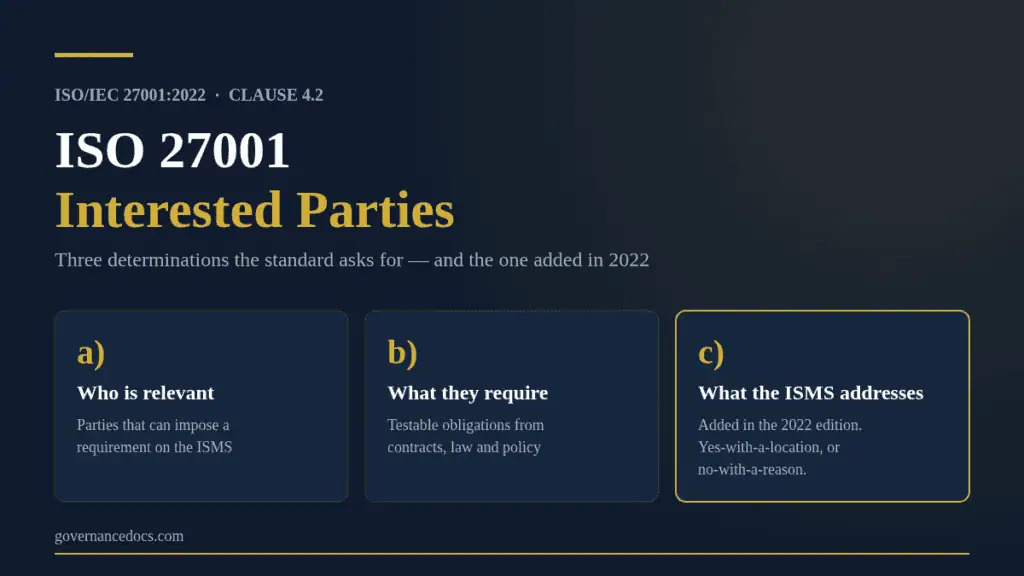
ISO 27001 interested parties is the part of clause 4 that nearly every implementation gets half right. You list the customers, the regulators, the employees and the cloud providers, you write down what each of them wants, and you move on to scope. Then the auditor asks a question your register has no column for, and you find out that the 2022 edition added a third requirement to clause 4.2 that most templates never caught up with.
This guide covers what clause 4.2 actually demands of your ISO 27001 interested parties register, who belongs on the list, how it feeds scope, risk and management review, and the findings auditors write most often. If you are sequencing the whole project, our ten-step ISO 27001 implementation plan shows where clause 4.2 sits in the build order.
Free gap assessment
Where do you actually stand against ISO 27001?
Score every management system clause and all 93 Annex A controls, free, and get a prioritised gap list back.
Run the free ISO 27001 gap assessment → or View premium report sample
Clause 4.2 of ISO/IEC 27001:2022 asks for three determinations, not one. The organization has to determine the interested parties that are relevant to the information security management system; the relevant requirements of those interested parties; and which of those requirements will be addressed through the ISMS.
Those three determinations are the whole test. A register of ISO 27001 interested parties that answers only the first two is answering the 2013 edition, which stopped being certifiable when the transition window closed on 31 October 2025.
The standard adds a note that these requirements can include legal and regulatory requirements and contractual obligations. That note is the reason so many interested parties registers quietly turn into legal registers — more on why those are two different artifacts below.
Here is the part almost nobody states plainly: clause 4.2 never says “shall be available as documented information.” Compare it with clause 4.3 (scope), 5.2 (policy), 6.1.2 (risk assessment process) or 6.1.3 (Statement of Applicability), all of which do. A register of ISO 27001 interested parties is therefore not on the list of mandatory documents, which you can check against our breakdown of the documents ISO 27001 actually requires.
Free ISO 27001 risk assessment
Which of your risks sit above your appetite line?
Set your own risk criteria, pick from 61 information security risk scenarios, rate likelihood and impact, and decide how to treat each one. You get a heat map, a process score and the findings an auditor would raise, free.
Run the free risk assessment → or View premium report sample
That does not mean you should skip it. You still have to demonstrate that the determination happened, and a register is the cheapest way to do that. It just means the auditor is testing a decision, not admiring a spreadsheet.
Item (c) — which requirements will be addressed through the ISMS — was added in the 2022 edition. It is a small phrase with a large consequence: identifying a requirement is not the same as accepting it.
Under the 2013 edition you listed parties and listed requirements, and the implicit assumption was that everything on the list was now your problem. The 2022 text makes the filter explicit. You are expected to look at each requirement and say, in writing, whether the ISMS addresses it and where — or that it does not, and why.
In practice that means one extra column, with answers that look like this:
Those last two rows are what make the clause useful rather than bureaucratic. Item (c) is the sentence in the standard that lets you keep a scope finite. Without it, every requirement anyone has ever voiced is nominally inside your ISMS, and the first auditor who reads the register against your ISO 27001 scope statement will find the mismatch.
An interested party is anyone who can impose a requirement on your information security, or who is materially affected by it. That test rules out a surprising amount of what ends up on these lists. “The general public” is rarely an interested party for a B2B SaaS company; a single enterprise customer with a 40-page security addendum certainly is.
| Interested party | Typical requirement | Usually addressed through |
|---|---|---|
| Enterprise customers | Contractual security clauses, breach notification windows, right to audit | Supplier contracts, incident procedure, SoA controls |
| Regulators and supervisory authorities | Statutory breach reporting, data protection duties, sector rules | Legal register (A.5.31), incident response plan |
| Employees | Clear acceptable-use rules, proportionate monitoring, usable training | Topic-specific policies, awareness programme (A.6.3) |
| Board and shareholders | No material disruption, a certificate that unblocks sales | ISMS objectives (6.2), management review |
| Suppliers and cloud providers | Defined responsibilities, least-privilege access, exit terms | A.5.19–A.5.23 supplier and cloud controls |
| Insurers | Evidence of specified controls before underwriting | Internal audit results, control evidence |
| Certification body | Conformity evidence, notification of significant change | The ISMS itself; change notification process |
| Parent company or group | Group security standard, consolidated reporting | Scope interfaces and dependencies (4.3) |
Length is not a virtue in a list of ISO 27001 interested parties. A forty-row register is a liability, because every row is something an auditor can ask you to evidence and something you have to review. Most certified SMEs run eight to fifteen rows and can defend all of them.
ISO 27001 interested parties, clause 4.1 issues and the A.5.31 legal register overlap enough that teams collapse them into one document, then fail all three. They answer different questions and have different evidence obligations.
| Clause 4.1 issues | Clause 4.2 interested parties | A.5.31 legal register | |
|---|---|---|---|
| What it captures | Internal and external issues affecting the ISMS outcome | Who has requirements, what they are, and which the ISMS addresses | Laws, statutes, regulations and contracts, plus your approach to meeting them |
| Documented information mandatory? | No | No | Yes — the control says identified, documented and kept up to date |
| Typical owner | Top management with the ISMS manager | ISMS manager | Legal or compliance |
| Feeds | Scope (4.3), planning (6.1.1) | Scope (4.3), planning (6.1.1), management review (9.3.2) | Risk assessment, SoA justification, compliance evidence |
| Review trigger | Annual, plus material business change | Annual, plus new contract, regulator or market | On legal or contractual change |
The practical rule: a requirement that originates in a law or a signed contract belongs in both the interested parties register and the A.5.31 register, but only the A.5.31 version has to be documented and maintained as a control. Keep one as the source of truth and cross-reference, rather than maintaining the same clause in two places and letting them drift.
Your ISO 27001 interested parties determination is not a standalone exercise, and the auditor will follow the thread out of it. Four places it has to show up:
Six steps that produce a register you can defend at Stage 2 rather than one you have to explain away:
These are the ISO 27001 interested parties findings raised most often at Stage 2 and surveillance. All six are worth checking for before the auditor arrives:
Is an interested parties register a mandatory ISO 27001 document?
No. Clause 4.2 does not require documented information, and the register does not appear on the list of mandatory ISO 27001 documents. You will still be asked to evidence the determination, and A.5.31 separately requires the legal, statutory, regulatory and contractual requirements to be identified, documented and kept up to date — so in practice almost everyone writes one.
How many ISO 27001 interested parties should we list?
The standard gives no number. Most certified small and mid-sized organizations run eight to fifteen entries. Judge by whether each party can impose a requirement you would have to act on; if not, it is noise you will have to maintain forever.
What changed in clause 4.2 in the 2022 edition?
Item (c) was added, requiring you to determine which interested party requirements will be addressed through the ISMS. In the same revision, clause 9.3.2 gained changes in the needs and expectations of interested parties as a management review input. The rest of the clause 4 wording is largely unchanged from 2013.
Can we decline an interested party’s requirement?
Yes, and item (c) is precisely the mechanism for it. Record the requirement, record that the ISMS does not address it, give the reason and name who decided. A documented, reasoned exclusion is defensible; a silent omission is a finding.
How often should the register be reviewed?
At least annually, fed into management review. Beyond that, treat it as event-driven: a new regulated market, a major customer contract with new security terms, a new supervisory authority, an acquisition, or a change in your own service model.
If you are writing your ISO 27001 interested parties register from a blank page, start with the contracts and work outward — the clause 4.2 determinations are easier to defend when they are traceable to a signed obligation rather than to an opinion. The authoritative reference for the requirement text is ISO/IEC 27001:2022 on iso.org, which also covers the free climate-change amendment published in 2024.
If you would rather not build the register, the scope statement and the A.5.31 legal register from scratch, our ISO 27001 Toolkit ships 165 templates mapped to ISO 27001:2022 for $99, including the clause 4 context and ISO 27001 interested parties documents with the 4.2(c) column already in place.


October 11, 2026

October 11, 2026

October 11, 2026

October 11, 2026

October 11, 2026
