
CART
No products in the cart.
ISO Compliance Insights & Best Practices
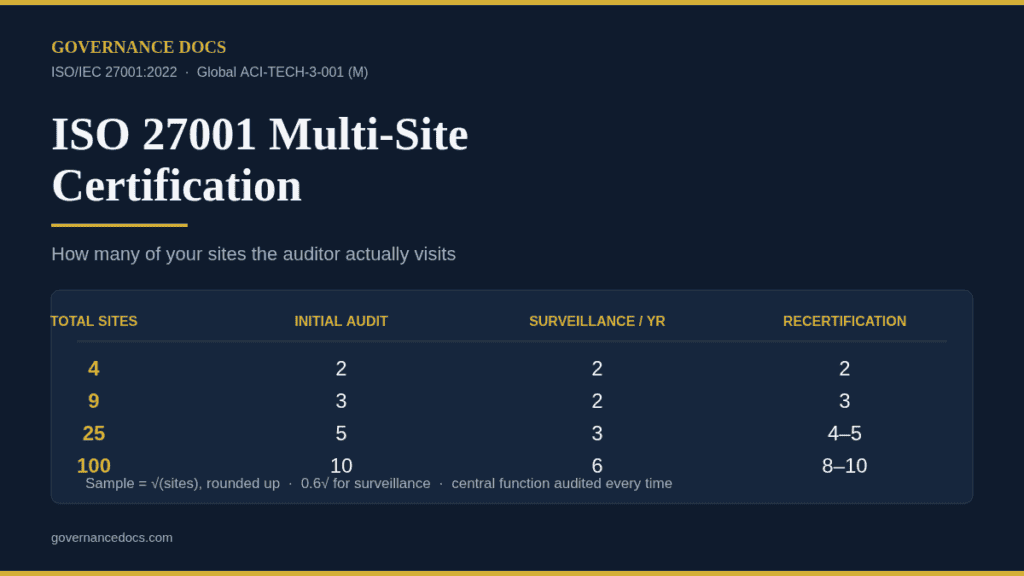
ISO 27001 multi-site certification lets an organization with several offices, data centers or delivery hubs hold one certificate covering every location, with the auditor visiting only a sample of them. Done properly it cuts audit days substantially. Done carelessly it produces a certificate your largest customer rejects, or a finding at one branch that takes down the whole group.
The rules of ISO 27001 multi-site certification are not a matter of certification body preference — they sit in a mandatory accreditation document, and the 2026 edition is new. Here is what it requires, what the sampling math gives you, and where this route breaks.
Free gap assessment
Where do you actually stand against ISO 27001?
Score every management system clause and all 93 Annex A controls, free, and get a prioritised gap list back.
Run the free ISO 27001 gap assessment → or View premium report sample
The governing rule is Global ACI-TECH-3-001 (M), the Mandatory Document for the Audit and Certification of a Management System Operated by a Multi-Site Organisation, issued 10 July 2026 with an implementation date of 28 August 2026. It is the reformatted successor to IAF MD 1:2023, carried over after the International Accreditation Forum ceased operations and its role passed to Global Accreditation Cooperation Incorporated. The document says it was reformatted “without any substantive change to the text,” so the rules applied in 2025 still stand — only the reference changed.
Its definition of a multi-site organization: one covered by a single management system comprising an identified central function — explicitly “not necessarily the headquarters” — at which certain processes are planned and controlled, plus a number of sites where those processes are carried out. Three consequences of that definition shape every ISO 27001 multi-site certification:
Before any sampling discussion, Section 5 sets six conditions for ISO 27001 multi-site certification. Fail one and your group cannot be treated as a multi-site organization at all:
Test 2 is where outsourced compliance fails: if a consultancy runs your ISMS, the central function has been subcontracted. Test 6 is where federated groups fail — a holding company receiving quarterly reports from autonomous subsidiaries cannot demonstrate authority to initiate corrective action at a site, which is the specific power the document asks you to prove. Our guide to defining the ISO 27001 scope covers drawing that boundary first.
Where sites each perform very similar processes, ISO 27001 multi-site certification lets the certification body sample. The minimum sample sizes are fixed arithmetic, not negotiation:
| Total sites | Initial audit sample | Annual surveillance sample | Recertification sample |
|---|---|---|---|
| 4 | 2 | 2 | 2 |
| 9 | 3 | 2 | 3 |
| 16 | 4 | 3 | 4 |
| 25 | 5 | 3 | 4–5 |
| 50 | 8 | 5 | 6–8 |
| 100 | 10 | 6 | 8–10 |
Four details change how that plays out. The central function is additional to the sample — audited at initial certification, at every recertification and at least once each calendar year during surveillance; it is never sampled out. At least 25% of the sample must be random, the rest weighted toward prior findings, complaints, size variation, shift patterns, recent changes and regulatory differences. The sample need not be named up front — the certification body may pick it after auditing your central function, on short notice, so “we will prepare the three sites they visit” is not a plan. And the sample size increases where the certification body’s risk analysis flags complexity, multinational operations or a weak internal audit record.
For a hierarchical group the formula applies at every level. The document’s own example: one head office audited every cycle, 4 national offices giving a sample of 2, 27 regional offices giving 6, and 1,700 local branches giving 42 — with the regional sample covering at least one office under each national office, which can push the real sample above the arithmetic minimum.
Audit days are capped too. The reduction in audit time per sampled site cannot exceed 50%, and for an ISMS the underlying calculation comes from ISO/IEC 27006-1:2024, Annex C, driven mainly by the effective number of people in scope. Since 31 March 2026 every ANAB-accredited certification body has had to use that edition for all clients.
Most buyers discover this late. The document is explicit that not all organizations meeting the multi-site definition are eligible for sampling, and sampling is permitted only where sites perform very similar processes. Certification bodies must hold documented procedures restricting it by sector, site size, variation in local implementation and use of temporary sites.
If your sites differ materially — a London software team, a Dubai sales office under different regulatory obligations, a Manila operations center on its own shift pattern — expect the non-sampling form of ISO 27001 multi-site certification:
Mixed groups get a combination of the two. Adding a site later differs by route: under sampling the certification body decides whether the new site needs an audit before joining the certificate; under the non-sampling route it shall be audited first.
The alternative is certifying each entity separately. The trade-off is rarely as one-sided as a certification body quote suggests.
| Factor | Multi-site, one certificate | Separate certificates per site |
|---|---|---|
| Audit days | Lower — only the sample plus the central function is visited | Highest — full audit time at every entity |
| Documentation effort | One ISMS, one risk assessment process, one Statement of Applicability | Duplicated per site and maintained separately |
| Local autonomy | Low — the central function must be able to force corrective action | High — each site owns its own system |
| Risk concentration | A major finding at one site blocks or withdraws the whole certificate | Contained to the affected entity |
| Customer evidence | One certificate naming every site in scope | Easier for a single-country buyer to read |
| Best fit | Branch networks, shared-service groups, one operating model | Acquisitions still on their own systems |
Choosing ISO 27001 multi-site certification is therefore a governance decision before it is a cost decision. You are trading audit days for a single point of failure, and the exchange rate is set by how much real authority your central function holds.
The certificate must carry the name and address of all the sites and make clear the certified activities are performed by the sites on that list. Where a site covers only part of the scope, its sub-scope must be stated.
Site-level copies are tightly constrained. One may be issued, but it must state that it is the whole organization’s management system that is certified, carry traceability to the main certificate, and include the statement that “the validity of this certificate depends on the validity of the main certificate.” It cannot be issued in the site’s own name or imply the site itself is certified — the rule to point at when a procurement team asks for a certificate in a subsidiary’s name.
Then the consequences, which are the real cost of ISO 27001 multi-site certification:
Our guides to the major and minor nonconformity rules and the annual surveillance cycle cover how those findings are raised and closed.
Preparing for ISO 27001 multi-site certification is mostly about evidencing that the central function is real. Six moves that hold up at audit:
Our ISO 27001 Toolkit provides 165 templates mapped to ISO/IEC 27001:2022, including the Statement of Applicability, risk assessment and treatment documents, internal audit program and management review records a central function needs to evidence control across every site. It is $99, in Microsoft Office format, ready to tailor. If you are still choosing an assessor, our certification body selection guide covers the accreditation checks worth making first, and the step-by-step certification guide sets out the full route.
Free ISO 27001 risk assessment
Which of your risks sit above your appetite line?
Set your own risk criteria, pick from 61 information security risk scenarios, rate likelihood and impact, and decide how to treat each one. You get a heat map, a process score and the findings an auditor would raise, free.
Run the free risk assessment → or View premium report sample
Home-based staff attached to an office are normally audited within that office’s scope. A fully remote team with no physical base is a virtual site in its own right and counts as a single site in the audit-time calculation. Check how your certification body has listed them — it changes the square root.
Yes, and it does not need your agreement. Sampling applies only where sites perform very similar processes, and certification bodies must hold documented procedures restricting it. Where it is ruled out, the alternative is full coverage at initial and recertification plus 30% of sites each surveillance year.
Sampling cuts audit days, not day rates. For context, a single-site stage 1 plus stage 2 typically runs $5,000–$12,000 in US certification body fees at 2026 auditor day rates of roughly $1,400–$2,500 — see our ISO 27001 certification cost breakdown. The per-sampled-site reduction is capped at 50%, travel is added on top, and the central function is always charged.
Yes. Under the sampling route the certification body decides what is needed before the site joins the certificate, which may or may not include auditing it. Under the non-sampling route it must be audited first. Either way the sample size for later audits is recalculated.
For a recent acquisition still running its own security program, yes. Forcing it into a group ISMS before the central function genuinely controls it puts the whole certificate at risk, and the eligibility tests are checked at audit, not at application.
ISO 27001 multi-site certification is open to any group with one genuine information security management system and a central function that can prove authority over every location. Where the sites are comparable, the auditor visits the square root of them at initial certification, 0.6 × the square root each surveillance year, and the central function every time. Where they are not, expect full coverage plus 30% per year. The savings are real; so is the fact that one major finding anywhere takes the whole certificate with it. The full requirements are published by ISO.


October 11, 2026

October 11, 2026

October 11, 2026

October 11, 2026

October 11, 2026
