An AI impact assessment for credit scoring deserves special care, because lending decisions shape people’s access to housing, transport, business finance and everyday life. A model that wrongly refuses credit, prices it unfairly or treats a group differently can cause lasting harm, and it can do so at scale and with an appearance of objectivity. The EU AI Act treats AI systems used to evaluate creditworthiness of natural persons as high-risk, which brings specific obligations.
This guide explains how to run an AI impact assessment for credit scoring: which impacts to consider, how to test for unfair outcomes, how to provide explanations and human review, how the assessment fits with other legal duties and how to monitor after launch. It is general guidance, not legal advice, and lending is heavily regulated, so involve legal and compliance specialists.
Why credit scoring needs a careful impact assessment
Credit decisions have long-lasting effects. A refusal can prevent someone from buying a home, starting a business or handling an emergency, and a poor score can follow a person from lender to lender. Models learn from historical data that may reflect past discrimination, so they can reproduce or amplify unfairness even when protected characteristics are not used directly.
Regulators are paying close attention. The EU AI Act, available at the EU AI Act, which lists creditworthiness assessment among high-risk uses, classes AI systems intended to evaluate the creditworthiness of natural persons or establish their credit score as high-risk, subject to some exceptions. Financial regulators, consumer protection authorities and data protection authorities also have rules. An impact assessment brings these strands together and shows how the system affects real people.
Scope an AI impact assessment for credit scoring
Describe precisely what the model does: is it a score that informs a human underwriter, or an automated decision? Which products does it cover? Which data does it use, including alternative data such as transaction patterns or device information? Who are the applicants, and which groups might be affected differently?
Screen the system to confirm that a full assessment is required; see AI impact assessment screening. For high-impact uses like lending, the answer is almost always yes. Also record the legal context: consumer credit rules, anti-discrimination law, data protection rules on automated decisions and any sector guidance.
Free AI impact assessment (ISO 42005)
Who could this AI system affect, and how?
Screen the system against sensitive and prohibited uses, describe it, check the safeguards for fairness, transparency and oversight, and rate its impacts on people and society from 26 scenarios with ISO 42001 Annex A measures. Free, with findings.
Identify impacts in an AI impact assessment for credit scoring
List the ways the system could affect people: wrongful denial, worse terms, exclusion of thin-file or new-to-credit applicants, exposure of sensitive information, stress from unexplained decisions and reduced ability to correct errors. Consider groups such as young adults, migrants, self-employed people, people in certain regions or those with disabilities.
Consider impacts on society too, such as reinforcing regional inequality or driving people towards high-cost lenders. Use a structured list of harms, such as the AI harm taxonomy, to avoid missing categories. Involve consumer advocates or affected community representatives in the discussion where possible.
Impact area
Example harm
Typical safeguard
Access to credit
Wrongful refusal for reasons unrelated to ability to repay
Human review of declines, appeal route
Price and terms
Higher rates for a group without justification
Pricing fairness testing
Discrimination
Proxy variables that stand in for protected traits
Feature review and group outcome tests
Transparency
Applicants cannot understand or challenge decisions
Clear reasons and explanations
Data and privacy
Use of unexpected data sources
Data minimisation and lawful basis checks
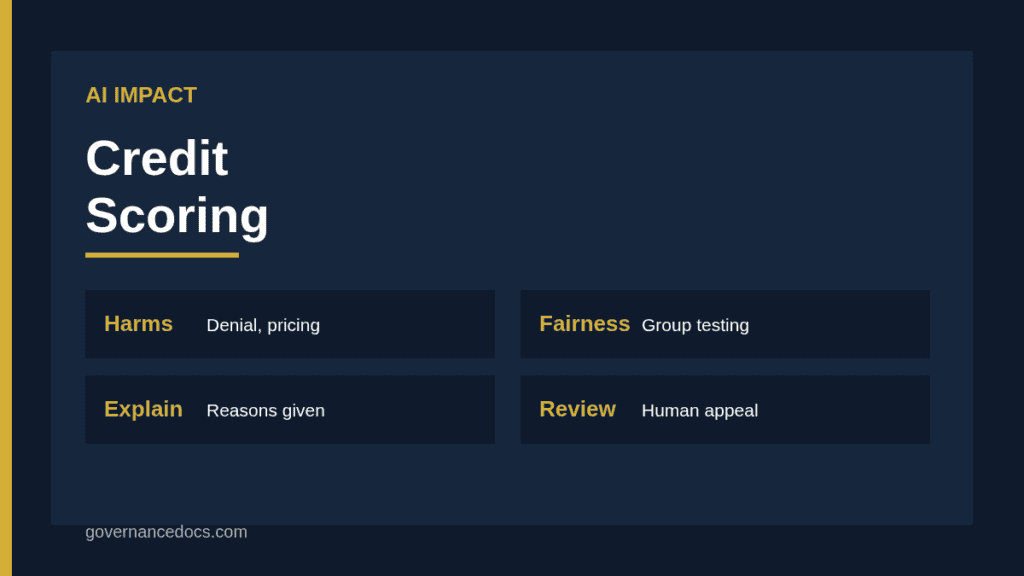
Denial of credit and unfavourable pricing
Discrimination directly or through proxy variables
Lack of transparency and inability to challenge
Privacy intrusion from data sources
Test for unfair outcomes in credit scoring
Test how the model performs across groups. Compare approval rates, error rates and pricing outcomes by relevant characteristics, using proxy methods or voluntary data where direct data is not held. Look for differences that cannot be justified by legitimate credit risk factors. Review the features for proxies, such as postcode, education or device type.
Document what you tested, the results, the thresholds you used and the actions taken. See AI bias testing for approaches. Be aware that there is no single fairness definition, so record which measures you chose and why, and consider whether less discriminatory alternatives exist that achieve similar predictive power.
Explanations and human review in an AI impact assessment for credit scoring
Applicants need to understand decisions and challenge them. Provide clear reasons for adverse outcomes, in plain language, focused on the main factors, and give a route to request review by a person. Data protection law in many jurisdictions gives rights relating to automated decisions, and sector rules may require specific adverse action notices.
Design human review so that it is meaningful: reviewers should see the relevant data, understand the model’s limits and have authority to override. See human oversight of AI for design points. Track overrides and appeals as indicators of the model’s quality and fairness.
Data protection and lawful use of data
Check that each data source has a lawful basis, is relevant to creditworthiness and is used in a way people would reasonably expect. Be cautious about social media data, location data and other alternative sources. Apply data minimisation and retention limits, and consider whether a DPIA is required; it usually is. See AI impact assessment vs DPIA for how the two fit together.
If special category data could be inferred, for example health or ethnicity through proxies, take extra care and take legal advice on the rules that apply.
Safeguards and residual impact
Choose safeguards that address each identified impact: feature review, fairness testing and remediation, thresholds for human review, explanation tools, appeal routes, data controls, monitoring and change control. Record how each safeguard addresses which impact, who owns it and how you will check that it works.
Rate the residual impact after safeguards, using a consistent scale; see AI impact assessment severity rating. If residual impact remains high, consider redesign, narrower use, additional human review or not deploying. Record the decision and the approver.
Monitor an AI impact assessment for credit scoring after launch
Credit models degrade as economic conditions change, applicant populations shift and data sources evolve. Monitor performance, approval and pricing outcomes by group, complaints and appeals, overrides and data drift. Set thresholds and triggers for review, and reassess after model updates or product changes. See AI impact assessment monitoring for a full approach.
Report results to the governance forum and to compliance and risk committees. Keep records of monitoring for regulators, who may ask for evidence over several years.
Common mistakes in an AI impact assessment for credit scoring
Frequent errors include treating the assessment as a model validation exercise only, ignoring proxy discrimination, testing only overall accuracy, giving applicants no meaningful explanation, using data sources that people would not expect, providing token human review and failing to monitor outcomes after launch. Another is assuming that a compliant vendor product needs no assessment of your own use.
Avoid these by looking at outcomes for people, involving compliance and legal specialists, testing across groups and documenting reasoning.
A short worked example
A lender introduces a model to score personal loan applications for a new online product. The assessment finds that the model uses device type and browsing patterns, which correlate with age and income in ways that may disadvantage older applicants and those with older devices. Testing shows a higher decline rate for older applicants that cannot be explained by repayment data.
The lender removes those features, retrains the model, adds human review of borderline declines, provides clear reasons and an appeal route and sets up monthly monitoring by age band and region. Residual impact is rated significant and accepted by the chief risk officer, with a six-month review. The record shows how issues were found and resolved.
Working with vendors and models from third parties
Many lenders buy scores or platforms from vendors. You remain responsible for how the output is used, so ask suppliers for documentation on data, testing, limitations and fairness analysis, and for access to logs and explanations. See third-party AI impact assessment for supplier questions.
Test the model on your own applicant population before relying on it. A model validated on another market may not perform the same way with your customers. Include change notification clauses in the contract, so you learn about model updates in time to reassess.
Structuring the assessment
If you want a report and workbook with screening, impacts on people, safeguards, measures and review in one place, the AI Impact Assessment Report and Workbook provides a structured layout built around ISO/IEC 42005. Whatever tool you use, a sound AI impact assessment for credit scoring puts applicants at the centre, tests outcomes honestly and keeps watching after launch.
AI impact assessment for credit scoring FAQ
Is credit scoring high-risk under the EU AI Act?
AI systems intended to evaluate the creditworthiness of natural persons or establish their credit score are listed as high-risk, with some exceptions such as detecting financial fraud. Check the current text and guidance for your case.
What is the biggest fairness risk in credit models?
Proxy discrimination, where variables like postcode or device type stand in for protected characteristics and produce unjustified differences in outcomes.
Do applicants have a right to an explanation?
Rules vary, but many jurisdictions give rights relating to automated decisions and require reasons for adverse actions. Provide clear reasons and a route to human review.
Can we rely on a vendor’s validation?
Not entirely. Test the model on your own population and understand its limits. You remain responsible for how the output is used.
How often should we monitor a credit model?
Continuously through indicators, with formal reviews at least annually and after model or product changes.