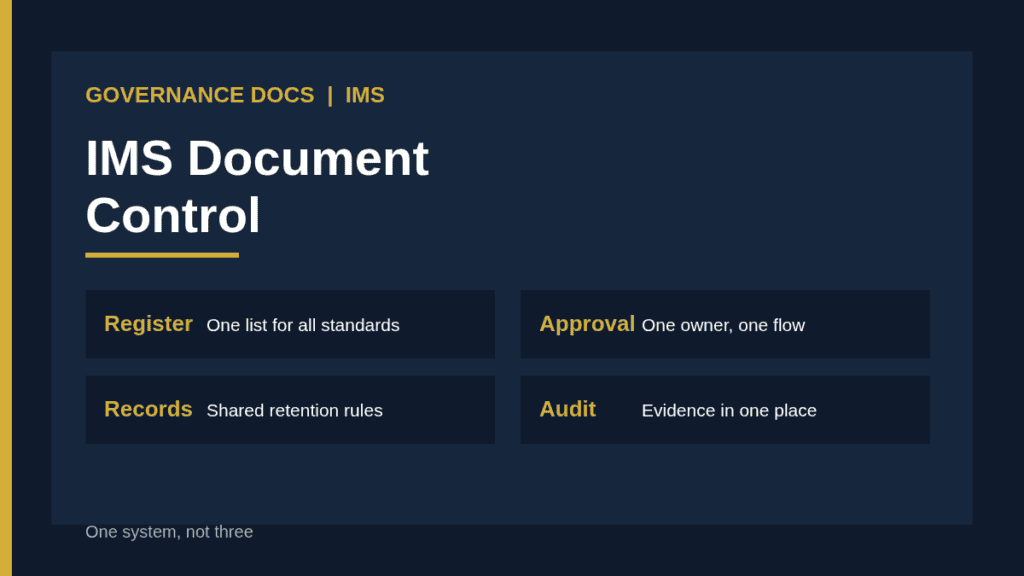
IMS document control is the discipline of managing every policy, procedure, form and record of an integrated management system through one register, one approval flow and one set of retention rules, instead of running a separate document system for each standard. Done well, it removes the duplicate procedures that quietly multiply when quality, environment and safety systems are built by different people at different times.
This guide explains what the standards actually require, how to design a single control process, what to share and what to keep separate, and which document control findings appear again and again in audits.
Free gap assessment
Are you ready for the 2026 edition of ISO 9001?
Score yourself against the new edition, free, including the risk and opportunity split and the clause 10 renumbering that breaks converted checklists.
What the standards require for IMS document control
ISO management system standards that follow the harmonized structure, including ISO 9001, ISO 14001 and ISO 45001, all contain a clause on documented information. It asks for the same three things: that documents are identified and described, that they are reviewed and approved before use, and that they are controlled so the right version is available where it is needed and protected from loss or misuse. Because the wording is shared, one control process can satisfy all of them. That shared structure is the reason an Annex SL based integrated system is practical in the first place.
ISO confirms that ISO 9001:2026 retains the Harmonized Structure used across management system standards. If you are planning a transition, check the clause numbering and any refinements to documented information against your licensed copy of the new edition before you rewrite your procedure.
Requirement
What it means in practice
Shared or separate?
Identification and description
Title, number, date, author, version
Shared naming convention
Review and approval
Approved by someone competent before use
Shared flow, standard-specific approvers
Availability
Current version reachable at the point of use
Shared platform
Protection
Access, confidentiality, integrity, backup
Shared controls
Change control and retention
Version control, retention period, disposal
Shared rules, longer periods where a law demands
Why separate systems fail
Most organizations arrive at integration from the opposite direction. The quality team has a document control procedure, the environmental lead wrote another, and the safety manager keeps controlled copies in a third location. Each one works on its own. Together they produce three numbering schemes, three approval routes, and several procedures that describe the same activity in slightly different words.
The cost shows up in audits and in daily work. Staff are unsure which version applies. Internal auditors find that the emergency response procedure says one thing in the environmental folder and another in the safety folder. A change to a shared process has to be made in several places, and one of them is missed. IMS document control solves this by treating each activity as one document that serves every standard it touches.
Designing one IMS document control process
Start with the hierarchy, then the register, then the workflow. Working in that order keeps the design simple.
1. Set a clear document hierarchy
Most integrated systems use four levels: policy and manual at the top, then process descriptions, then procedures and work instructions, then forms and records. Every document belongs to exactly one level. Our guide to the integrated management system manual shows how the top level can map to each standard without repeating the content.
2. Build one register
The register is the single source of truth. Give each entry a unique number, title, level, owner, current version, approval date, next review date, the standards and clauses it supports, and its storage location. The column listing the standards it supports is what makes the register integrated: it lets an auditor for any standard filter to the documents that matter to them in seconds.
3. Define one approval workflow
Use one route for creating, reviewing, approving and publishing. Where a document affects a specific discipline, such as a hazard procedure, add that discipline’s owner as a required reviewer, but keep a single flow. Record who approved what, and when, because approval evidence is one of the first things an auditor samples.
4. Control the change
Every revision needs a reason, a version number, an approver and a visible history. Old versions must be withdrawn from the places where people work, and any retained copy must be clearly marked as superseded. Uncontrolled printouts are the most common source of use of obsolete documents, so decide whether printing is allowed and how printed copies are marked.
What to share and what to keep separate
Integration does not mean everything is merged. A sensible split keeps the shared, generic material in one place and leaves discipline-specific content where the expertise sits.
Share: document control itself, control of records, internal audit, management review, corrective action, competence and training, and communication. These are generic processes with the same shape in every standard. See how one team handled this in our guide to the combined internal audit.
Share with add-ons: risk and opportunity assessment, objectives, supplier control and change management. One process, with discipline-specific criteria or checklists attached.
Keep separate: environmental aspects registers, hazard and risk registers for health and safety, legal requirements registers, and product or service specific quality plans. They can be linked from the main register but they need their own content and owners.
Records: the part people forget
Documents state what should happen. Records prove it did. IMS document control must therefore cover records with the same care: what is kept, where, who can access it, how it is protected, and for how long. Set default retention periods once for the whole system and list the exceptions. Legal or contractual requirements can demand longer retention for some records, such as training records tied to safety-critical roles or monitoring records tied to environmental permits. Confirm the periods that apply in your jurisdiction with your legal adviser rather than copying figures from another organization.
Common IMS document control audit findings
The same weaknesses recur, so check your own system against them before an auditor does.
Obsolete documents in use. Old forms saved on local drives or pinned to a notice board.
Missing approval evidence. A document is live but nobody can show who approved it.
Overdue reviews. The register shows review dates that passed a year ago.
Duplicate procedures. The same activity is described in two documents that differ.
External documents not controlled. Standards, permits, customer specifications and legal texts are used but not identified or tracked.
Records without retention rules. Nobody can say how long a record must be kept or who may delete it.
Overdue reviews and duplicate procedures are usually found together, and both are symptoms of missing ownership. Assign a named owner to every document and have the register flag reviews that are coming due, so that the work is spread across the year instead of landing in the week before the audit. Our note on the integrated management review explains how to feed document control results into the meeting where leadership sees them.
A practical rollout sequence
Export every existing document from each system into one list.
Remove duplicates and decide which version is authoritative.
Assign owners and a level in the hierarchy.
Apply one numbering and naming convention.
Migrate to a single platform and lock down editing rights.
Withdraw the old locations and tell staff where documents now live.
Run an internal audit on the new process within a few months.
Most teams underestimate step two. Deciding which of two competing procedures wins takes real conversations, and it is the point where integration either happens or quietly stalls. If you are deciding how to sequence the wider project, our guide to IMS implementation covers it end to end.
Starting from a finished IMS document structure
If you would rather not draft every document yourself, the IMS Toolkit supplies a ready set of integrated management system templates, including the procedures and forms that IMS document control depends on. Adapt them to your own processes and keep the register, whichever tool you choose, in one place.
IMS document control FAQ
Do I need a separate document control procedure for each standard?
No. The documented information requirements are shared across the harmonized standards, so one procedure can cover all of them. Add a short table showing which clauses of each standard it addresses.
Is a document management platform mandatory?
No. The standards do not require specific software. A well-managed shared drive or a controlled register can meet the requirements, provided identification, approval, availability and version control are demonstrable.
How often should documents be reviewed?
The standards do not set a fixed interval. Many organizations use twelve to twenty-four months, with shorter cycles for high-risk procedures, and review earlier when a process, law or standard changes.
How should external documents be handled?
Identify the external documents your system relies on, such as standards, permits and customer specifications, record where they come from and who is responsible for keeping them current, and control distribution where necessary.
Who should own IMS document control?
Give the process to one named owner, often the management representative or a quality and compliance lead, and give every document its own owner. Process ownership keeps the register accurate, while document ownership keeps the content current.