
CART
No products in the cart.
ISO Compliance Insights & Best Practices
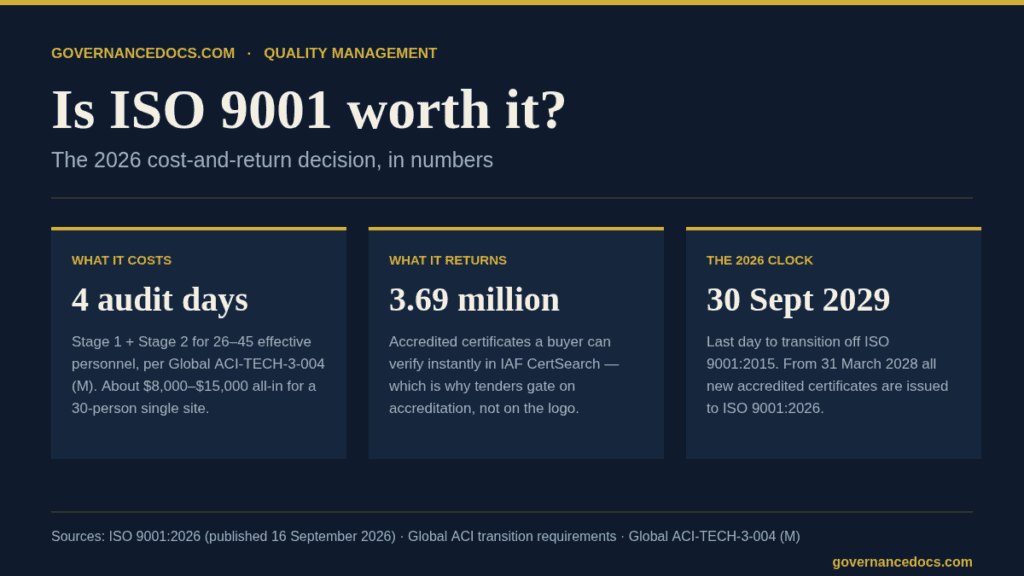
Is ISO 9001 worth it? For most companies selling into other businesses — manufacturing, engineering, construction, logistics, professional services — the answer is yes, but for one reason ahead of all the others: someone in your supply chain is already asking for it. A first cycle costs a typical small or mid-sized organization $5,000 to $30,000 all-in, and the return shows up as tenders you are allowed to bid for, customer audits that get shorter, and rework that stops repeating. If no customer, prime contractor or regulator has raised the question yet, that budget does more good spent directly on the processes.
Is ISO 9001 worth it for your company in particular? This guide puts both sides of the equation on the table with 2026 figures: what the audit costs under the accreditation rules certification bodies are actually required to follow, what the certificate gives back, who it clearly suits, and when the honest answer is “not yet”. It also covers the timing question that is new this year, because ISO 9001:2026 published on 16 September 2026 and the transition rules are already fixed.
Free gap assessment
Are you ready for the 2026 edition of ISO 9001?
Score yourself against the new edition, free, including the risk and opportunity split and the clause 10 renumbering that breaks converted checklists.
The decision rarely turns on the merits of the standard. It turns on whether the certificate removes a commercial obstacle you are already hitting. Use this as the first filter.
| Your situation | Is ISO 9001 worth it? | Why |
|---|---|---|
| A customer, prime contractor or public tender asks for it | Yes, almost always | Certification is a pass/fail gate in prequalification. Without it the rest of your bid is never read. |
| You supply automotive, aerospace or medical devices | Yes, as the foundation | IATF 16949, AS9100 and ISO 13485 are all built on the ISO 9001 clause structure, so this layer makes the sector audit cheaper. |
| You are losing weeks to repeat customer audits | Usually | One accredited certificate displaces several second-party audits of the same processes, each costing preparation time you never invoice. |
| The same quality problems keep recurring and nobody owns them | Usually | The value here is the management system, not the certificate. Budget for the system and treat the certificate as the by-product. |
| Owner-operated, local customers, no tenders, no complaints | Not yet | Spend on the measurable problem instead, and certify the year a contract needs it. |
| You mainly want the logo on the website | No | Accredited certification is audited every year. It is an operating commitment, not a badge. |
Anyone asking “is ISO 9001 worth it” needs the cost side in front of them first. The audit fee is the one line you can predict before you talk to anybody, because it is set by a mandatory rule rather than by a salesperson. Global ACI-TECH-3-004 (M) — the audit-time document that carried over IAF MD 5:2023 unchanged when the International Accreditation Forum handed its role to Global ACI, with an implementation date of 28 August 2026 — starts every quote from your effective number of personnel.
| Effective personnel | Initial audit, Stage 1 + Stage 2 | Each surveillance year | Recertification in year three |
|---|---|---|---|
| 1–5 | 1.5 days | about 0.5 day | about 1 day |
| 6–10 | 2 days | about 0.7 day | about 1.3 days |
| 16–25 | 3 days | about 1 day | about 2 days |
| 26–45 | 4 days | about 1.3 days | about 2.7 days |
| 46–65 | 5 days | about 1.7 days | about 3.3 days |
| 66–85 | 6 days | about 2 days | about 4 days |
| 86–125 | 7 days | about 2.3 days | about 4.7 days |
Initial-audit days come straight from Table QMS 1. The surveillance and recertification columns are calculated from the same document’s rules: annual surveillance is about one-third of the initial audit time, and recertification is about two-thirds of a fresh initial audit priced at the time of recertification. Two other provisions are worth knowing before you compare quotes. Any reduction for a simple, low-risk, repetitive operation is capped at 30% of the table figure, and the audit should not run below 80% of the calculated time. A quote that undercuts everyone else by half is not a better negotiator; it is usually a different scope, or a body that is not accredited.
Multiply days by a day rate — commonly $1,200 to $2,500 in the US, with travel billed on top — and add the application and certificate charges. Then add the costs the audit fee does not cover: documentation, whatever the gap analysis turns up, and internal time, which is almost always the largest real number and the one nobody invoices. Buying the standard itself from ISO costs CHF 196 for the 2026 edition. Our full ISO 9001 certification cost breakdown works through every line by company size.
Ask an auditor rather than a marketer “is ISO 9001 worth it” and the return comes back as four things, in descending order of how reliably they show up.
This is the return that pays for everything else. Large manufacturers, public buyers and tier-one contractors routinely write accredited ISO 9001 certification into prequalification as a threshold requirement. One released contract frequently exceeds the whole three-year program cost, which is why the honest version of the question is not “is ISO 9001 worth it in general” but “how much revenue is currently sitting behind this gate”.
An accredited certificate is verifiable by anyone. Certification bodies upload accredited certificates to IAF CertSearch, the database ISO itself now compiles the ISO Survey from; it carries 3.69 million certifications from 2,560 certification bodies under 81 accreditation bodies. A buyer who can confirm your certificate in ten seconds is a buyer who does not need to send two people to your site for a day. That is the practical argument for paying for accreditation rather than a cheap unaccredited certificate — an unaccredited one is not in that database, and procurement teams increasingly check.
ISO 9001 does not improve quality by itself. What it does is force the unglamorous mechanics to happen on a schedule instead of when someone remembers: process ownership, nonconformity and corrective action, internal audit, management review with owners and dates. Most organizations find the money here in one specific place — the recurring defect that everybody knew about and nobody was accountable for closing.
In a small company, quality usually lives in one experienced head. A documented quality management system moves it into procedures, records and a review cycle. When that person retires, the knowledge does not leave with them. Owners underrate this benefit at the start and name it first eighteen months later.
Is ISO 9001 worth it at 30 people? Run the arithmetic rather than the argument. Thirty effective personnel sits in the 26–45 band, so the initial audit is four days: roughly $4,800 to $10,000 in certification-body fees, plus perhaps $1,500 to $3,000 if you buy an external gap analysis, $99 to $500 for a documentation template set instead of authoring from scratch, and four to six months of one person at roughly a third to a half of their time. Call it $8,000 to $15,000 in cash for a straightforward single-site company, then about $1,600 to $3,300 a year for surveillance.
Against that, ask a narrower question than “will this grow the business”. Ask how much annual contract value is sitting in a pipeline stage where the absence of a certificate is the stated blocker. If the answer is one $60,000 contract, the program pays for itself inside the first cycle. If the answer is nothing, you have your answer too, and nothing about the standard changes it. That is the only version of “is ISO 9001 worth it” a board or a bank will accept as an answer.
Timing matters as much as money. Stage 2 tests a system that has been running, which means real internal audit results, a completed management review and nonconformities that have been through the process. No amount of spending compresses that operating period, so six to twelve months from a standing start is the realistic figure — our ISO 9001 certification timeline sets out the sequence week by week. Starting the quarter a tender closes is starting too late.
This is the genuinely new part of the decision, and most cost-benefit articles written before September have not caught up with it. ISO 9001:2026, the sixth edition, published on 16 September 2026, and ISO 9001:2015 together with its 2024 climate amendment is now withdrawn. Global ACI has already published the binding transition requirements.
| Date | What happens |
|---|---|
| 16 September 2026 | ISO 9001:2026 published. The three-year transition clock starts. |
| 31 March 2027 | Accreditation bodies must be ready to assess against the new edition by this date at the latest. |
| 30 June 2027 | Certification bodies must submit their transition declaration and supporting information. |
| 30 September 2027 | Accreditation body transition decisions completed. |
| 31 March 2028 | New and initial accredited certifications may only be issued to ISO 9001:2026. |
| 30 September 2029 | Last date for organizations already certified to ISO 9001:2015 to complete the transition. |
Read practically, that timeline says: do not wait. Certifying in the next eighteen months may well get you a 2015 certificate, because certification bodies cannot issue 2026 certificates until their own accreditation is in place — but that certificate is valid, it wins tenders now, and the transition is normally folded into a scheduled surveillance visit rather than charged as a separate audit.
So the honest answer to “is ISO 9001 worth it in 2026, or should we wait” is that the arithmetic favours starting now. Waiting until 2028 for a “clean” 2026 certificate means two more years without the thing you were buying. The only sensible adjustment is to build your documentation against the 2026 text from the start so the transition is a review rather than a rewrite. Our guide to the ISO 9001:2026 changes covers what actually moved: risk and opportunity split into separate clauses, seven considerations for planned change, quality culture and ethical behaviour written into leadership, and climate change in the body of clause 4.1.
Three cases where the answer to “is ISO 9001 worth it” is no, stated plainly. First, when nobody is asking and you have a real quality problem: implement the management system, skip the audit, and certify when a customer makes it worth the fee. Second, when the scope you would certify is not the scope your customers care about — certifying a head office while the manufacturing site sits outside the boundary buys a certificate that fails the first serious procurement question.
Third, when the plan is to buy an unaccredited certificate cheaply. It will not appear in IAF CertSearch, most prequalification processes check the accreditation mark, and discovering that during a bid is worse than having no certificate at all.
Once the answer to “is ISO 9001 worth it” is yes, five decisions change the size of the return more than anything else.
The documentation phase is the part you can genuinely shorten. Our ISO 9001 Toolkit ships 84 editable Word and Excel templates written to the 2026 edition — policies, procedures, registers, internal audit and management review packs, mapped to the clause each one satisfies — for $99. It will not operate your processes, but it removes the six to ten weeks most teams spend drafting from nothing, and it means the transition to the sixth edition is already done.
How long is an ISO 9001 certificate valid?
Three years, with a surveillance audit in each of the intervening years and a recertification audit before it expires. Skipping a surveillance audit puts the certificate at risk, so budget the cycle rather than the first invoice.
Is ISO 9001 worth it if my customers only ask for a quality questionnaire?
Often not yet. Answer the questionnaire, and watch whether the questions are trending towards a certificate requirement. Sectors move as a block; when two customers ask in the same quarter, start.
Is ISO 9001 worth it for a service business with no production line?
Yes, on exactly the same test. The standard is written for products and services alike, and the clauses that bite hardest in a service business — competence, control of externally provided processes, customer communication and nonconformity — are the ones most service firms handle informally today.
Can a small company get certified without a consultant?
Yes, and many do. What you cannot skip is the operating period before Stage 2 and the internal audit and management review records it produces. A consultant buys speed and confidence, not a shortcut past the evidence.
Does ISO 9001 certification guarantee better quality?
No, and any body that implies it should be avoided. The certificate confirms that a quality management system meeting the standard’s requirements is in place and being audited. Whether outcomes improve depends on what you point the system at.
We already hold ISO 27001 — does that help?
The shared management-system clauses on context, leadership, internal audit and management review carry across, which cuts documentation work materially. The product and process requirements in clauses 8.1 to 8.7 do not. If you are weighing both, our breakdown of whether ISO 27001 is worth it applies the same arithmetic to the information security side.
Answer the commercial question first, in writing: which named customer or tender needs this, and by when. That date sets everything else. Then work backwards from the certificate decision through Stage 2, Stage 1, internal audit and the evidence period. Our complete guide to ISO 9001 and quality management is the place to begin if you have not read the standard’s structure yet.
In the end, “is ISO 9001 worth it” is a commercial question with a date attached, not a philosophical one. Answer it that way and the budget argument looks after itself.

September 24, 2026
September 23, 2026
September 22, 2026
September 22, 2026
September 21, 2026
