CART
The COBIT design factors are the eleven inputs COBIT 2019 uses to turn a generic framework of 40 governance and management objectives into a governance system for one specific enterprise, and they are the part of the framework that answers the objection every previous COBIT version attracted: that nobody can implement all of it. Nobody is meant to.
The Design Guide — one of the four core COBIT 2019 publications — works the eleven factors through a four-stage design workflow whose output is a prioritised set of objectives, each with a target capability level and, where a factor demands it, a focus-area variant. This guide lists the eleven COBIT design factors with the values each can take and the objectives each tends to raise or lower, walks the four design stages, gives a worked example for a mid-sized regulated company, and lists the ways a design workshop produces a governance system nobody can afford.
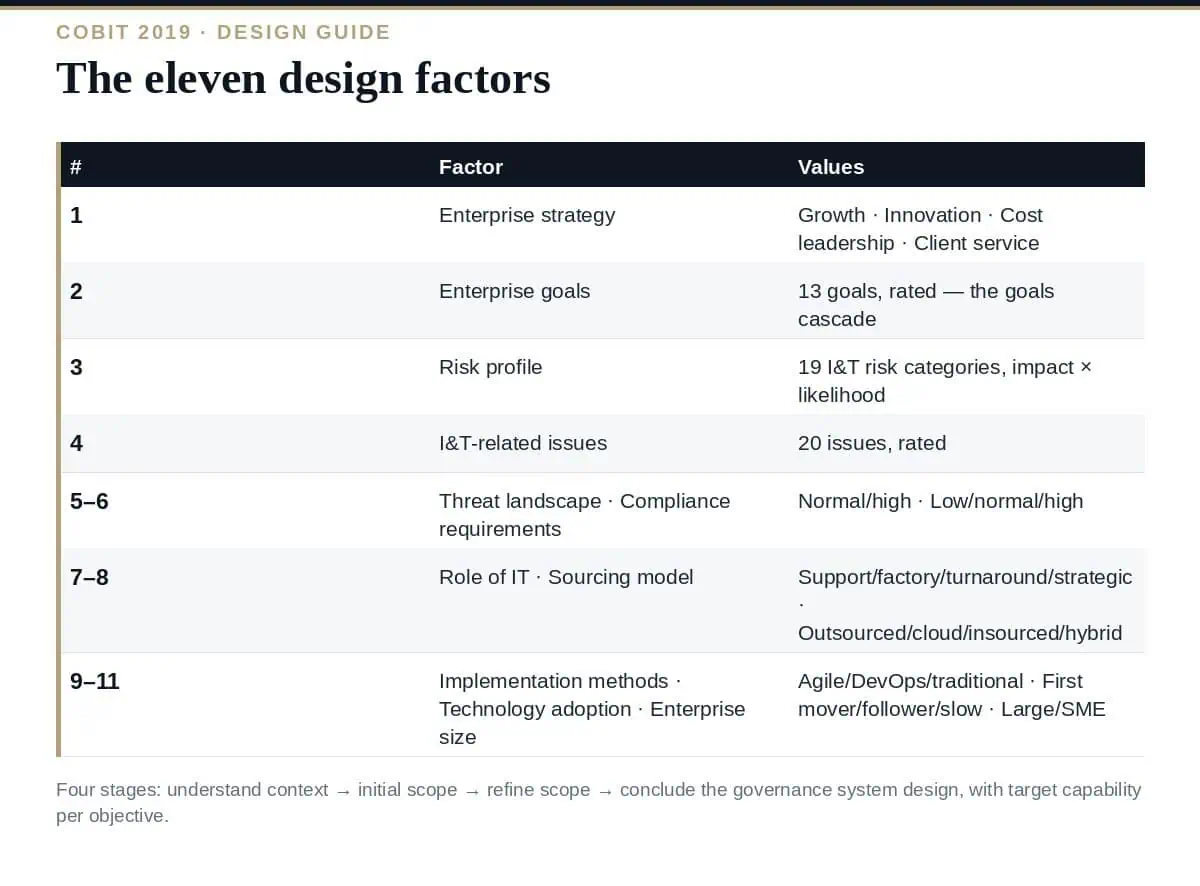
| # | Design factor | Values it can take | What it tends to prioritise |
|---|---|---|---|
| 1 | Enterprise strategy | Growth/acquisition; innovation/differentiation; cost leadership; client service/stability — one primary, one secondary | Innovation raises APO04 (innovation) and BAI objectives; cost leadership raises APO06 (budget and costs) and DSS efficiency; client service raises APO09, DSS02 |
| 2 | Enterprise goals | The 13 COBIT enterprise goals, rated by importance, cascading to 13 alignment goals | Each enterprise goal maps to alignment goals, which map to objectives — the goals cascade is the mechanism |
| 3 | Risk profile | 19 I&T risk categories rated for impact and likelihood — from IT investment decision-making through data and information management to industrial control | High-rated categories raise the objectives that mitigate them: security risk raises APO13 and DSS05; project risk raises BAI01 and BAI11 |
| 4 | I&T-related issues | 20 listed issues rated for seriousness — frustration between IT and business, failed initiatives, hidden or rogue IT spend, insufficient resources, regulatory non-compliance | Each issue points at the objectives whose absence causes it |
| 5 | Threat landscape | Normal or high | High raises APO12, APO13, DSS05, DSS04 and their target capability |
| 6 | Compliance requirements | Low, normal or high | High raises MEA03 (compliance with external requirements), MEA04 (assurance) and APO12 |
| 7 | Role of IT | Support, factory, turnaround or strategic (the Nolan–McFarlan grid) | Strategic and turnaround raise EDM and APO strategy objectives; factory raises DSS reliability; support lowers targets across the board |
| 8 | Sourcing model for IT | Outsourcing, cloud, insourced, or hybrid | Outsourcing and cloud raise APO10 (vendors) and the supplier aspects of security and continuity |
| 9 | IT implementation methods | Agile, DevOps, traditional, or hybrid | Agile and DevOps invoke the focus-area variants of BAI objectives; the DevOps focus area publication exists for this |
| 10 | Technology adoption strategy | First mover, follower, or slow adopter | First mover raises APO04 and risk; slow adopter raises stability objectives |
| 11 | Enterprise size | Large (over 250 FTE) or small and medium (50–250 FTE) | Small and medium invokes the SME focus area and reduces the expected formality of components |
The factors are not weighted equally by the framework; they are weighted by the enterprise. The Design Guide’s toolkit assigns each factor’s values to objectives through published mapping tables, and the sum across factors produces a relative importance score per objective — which the design team then reviews rather than accepts. Our guide to COBIT 2019 covers the objectives the factors act on; the COBIT domains lists all 40.
| Stage | Design factors used | Output |
|---|---|---|
| 1. Understand the enterprise context and strategy | 1 Enterprise strategy; 2 Enterprise goals; 3 Risk profile; 4 I&T-related issues | An initial view of which objectives the strategy, goals, risks and pain points point to |
| 2. Determine the initial scope of the governance system | Stages 1’s factors applied through the goals cascade and the risk and issues mappings | An initial prioritised list of objectives with relative importance scores |
| 3. Refine the scope | 5 Threat landscape; 6 Compliance requirements; 7 Role of IT; 8 Sourcing model; 9 Implementation methods; 10 Technology adoption; 11 Enterprise size | The list adjusted; focus-area variants selected (DevOps, SME, security, risk); target capability levels proposed |
| 4. Conclude the governance system design | All, resolved by judgement | The tailored governance system: the objectives in scope, target capability per objective, the focus areas, and the specific component variants — documented with the reasoning |
Stage 4 is where the design becomes a document: the argument for why this enterprise prioritises these objectives at these levels. That argument is what the board approves, what the implementation programme scopes from, and what an auditor or regulator reads to understand why, say, BAI03 is at level 2 and APO12 at level 4. Our guide to COBIT capability levels covers the scale the targets are set on.
A 400-person financial services firm, regulated, with a client-service strategy, a hybrid sourcing model heavy on SaaS, agile delivery, a follower adoption stance and a high compliance requirement.
| Factor | Value | Effect on the design |
|---|---|---|
| Enterprise strategy | Client service/stability (primary), growth (secondary) | APO09 service agreements, DSS02, DSS04 rise; APO04 innovation modest |
| Enterprise goals | Customer-oriented service culture; compliance with external laws; business service continuity rated highest | Cascade raises DSS01–DSS05, MEA03, APO12 |
| Risk profile | Data and information management, third-party/supplier, regulatory compliance rated high | APO10, APO12, APO13, DSS05, DSS06 rise |
| I&T-related issues | Hidden SaaS spend; audit findings on access control | APO06 budget and cost, DSS05, DSS06 rise |
| Threat landscape | High | APO13, DSS05 target capability raised to 4 |
| Compliance requirements | High | MEA03, MEA04 in scope at level 3–4 |
| Role of IT | Factory | Reliability objectives prioritised; EDM at level 3 |
| Sourcing model | Hybrid, cloud-heavy | APO10 managed vendors at level 4; cloud aspects of DSS05 and DSS04 emphasised |
| Implementation methods | Agile | BAI02, BAI03, BAI06 use the agile focus-area variants |
| Technology adoption | Follower | APO04 at level 2 |
| Enterprise size | Large | Full component set expected |
| Result | 14 objectives in scope at level 3 or 4; the remaining 26 at level 1–2 or out of scope | A governance system a 400-person firm can run |
What are the COBIT design factors?
Eleven inputs in COBIT 2019’s Design Guide — enterprise strategy, enterprise goals, risk profile, I&T-related issues, threat landscape, compliance requirements, role of IT, sourcing model, IT implementation methods, technology adoption strategy and enterprise size — that determine which of the 40 objectives an enterprise prioritises, at what capability, and with which focus-area variants.
Do you have to use all eleven?
The Design Guide’s workflow uses all of them across its four stages, but their influence differs: the first four set the initial scope through the goals cascade and the risk and issues mappings; the remaining seven refine it. Skipping a factor leaves an objective’s priority unjustified.
What is the goals cascade?
The mechanism behind design factor 2: enterprise goals map to alignment goals, which map to governance and management objectives, so a rated enterprise goal raises the priority of the objectives that support it.
What does the design produce?
A tailored governance system: the objectives in scope, a target capability level for each, the focus areas applied, and the documented reasoning. It is the input to the seven-phase implementation lifecycle.
Do the design factors change in COBIT 7?
ISACA has announced COBIT 7 certificates replacing the 2019 certificates from 27 October 2026, with the 2019 certificates sunset on 26 April 2027, but has not yet published the framework’s content. Until it does, the eleven factors and the four-stage workflow are the current design method.
Use the COBIT design factors as the framework intends: take the strategy, goals, risks and issues from the enterprise rather than the workshop, let the mappings produce the initial scope, refine it with the seven contextual factors and the focus areas, set capability targets that vary, and write the reasoning down. A governance system with fourteen justified objectives will be run; one with forty asserted ones will be shelved.
The design factor workbook with the eleven factors and their mapping to objectives, the governance system design document template, the goals cascade worksheet and the target capability register are in the COBIT 2019 IT Governance Toolkit, or start with the free templates.

September 22, 2026
September 21, 2026
September 21, 2026
September 20, 2026
September 20, 2026

