CART
A facility management SLA is where an ISO 41001 management system meets the money. The standard asks you to agree, measure and review the service you provide or receive; the SLA is the document that says what “agreed” means — and most of them measure the provider’s activity rather than the organization’s outcome.
This guide covers the five elements a facility management SLA needs, how to write response and rectification targets that survive contact with reality, and where these agreements break.
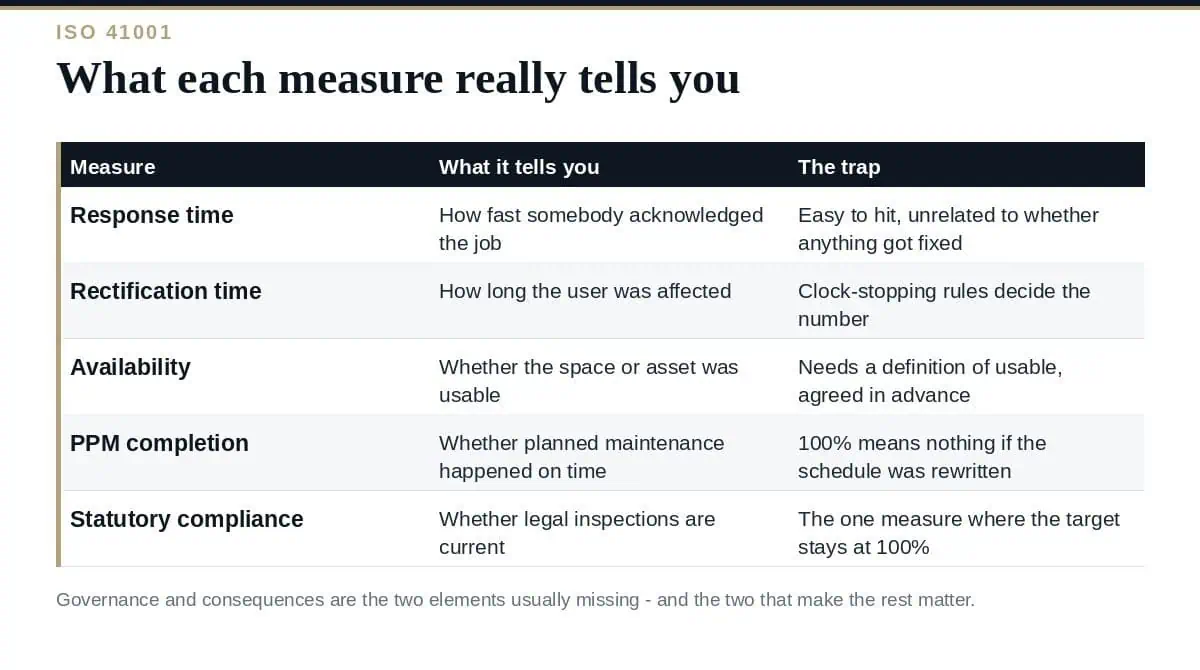
Most facility management SLAs are written by procurement from a template and cover the first three elements well. Governance and consequences require the client organization to commit its own time and to accept that it will sometimes have to act, which is why they end up as a paragraph. The result is an agreement that can describe failure precisely and do nothing about it.
| Measure | What it actually tells you | The trap |
|---|---|---|
| Response time | How fast somebody acknowledged the job | Easy to hit and unrelated to whether anything got fixed |
| Rectification time | How long the user was affected | Clock-stopping rules decide the number — define them |
| Availability | Whether the space or asset was usable | Needs a definition of “usable” agreed in advance |
| PPM completion | Whether planned maintenance happened on time | 100% is meaningless if the schedule was rewritten mid-period |
| Statutory compliance | Whether legal inspections and certificates are current | The only measure where the target is 100% and stays there |
Two design rules save most of the argument. Define the clock precisely — when it starts, what pauses it, when it stops — because “awaiting parts” and “awaiting access” quietly consume half the elapsed time in any real estate. And prioritise by consequence rather than by asset: a failed light in a stairwell and a failed light in a store room are the same asset and not the same job.
An SLA measures the service; KPIs measure whether the facility is doing its job for the organization. Both are needed, and confusing them produces a provider hitting every target while occupants complain. Our guide to facility management KPIs covers the four groups worth keeping, and ISO 41001 covers where the demand organization’s own obligations sit.
Everything is priority one. When users set the priority, most jobs arrive urgent, and the categories stop discriminating. Priority should be set by rules against consequence, with a small override route.
The provider reports on itself. Self-reported performance from the provider’s own system is normal and needs a verification right — spot audits, raw data access, or independent sampling.
Service credits capped so low they are irrelevant. A credit worth less than the cost of doing the work properly is a price list for failure.
No change mechanism. Estates change constantly — sites open, hours shift, equipment is replaced. An SLA that cannot be varied except by contract amendment is out of date within a year.
Statutory work inside the general regime. Legal compliance tasks should sit outside service credits entirely, with their own escalation. They are not a performance measure; they are a duty.
What should a facility management SLA contain?
Scope and exclusions, measurable service levels with definitions, measurement and reporting arrangements, governance, and consequences for failure. The last two are the ones most often thin.
Does ISO 41001 require an SLA?
It does not mandate the document, but it requires agreed requirements, measurement and review of the facility management function — which in a contracted arrangement is what an SLA carries.
How many service levels should we have?
Few enough to be managed in a monthly meeting. Twenty measures produce a report nobody reads; six to ten that map to real consequences produce a conversation.
Should service credits be the main lever?
No. They matter, but the useful levers are governance, remediation plans and — for persistent failure — termination. Credits alone let a provider price in underperformance.
How is an SLA different from a KPI set?
The SLA is a contractual commitment about the service delivered. KPIs measure whether the facility supports the organization’s objectives. A provider can meet every SLA target while the KPIs deteriorate.
Write the facility management SLA around consequence: define priority by impact, define the clock precisely including what pauses it, and keep statutory compliance outside the credit regime with its own escalation. Then build the two elements everyone skips — a governance forum with authority to change things, and consequences proportionate to the cost of failure. Measure the service in the SLA and the outcome in your KPIs, and review both together, because only one of them tells you whether the building is working.
Agreement templates, service level schedules and performance reports are in the ISO 41001 Facility Management Toolkit, or start with the free ISO templates.

October 25, 2026
October 24, 2026
October 24, 2026
October 23, 2026
October 23, 2026

