Hiring an ISO 27001 consultant is the largest discretionary decision in most certification budgets, and it is the one buyers understand least. The standard itself never mentions consultants. Certification bodies do not require you to use one. Yet a large share of first-time implementers hand the whole programme to an outside adviser without ever pricing the alternatives, and a smaller but painful share hire one and still fail Stage 2 because nobody inside the business could answer an auditor’s questions.
This guide sets out what an ISO 27001 consultant actually does, what one costs in 2026, the impartiality rule that stops your adviser from also certifying you, and a straight comparison of the three routes to a certificate: adviser-led, toolkit-led, and platform-led.
Free gap assessment
Where do you actually stand against ISO 27001?
Score every management system clause and all 93 Annex A controls, free, and get a prioritised gap list back.
ISO/IEC 27001:2022 is a 19-page requirements standard — clauses 4 to 10 plus Annex A. That Annex contains 93 controls arranged in four themes: 37 organizational, 8 people, 14 physical and 34 technological. The clauses tell you to build a management system; Annex A gives you a reference set of controls to consider against your risks. Nothing in either part is technically difficult. What is difficult is judgement: deciding scope, deciding which risks matter, and deciding which of the 93 controls you can justify excluding.
That judgement is what a good adviser sells. A typical engagement covers:
Scope definition (clause 4.3) — drawing the boundary tightly enough to be affordable and widely enough to satisfy the customer who asked for the certificate in the first place.
Risk assessment and treatment (clause 6.1) — a repeatable method, a populated risk register, and a treatment plan that owners have actually agreed to.
Statement of Applicability — mandatory under clause 6.1.3 d), and the document auditors open first. Every one of the 93 Annex A controls needs an include or exclude decision with a written justification.
Policy and procedure drafting — the documented information the standard requires, tailored rather than generic.
Internal audit and management review (clauses 9.2 and 9.3) — both must have run at least once, with records, before a certification body will pass Stage 2.
Stage 1 and Stage 2 support — rehearsing the questions, sitting in the room, and closing nonconformities afterwards.
Note what is not on that list: buying tools, writing code, or running your security operations. An ISO 27001 consultant builds and evidences a management system. If your gaps are technical — no MFA, no logging, no patch process — an adviser will document the gap and hand it back to your engineers to fix.
ISO 27001 consultant costs in 2026
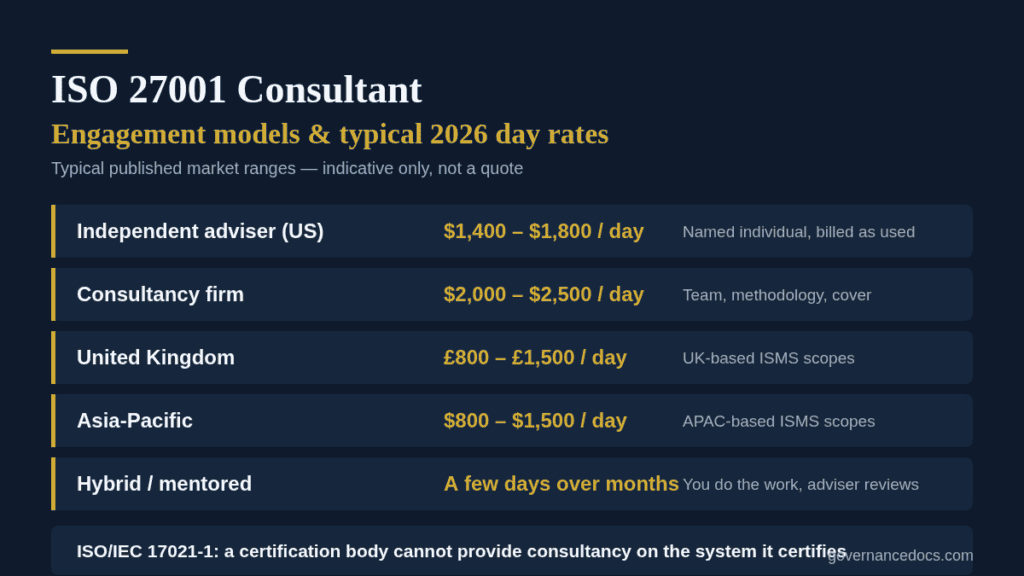
Advisory work is priced three ways, and the model matters more than the headline rate. Treat every figure below as a typical published market range for 2026, not a quote: rates vary sharply by country, sector and scope, and anything involving regulated data or a multi-site scope sits at the top of the range.
Engagement model
Typical 2026 range
What you get
Best suited to
Day rate, independent adviser (US)
$1,400–$1,800 per day
Named individual, billed as used
Filling one or two specific gaps
Day rate, consultancy firm
$2,000–$2,500 per day
Team, methodology, cover for absence
Complex or multi-site scopes
Day rate, United Kingdom
£800–£1,500 per day
As above, UK market
UK-based ISMS scopes
Day rate, Asia-Pacific
$800–$1,500 per day
As above, APAC market
APAC-based ISMS scopes
Fixed-price implementation
Low five figures upward
Defined deliverables to certification readiness
Firms that need budget certainty
Hybrid or mentored
A few days spread over months
Review and challenge, you do the work
Teams with a capable internal owner
Two cost drivers do more damage than the rate itself. The first is scope: every extra location, product line and legal entity adds risk assessment work and audit days. The second is elapsed time. A small organisation with a narrow scope and a decent security baseline can reach certification in roughly three to nine months; drag that to eighteen and a retained adviser’s fees compound while nothing else improves. Our ISO 27001 timeline guide breaks the phases down, and the full certification cost breakdown covers the audit and surveillance fees that sit alongside advisory spend.
Free ISO 27001 risk assessment
Which of your risks sit above your appetite line?
Set your own risk criteria, pick from 61 information security risk scenarios, rate likelihood and impact, and decide how to treat each one. You get a heat map, a process score and the findings an auditor would raise, free.
Certification body fees are separate, and you cannot avoid them: Stage 1, Stage 2, two surveillance audits, then recertification in year three. The standard itself is CHF 155 from ISO, and the climate-change amendment, ISO/IEC 27001:2022/Amd 1:2024, is published at no charge. Internal staff time — usually the biggest hidden number — does not disappear either. Interviews, evidence gathering and the management review all need your people.
The rule buyers miss: your ISO 27001 consultant cannot certify you
This surprises buyers every year. Under ISO/IEC 17021-1:2015, the standard that accredited certification bodies are themselves assessed against, a certification body shall not provide management system consultancy (clause 5.2.5). Where a body related to the certification body has provided that consultancy, the recognised mitigation described in clause 5.2.7 is that the certification body shall not certify the management system for a minimum of two years after the consultancy ends.
In practice: if a firm offers to both build your ISMS and issue your certificate, something is wrong. Either the certificate is not accredited, or the arrangement will not survive scrutiny. Keep the two relationships separate and choose your certification body independently of whoever helped you prepare.
ISO 27001 consultant vs toolkit vs compliance platform
There are three realistic routes, and most successful programmes use more than one.
Factor
Consultant-led
Toolkit-led
Platform-led
Typical outlay
Five figures
Under a few hundred dollars
Recurring annual subscription
Documentation
Written for you
Templates you tailor
Generated from questionnaires
Evidence collection
Manual, adviser-directed
Manual, you own it
Automated integrations
Judgement on scope and risk
Included
Yours to make
Limited, guided by the tool
Internal knowledge left behind
Depends on the engagement
High, because you did the work
Moderate
Main failure mode
Nobody internally can defend the ISMS
Templates left generic and unedited
Controls automated but not risk-justified
Ongoing cost after year one
Retainer or new engagement
Near zero
Subscription continues
The failure mode row is the one to read twice. Auditors do not fail organisations for imperfect documents; they raise nonconformities when the system on paper does not match the organisation in the room. A beautifully written policy nobody has read is worse than a plain one that people follow, because it proves the ISMS was outsourced rather than adopted.
When an ISO 27001 consultant is worth the money
Hire one when at least two of these are true:
A deal is on the clock. A named customer contract depends on the certificate within a fixed window and you have no slack.
Nobody owns it. There is no internal person with the authority and the hours to run the programme. An adviser cannot fix this, but they can compensate for a while.
The scope is genuinely complex. Multiple entities, regulated data, a manufacturing environment, or a scope that must satisfy several frameworks at once.
You have failed before. A previous audit produced major nonconformities and you do not know why.
The scope decision is high-stakes. Getting clause 4.3 wrong is expensive to undo, and it is the single judgement where outside experience pays for itself fastest.
Skip the full ISO 27001 consultant engagement when your scope is one product and one office, you have an internal owner with real hours, and your security baseline is reasonable. In that situation the sensible sequence is to run a gap analysis first, then decide. A structured gap analysis costs little and turns an open-ended question into a defined list of work, at which point you can buy exactly the days you need instead of an open-ended retainer.
How to choose an ISO 27001 consultant
Ask these seven questions before signing anything. The answers separate practitioners from resellers.
How many ISMS implementations have you taken through Stage 2 in the last two years, at my size and in my sector? Ask for the count, not the logos.
Who does the work? A named individual, or a junior behind a senior’s CV.
What exactly is your deliverable, and what is mine to do? A written split of responsibilities prevents the classic argument at month five.
Will you write our Statement of Applicability, or facilitate us writing it? Facilitation is usually the better answer, because you have to defend it.
Do you have any relationship with a certification body? Disclose it, then apply the two-year rule above.
What happens if we get a major nonconformity? Is remediation included, and for how long.
What will we still be able to do after you leave? Surveillance audits arrive every year. If the ISMS only works while the adviser is billing, you have bought a certificate rather than a management system.
Qualifications held by the individual, such as lead implementer or lead auditor, are worth something but prove less than a track record. Note also that no ISO body certifies consultancies themselves: a firm claiming to be an “ISO-certified consultant” is describing a personal training qualification, not an accredited status.
A middle path most buyers overlook
The choice is rarely all-or-nothing. The cheapest defensible route for a small or mid-sized organisation is usually to buy a documentation set, tailor it internally, and buy a handful of advisory days at the two moments where judgement matters most: scope and risk assessment at the start, and a mock audit before Stage 2. That converts a five-figure engagement into a few thousand dollars, and leaves the knowledge inside the business.
Our ISO 27001 Toolkit covers the documentation half of that plan: 162 ISMS templates including the Statement of Applicability, risk register, treatment plan and the full policy set, for $99. Pair it with your own subject-matter knowledge, and spend your advisory budget only where it earns its keep.
Frequently asked questions
Do I need an ISO 27001 consultant to get certified?
No. Neither ISO/IEC 27001 nor any accreditation rule requires external help. Certification bodies assess your management system, not who wrote it. Organisations with a narrow scope, an internal owner and a workable security baseline certify without one every year.
Can an ISO 27001 consultant also perform our internal audit?
Yes, and this is a common and legitimate use of outside help. Clause 9.2 requires internal audits to be objective and impartial, so an auditor must not audit their own work. If the same adviser wrote your policies, have someone else audit them.
How many days should a first implementation take?
For a small, single-site scope, mentored engagements commonly run to a handful of days spread across the project, while full implementations run substantially longer. Ask any prospective ISO 27001 consultant to quote days by phase — scope, risk, documentation, internal audit, audit support — rather than a single number.
Is a compliance platform a substitute for an ISO 27001 consultant?
Partly. Platforms are strong at evidence collection and continuous monitoring, and weak at the judgement calls: scope boundaries, risk criteria, and control exclusions. They reduce the hours an adviser needs; they do not remove the decisions.
What is the transition status of ISO 27001:2013?
Closed. The transition period from ISO/IEC 27001:2013 to the 2022 edition ended on 31 October 2025, so all current accredited certificates are to ISO/IEC 27001:2022. Any adviser still working from the 2013 Annex A structure is out of date.
The decision, in one line
Buy judgement, not paperwork. Documentation is a commodity in 2026 and the market prices it accordingly. What an experienced ISO 27001 consultant sells that you cannot download is the ability to look at your business and say which risks matter, where the boundary goes, and what an auditor will not accept. Price that separately, buy it deliberately, and keep the rest in-house.