The ISO 42001 certification cost question lands on a founder’s desk the moment an enterprise buyer adds an AI governance clause to a security questionnaire. ISO/IEC 42001:2023 was only published on 18 December 2023, and the audit market around it is young enough that two accredited bodies can quote the same scope at prices that differ by a factor of three. That spread is not a scam — it reflects how differently certification bodies read your AI footprint.
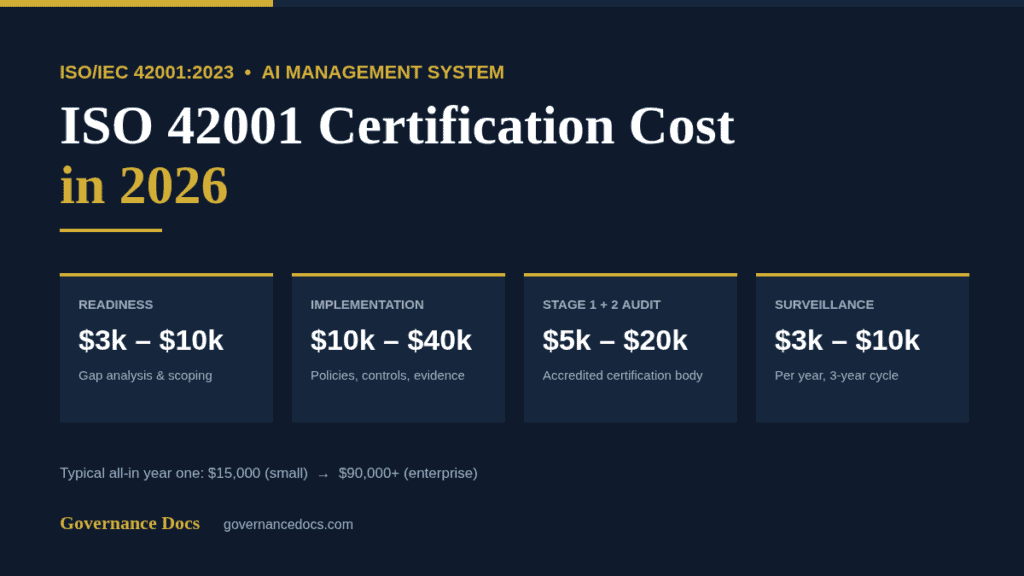
This breakdown sets out what you pay, to whom, and in which year: readiness work, implementation, the Stage 1 and Stage 2 audit, and the three-year maintenance cycle that follows. Every figure below is a typical market range for 2026, not a quote. Your own ISO 42001 certification cost depends on scope, and scope is the one variable you control.
Free gap assessment
How much of ISO 42001 could you evidence today?
Score every clause and Annex A control of the AI management standard, free, and see where the programme really sits.
Certification means an accredited certification body audits your AI management system (AIMS) against ISO/IEC 42001 and, if it passes, issues a certificate valid for three years. Annex A of the standard offers 38 controls grouped under nine control objectives, and you justify which ones apply in a Statement of Applicability. You are not obliged to implement all 38 — you are obliged to defend your selection against your AI risk and impact assessments.
Three consequences for your ISO 42001 certification cost follow from that structure. First, the certificate is issued to a management system, not to a model, so a company running twelve AI systems inside one governed process may pay less than a company running two systems with no process at all. Second, because certification runs on a three-year cycle, the year-one figure is never the whole bill. Third, the auditor charges for days, and days are driven by how many people touch your AI lifecycle.
ISO 42001 certification cost: the four line items
Almost every quote you receive decomposes into the same four buckets. Only one of them goes to the certification body.
Cost line
Typical 2026 range
Who you pay
What it covers
Readiness / gap analysis
$3,000 – $10,000
Consultant or internal team
AIMS scoping, documentation review, first AI risk and impact assessments
Implementation
$10,000 – $40,000+
Internal effort, tooling, consultants
Policies, Annex A controls, training, evidence, internal audit
Stage 1 + Stage 2 audit
$5,000 – $20,000
Accredited certification body
Documentation review, then the on-site or remote AIMS assessment
Typical ranges reported across the 2026 market. Treat them as planning figures, not quotes.
Read that table twice before you budget. The audit fee — the number most people mean when they ask about ISO 42001 certification cost — is usually only 25% to 40% of total year-one spend. The work that gets you audit-ready costs more than the audit itself, and it is the part you can compress.
ISO 42001 certification cost by size of AI operation
Certification bodies size the engagement by audit days, then apply a day rate. The realistic bands look like this:
Profile
Indicative audit days (Stage 1 + 2)
Audit fee
All-in year one
Small: up to ~10 people in the AI lifecycle, one or two AI systems
3.5 – 5
$5,000 – $10,000
$15,000 – $40,000
Mid-size: up to ~25 people, several systems, some regulated use
4.5 – 7
$8,000 – $18,000
$40,000 – $90,000
Large: ~85 people or more, multi-site, high-risk applications
7.5 – 11+
$20,000 – $40,000+
$90,000 – $200,000+
Audit-day bands reflect practitioner readings of ISO/IEC 42006:2025 Table A.1; fees vary by certification body and region.
Surveillance audits in years two and three typically run at roughly 30% to 40% of the initial audit fee, and recertification in year four repeats something close to the original Stage 2 effort. Budget the three-year total, not the first invoice.
Why ISO/IEC 42006 changed the arithmetic
ISO/IEC 42006:2025, published on 7 July 2025, sets the rules certification bodies must follow when they audit an AIMS — auditor competence, and how audit time is calculated. The important commercial detail is that audit time keys off the number of people involved in AI activities, not total headcount.
That distinction is worth real money. A 600-person manufacturer with fifteen people building and overseeing one AI model is sized like a small organization. A 40-person AI startup where nearly everyone touches the model pipeline is not. If a certification body quotes you off total employee count, ask them to re-scope against the people genuinely inside the AI lifecycle — that single conversation is the cheapest reduction in ISO 42001 certification cost available to you.
Adjustments still apply upward for the number of distinct AI systems, the regulatory regimes in play, and high-risk applications. Auditors also need specialist AI competence, and that competence is scarce, which keeps day rates firm.
Where ISO 42001 certification cost quietly overruns
Loose scope. A vague AIMS boundary is the most common source of late-stage rework. Every AI system you sweep in adds evidence, and every sweep-in discovered at Stage 2 costs more than it would have at scoping.
Your role in the AI supply chain. A provider that develops and sells AI systems carries heavier obligations across the lifecycle than a deployer using third-party tools, and the Annex A controls you can justify excluding shrink accordingly.
Starting documentation from zero. Drafting an AI policy set, impact assessment procedure, training data registry and human oversight log from a blank page is where consultant hours accumulate fastest.
No existing management system. If you have no ISMS, you are also building document control, internal audit and management review from scratch — plumbing ISO 42001 assumes you already own.
Chasing the certificate before the evidence exists. Booking Stage 2 too early risks nonconformities, a corrective action cycle and a return visit you pay for.
How it compares with ISO 27001
Most companies asking about ISO 42001 already hold or want ISO 27001, so the comparison matters. The two standards share the Annex SL management-system spine: context, leadership, planning, support, operation, performance evaluation, improvement. If your ISMS already works, roughly a third of the 42001 requirements are satisfied by machinery you own — you are adding AI-specific risk, impact assessment, data governance and transparency obligations on top.
Companies certifying to both in one combined audit commonly save on audit days versus two separate engagements. If you are budgeting the pair, read our ISO 27001 certification cost breakdown alongside this one, and look at the sequencing advice in the ISO 42001 implementation guide. As a planning heuristic, an ISO 42001 certification cost for a company with a mature ISMS tends to land 20% to 30% below the same company starting cold.
Does the EU AI Act force you to certify?
No. ISO 42001 certification is voluntary, and it does not by itself grant conformity with the EU AI Act — presumption of conformity flows from harmonised European standards, which are still being finalized. Certification is evidence of a governed process, not a regulatory passport.
The timing has also moved. The EU’s Digital Omnibus on AI, agreed in 2026, deferred the high-risk obligations for standalone Annex III systems to 2 December 2027 and for AI embedded in regulated products under Annex I to 2 August 2028. The Article 50 transparency duties were not deferred and applied from 2 August 2026. So the deadline pressure eased, but the direction did not change — and a 42001 AIMS gives you the risk assessments, impact assessments and oversight records those obligations will ask for. For the mapping detail, see ISO 42001 vs the EU AI Act.
Free AI risk assessment
Which of your AI systems could harm people, or you?
List your AI systems, models and data, pick from 38 AI risk scenarios, rate them for the people affected and for you, and plan treatment with ISO 42001 Annex A controls. You get a heat map, a process score and the findings an auditor would raise, free.
Scope to the AI that matters. Certify the systems your buyers ask about. You can widen the scope at the next recertification.
Get three quotes from accredited bodies. Ask each for the audit-day calculation and the basis of the headcount, then compare like for like. Check accreditation on the IAF CertSearch, ANAB or UKAS registers before signing.
Start from templates, not a blank page. Documentation is the largest controllable line item.
Run a real internal audit and management review before Stage 1. Finding your own nonconformities is free; letting the auditor find them is not.
Combine audits. If ISO 27001 is due, ask about an integrated assessment.
On point three: our ISO 42001 Toolkit gives you 67 editable templates organized by clause — policies, procedures, registers, the Statement of Applicability, an AI system inventory and an EU AI Act crosswalk — for $199. Against a documentation line that routinely runs five figures in consultant time, it is the cheapest lever in the list. If you want to see where you stand first, start with the ISO 42001 certification guide.
ISO 42001 certification cost FAQ
How much does ISO 42001 certification cost for a startup?
A startup with one or two AI systems and fewer than about ten people in the AI lifecycle should plan $15,000 to $40,000 all-in for year one, of which roughly $5,000 to $10,000 is the certification body’s audit fee. Teams that already hold ISO 27001 and use template documentation land at the lower end.
How long does certification take?
Six to twelve months is typical from kickoff to certificate for a first-time AIMS, and three to six months for organizations with an existing management system and disciplined evidence collection. The audit itself is a few days; the readiness work is the timeline, and it is where most of the ISO 42001 certification cost is incurred.
Is ISO 42001 certification mandatory?
No. It is a voluntary certification. It is increasingly requested in enterprise procurement and vendor due diligence, which is why most companies pursue it, but no law currently requires it.
What are the ongoing costs after certification?
Expect an annual surveillance audit at roughly 30% to 40% of the initial audit fee, plus internal effort for monitoring, internal audits, management review and policy upkeep — commonly $3,000 to $10,000 a year in total. Recertification in year four repeats a full assessment.
Can we cut the ISO 42001 certification cost by using an unaccredited certifier?
You can pay less, but the certificate carries little weight. Enterprise buyers and regulators look for accreditation from a recognized body such as ANAB, UKAS or RvA. An unaccredited certificate often has to be redone properly, which costs more than doing it once.
Does ISO 42001 require ISO 27001 first?
No. ISO 42001 can be certified on its own. In practice most organizations implement it after ISO 27001 because the shared management-system clauses and existing security controls reduce both effort and audit days.
The bottom line
For most mid-market companies the ISO 42001 certification cost lands between $40,000 and $90,000 in year one, with the audit fee a minority of that total and the documentation and implementation effort the majority. Control your scope, size the audit against the people actually inside your AI lifecycle, and buy your documentation rather than writing it, and you will spend closer to the bottom of every range in this article than the top.