
 IATF 16949 Toolkit - 250+ Comprehensive Templates
 Subtotal: $99.00

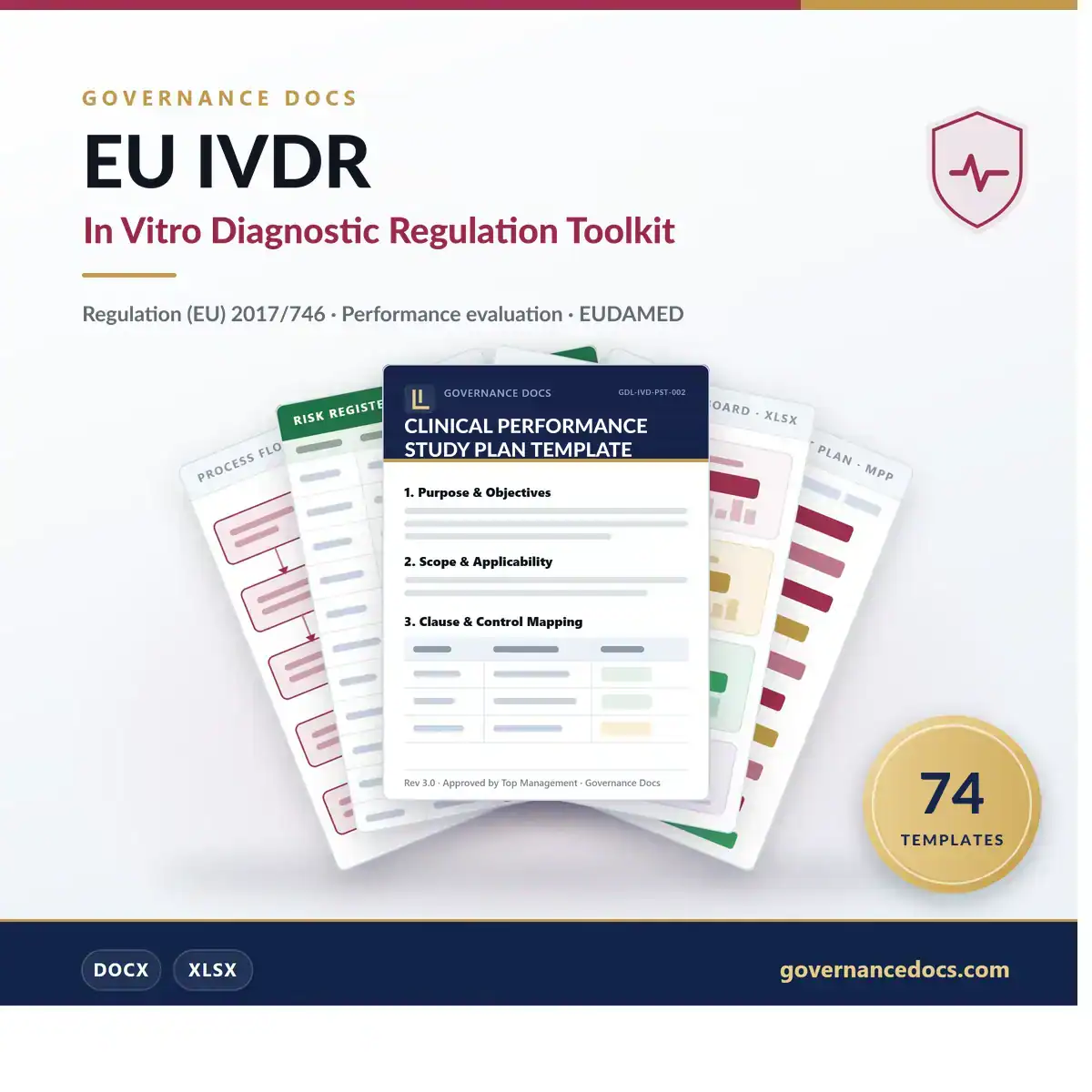
EU IVDR Toolkit delivers 74 ready-to-use Microsoft Office templates covering Regulation (EU) 2017/746 as consolidated on 10 January 2025 — Annex II and Annex III technical documentation, the Annex I GSPR conformity checklist, classification under the seven Annex VIII rules, performance evaluation across scientific validity, analytical performance and clinical performance, performance studies, UDI and EUDAMED registration, post-market surveillance, PSUR and vigilance, labelling and the summary of safety and performance, and the staggered Article 110 transition. Built for IVD manufacturers who need a regulatory file a notified body can actually review.
$99.00
✓ In stock — instant download after checkout
This is the in vitro diagnostic pack, not the medical device one. Article numbers here are IVDR numbers. They do not match Regulation (EU) 2017/745, and the two regulations diverge exactly where it costs most — classification, clinical evidence and the structure of the technical file. If you make medical devices rather than IVDs, you want the EU MDR Toolkit instead.
Regulation (EU) 2017/746 is a live instrument. It has been amended four times, and its operative dates are scattered across amending regulations, an implementing decision on harmonised standards, and — for EUDAMED — a notice published under a completely different regulation. That is why most IVD documentation packs are quietly out of date.
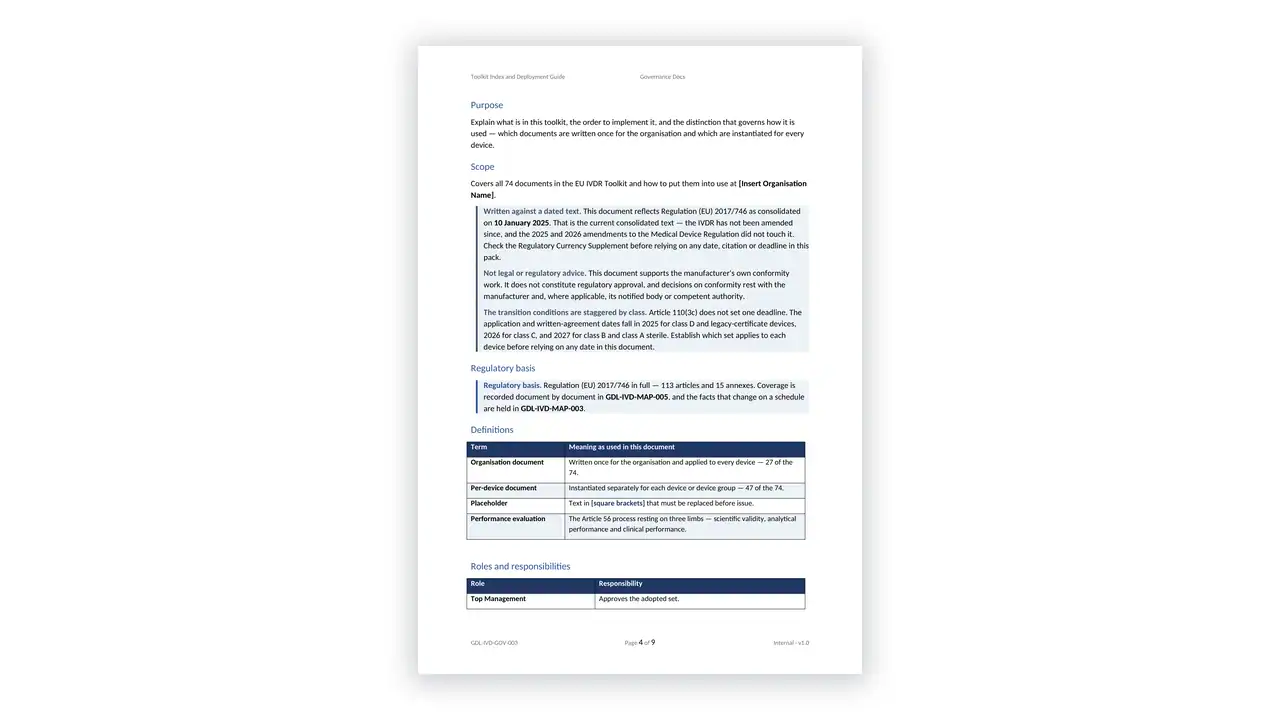
This one is written against a dated text — Regulation (EU) 2017/746 as consolidated on 10 January 2025 — and every one of its 74 documents states that on its cover.
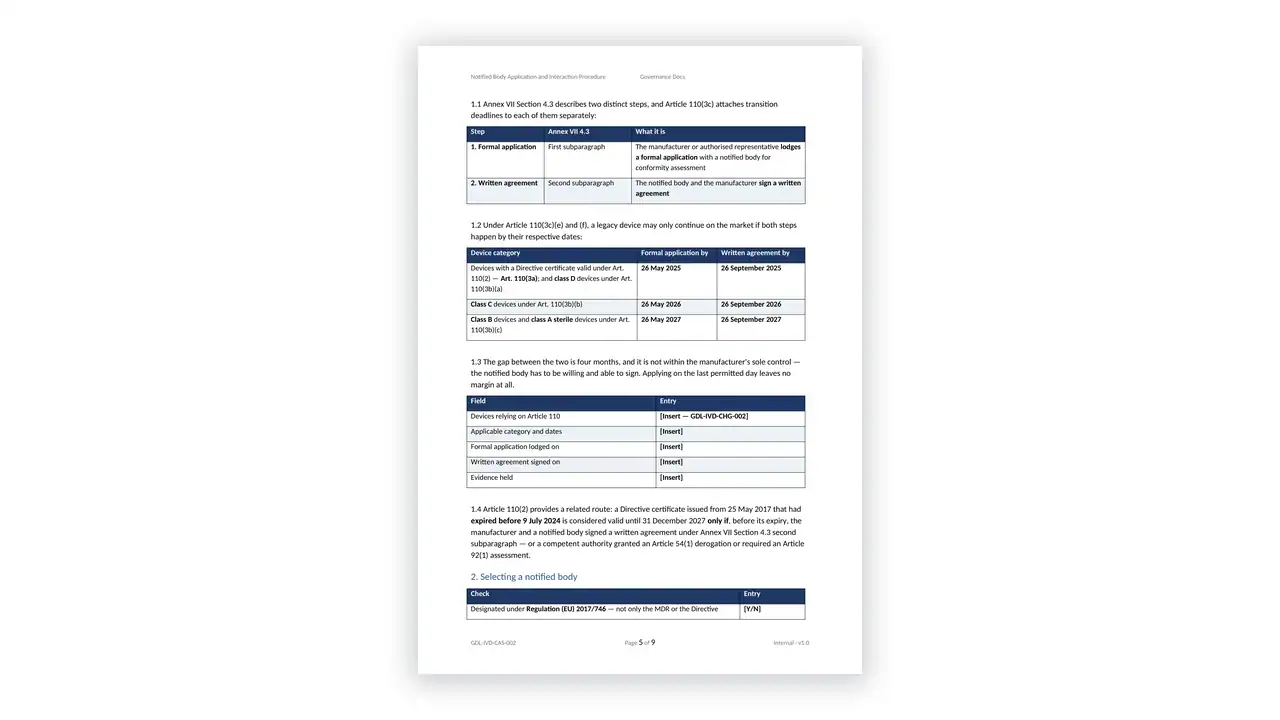
For class C legacy devices, Article 110(3c)(f) requires the manufacturer and a notified body to have signed a written agreement by 26 September 2026. Not applied — signed.
The application deadline for those devices passed on 26 May 2026. The four months between the two dates are not within the manufacturer’s control, because a notified body has to be willing and able to sign. If the agreement is not signed by 26 September, the condition fails and the device can no longer be placed on the market under Article 110 — on 27 September, not on 31 December 2028.
Class D legacy devices ran the same gauntlet in 2025. Class B and class A sterile devices reach theirs on 26 May and 26 September 2027, with placing on the market ending 31 December 2029.
There is no remediation procedure for a missed condition and no grace period. The toolkit’s transition tracker takes evidence references, not a Yes for each of the six Article 110(3c) conditions, tracks both Annex VII Section 4.3 milestones separately, and carries a worked example of a device whose written agreement is unsigned two months out — position, escalation, supply suspended.
Article 113(3)(f) of the IVDR ties its own EUDAMED obligations to a notice published under Article 34(3) of the Medical Device Regulation. Not to a separate IVDR notice.
So Commission Decision (EU) 2025/2371 — an MDR instrument — started the six-month clock for IVD manufacturers too, and the same four modules became mandatory on 28 May 2026: actor registration, UDI and device registration, notified bodies and certificates, and market surveillance.
An IVD manufacturer reading only its own regulation will not find the decision that binds it. The toolkit gives that dependency a document of its own, and adds the staged follow-ons most packs miss: Article 113(3)(fa) gives manufacturers six months from that date to enter Article 26 information — expressly including devices still on the market under Article 110. Legacy devices get registered.
This is the structural difference that decides whether an IVD file survives review, and it is where a repurposed MDR pack fails outright.
Article 56(3) requires a defined and methodologically sound procedure demonstrating scientific validity, analytical performance and clinical performance — three separate limbs, each with its own report and its own permitted sources. Annex XIII Section 1.3.2 then requires the performance evaluation report to contain all three plus an assessment of them.
There is no single “clinical evaluation report” here. A file that answers analytical and clinical performance and takes scientific validity as read is the commonest shape of an inadequate IVD performance evaluation, because the association between the marker and the condition is a demonstration in its own right.
The toolkit ships that structure as eight documents: the procedure, the plan with all twelve Annex XIII Section 1.1 elements, the three limb reports, the performance evaluation report that assembles them, the PMPF plan against Annex XIII Part B’s five aims and eight required contents, and the PMPF evaluation report that feeds back.
Annex XIII Section 1.2.2 sets a hierarchy most programmes meet too late:
An analytical shortfall escalating into a mandatory clinical study changes the timeline, the cost, and possibly whether Articles 57 to 77 and an ethics committee are engaged. The toolkit forces that determination back to plan stage, in the performance evaluation plan and the metrological traceability procedure, rather than leaving it to surface when the analytical performance report is being written.
Metrological traceability has no counterpart in the medical device Regulation at all. Annex I Section 9.3 requires it, Annex I Section 20.4.1(u) requires the maximum self-allowed batch-to-batch variation to be published in the instructions for use with figures and units, and EN ISO 17511 is the harmonised standard behind it. It gets its own procedure here.
Article 2(67) defines an incident to include any malfunction, any use error due to ergonomic features, any inadequacy in the information supplied — and then adds a limb the MDR does not contain:
> any harm as a consequence of a medical decision, action taken or not taken on the basis of information or result(s) provided by the device.
The device does not have to fail. If it returns a result within its stated performance, a clinician acts or declines to act on it, and harm follows, that is an incident — and if the harm meets Article 2(68), it is a reportable serious incident.
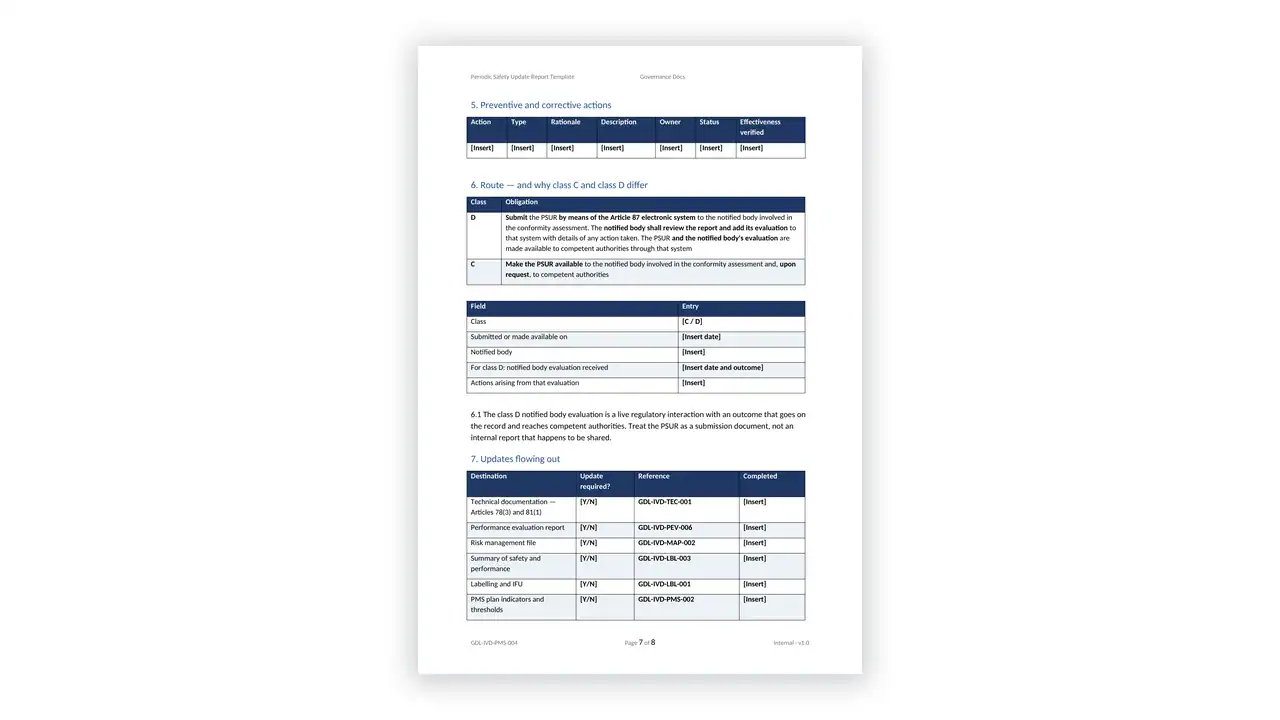
A vigilance procedure carried over from the MDR looks for device failures and will not catch this class of event. The toolkit builds intake around clinical outcomes instead, with a worked example of a false negative within stated performance that is nonetheless reportable.
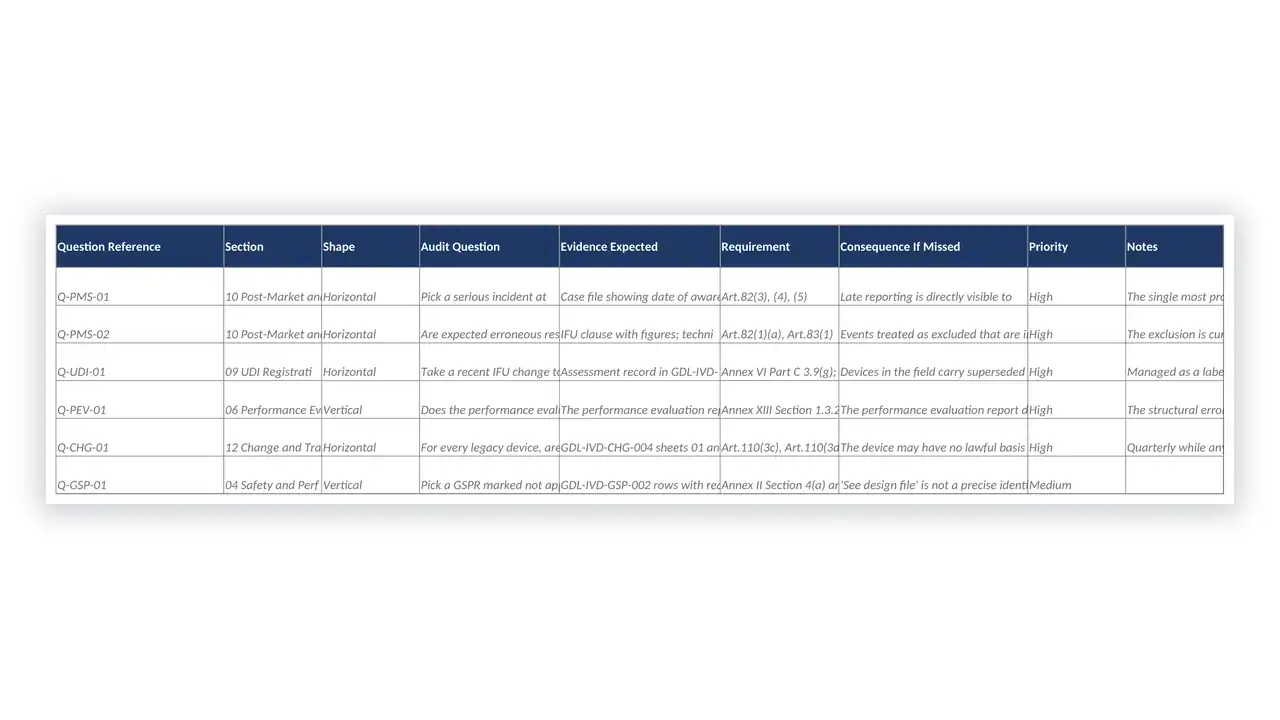
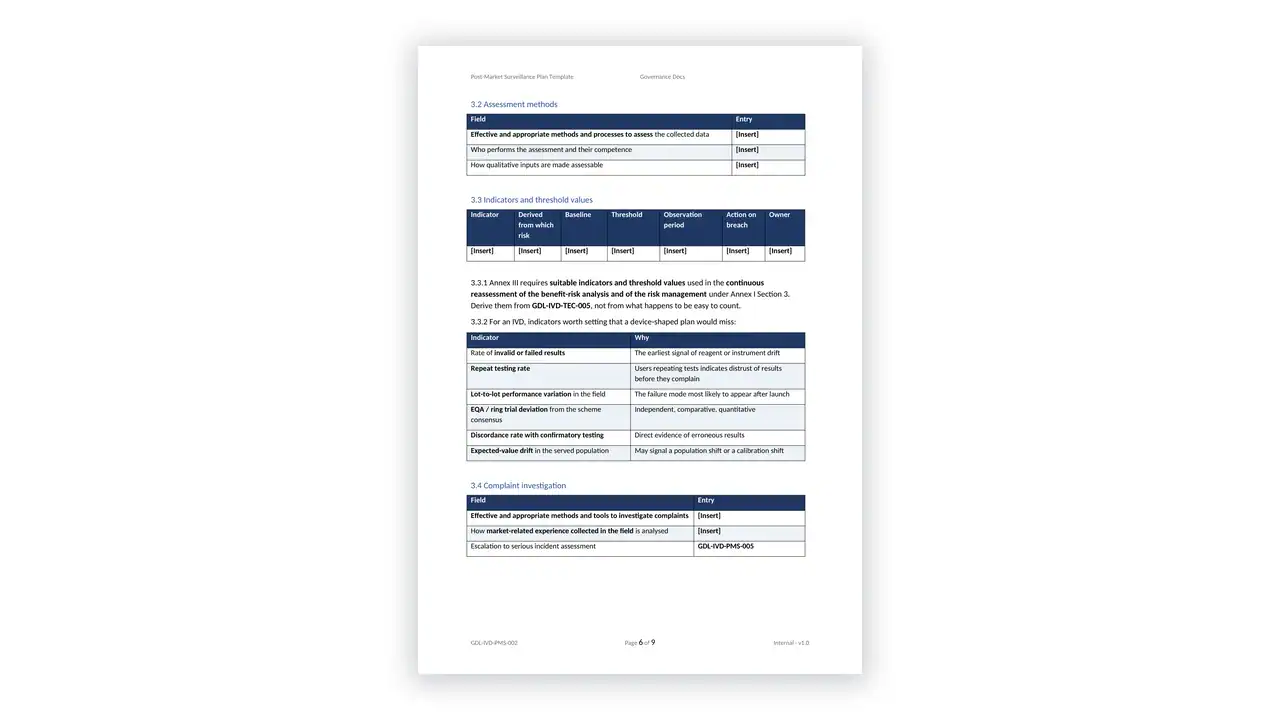
It also gets the exclusion right. Article 82(1)(a) excludes expected erroneous results from serious incident reporting, but only where they are documented and quantified in the product information, and in the technical documentation, and subject to trend reporting. All four, cumulatively. A manufacturer that never quantified its false negative rate has no exclusion to rely on — and nothing to trend against under Article 83’s second limb, which compares real-world erroneous results to the stated Annex I Section 9.1 performance.
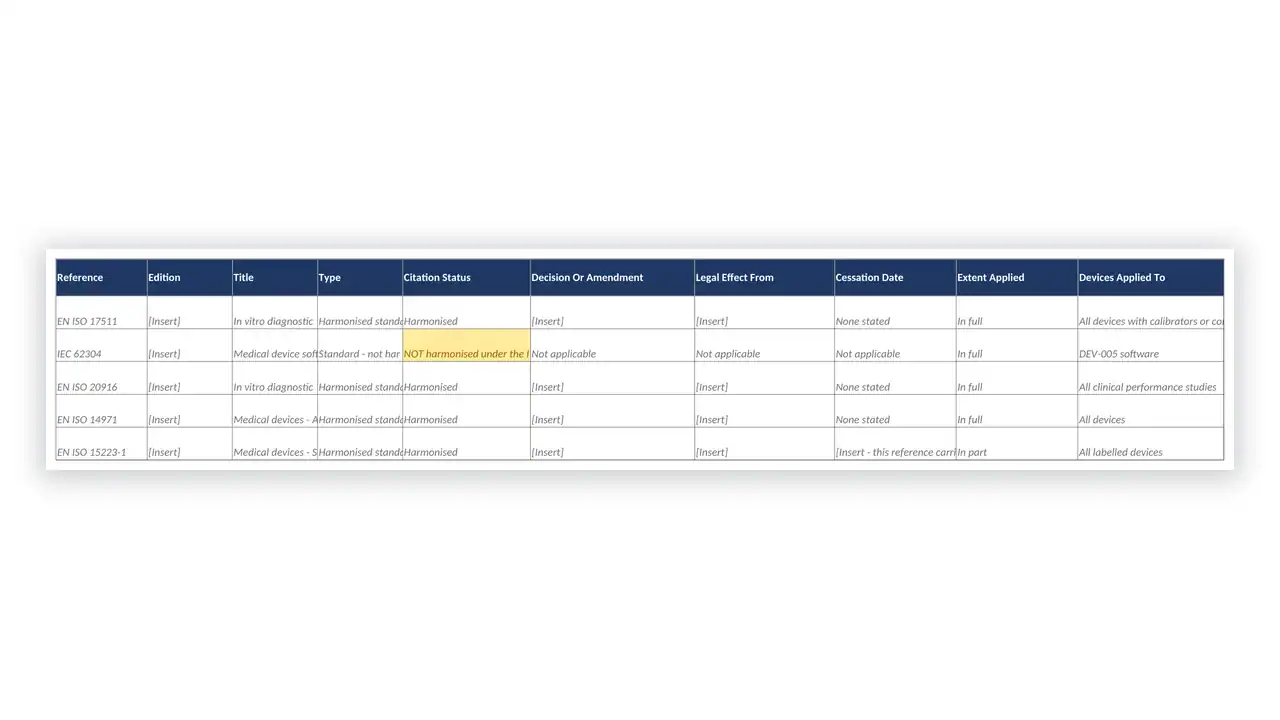
IEC 62304, IEC 62366-1 and EN ISO 20417 are described as harmonised under the IVDR in a great deal of commercial material. Checked against the European Commission’s own summary list for Regulation (EU) 2017/746, generated 17 June 2026, none of them is.
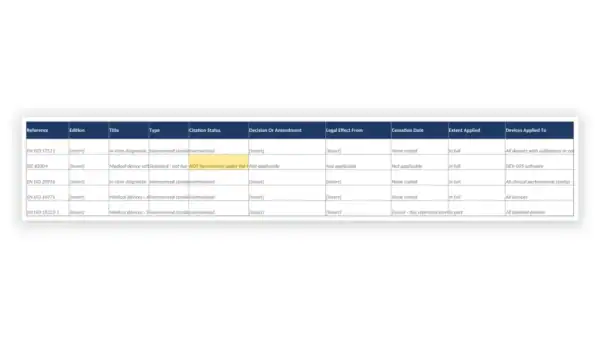
Applying them is still the right engineering decision. What they do not give is a presumption of conformity, so conformity with the corresponding Annex I requirements has to be demonstrated directly. The toolkit gives you the correct form of words for a technical file instead of the wrong one, and a standards register whose primary column is whether a presumption is actually available.
The two standards that *are* distinctively IVDR — EN ISO 17511 on metrological traceability and EN ISO 20916 on clinical performance studies — have no MDR counterpart and are treated as first-class citizens.
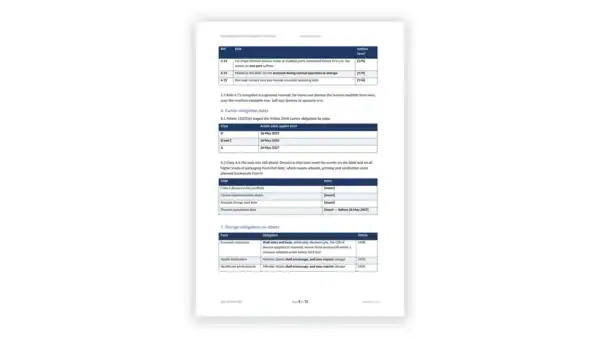
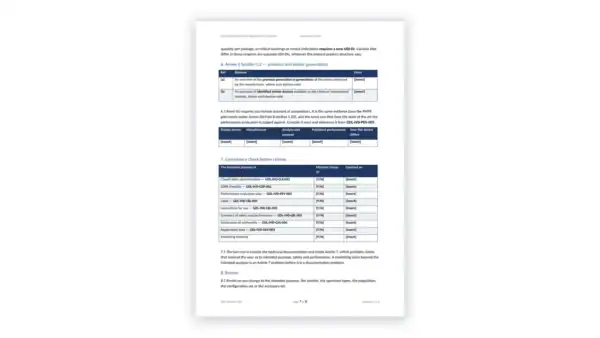
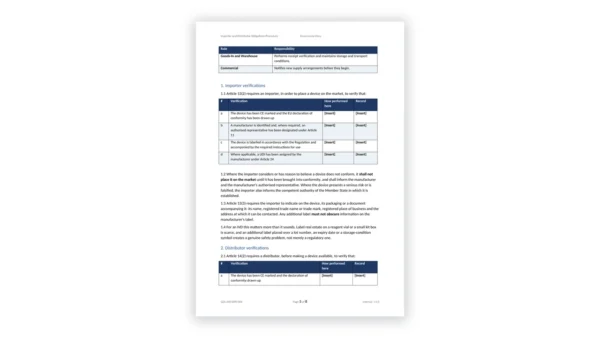
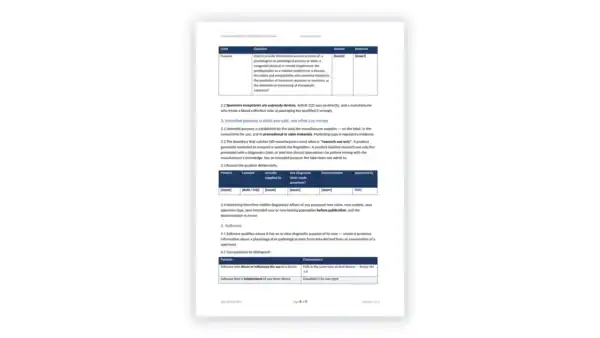
74 documents — 59 Microsoft Word and 15 Microsoft Excel — across thirteen sections, from the compliance policy through to the notified body evidence pack.
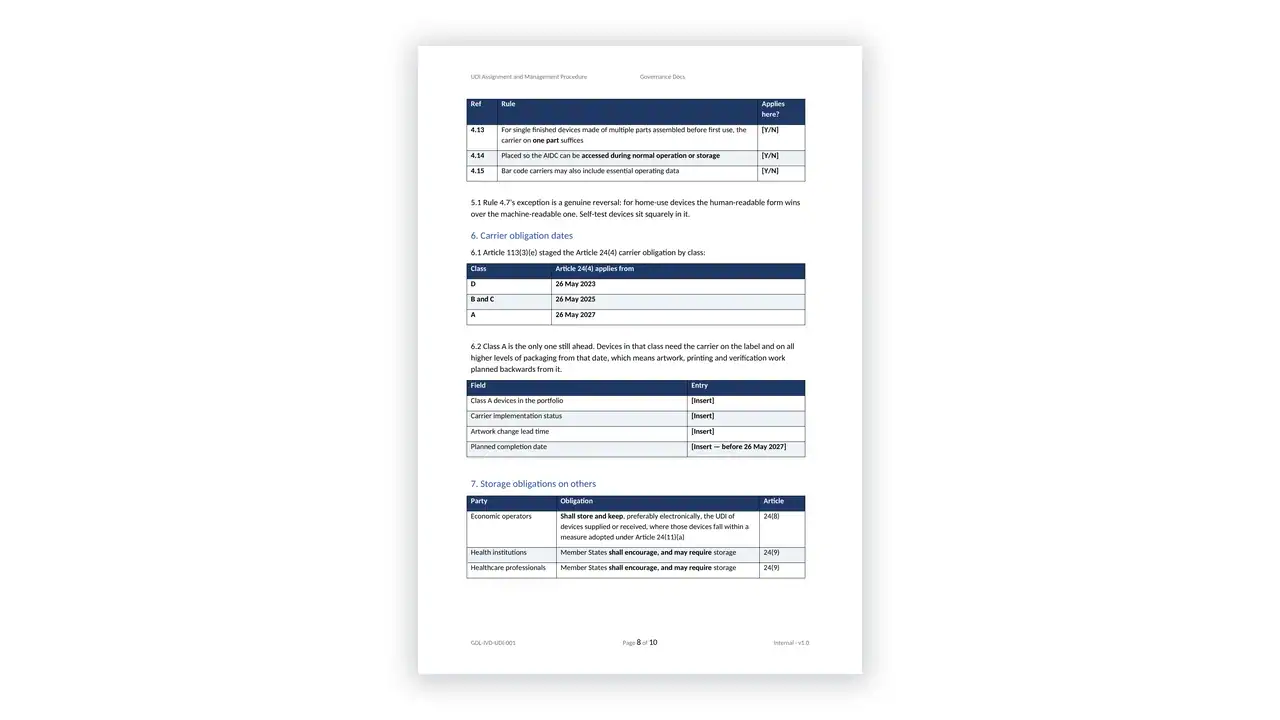
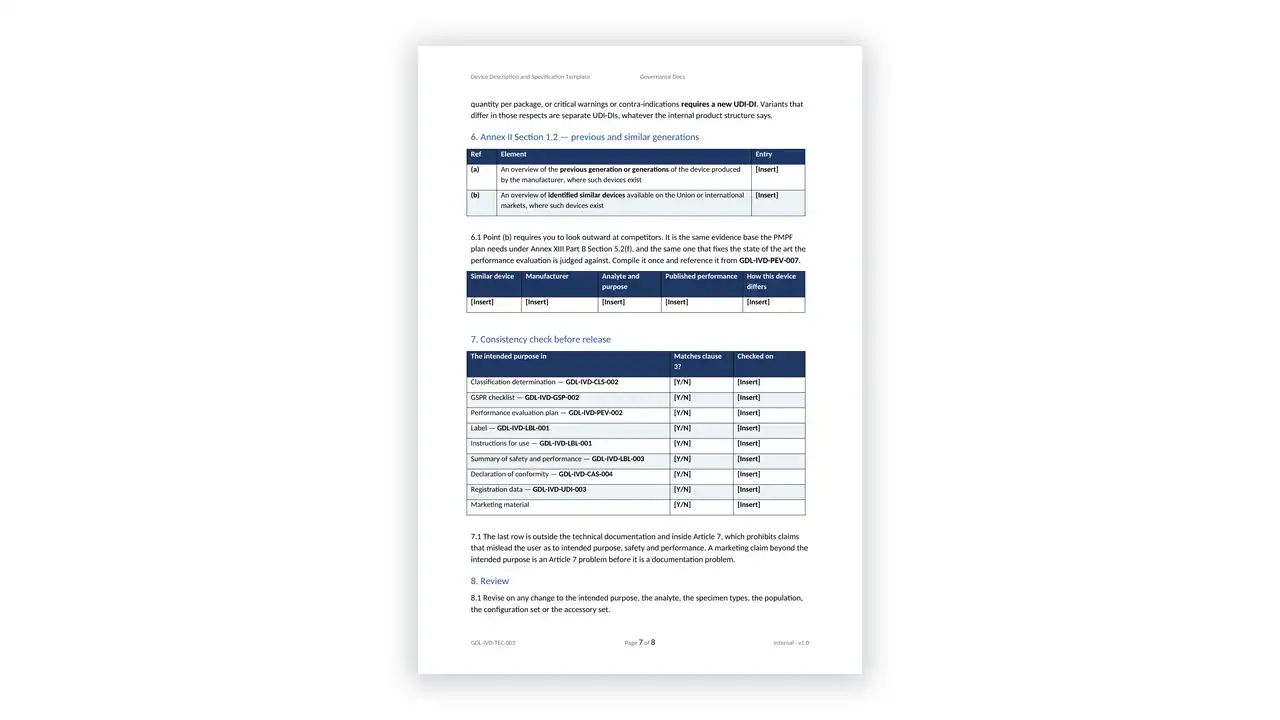
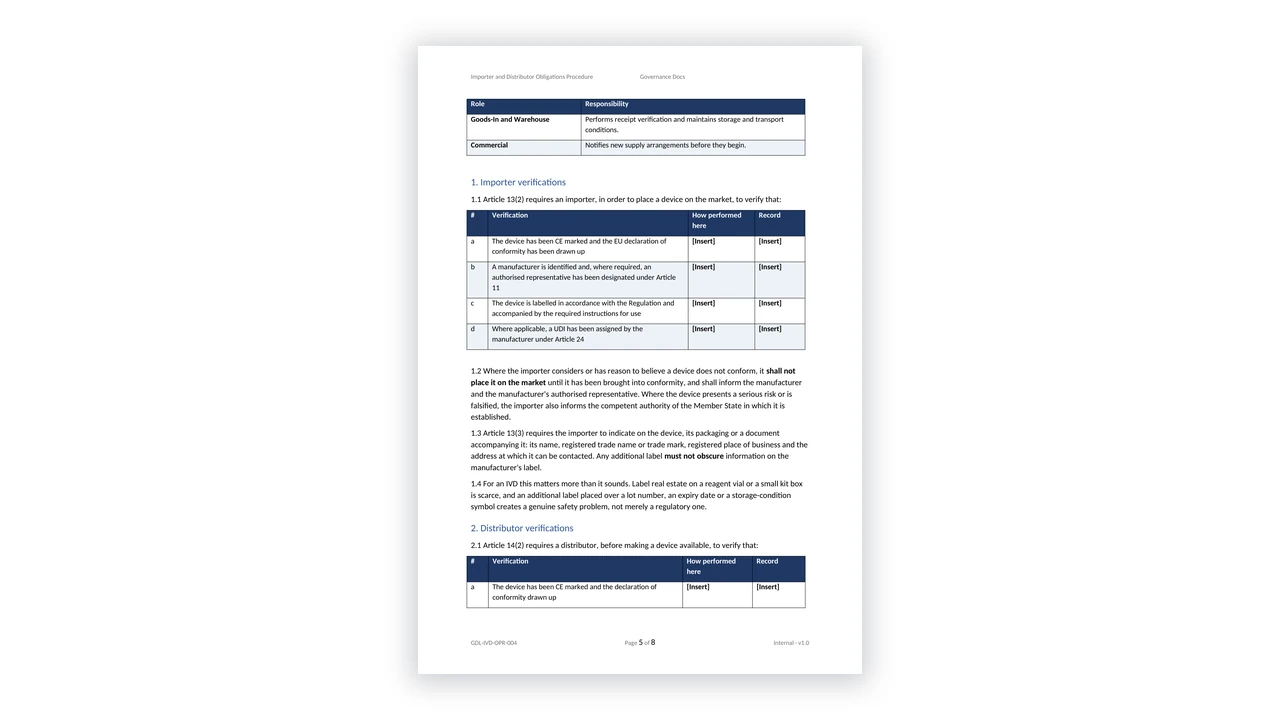
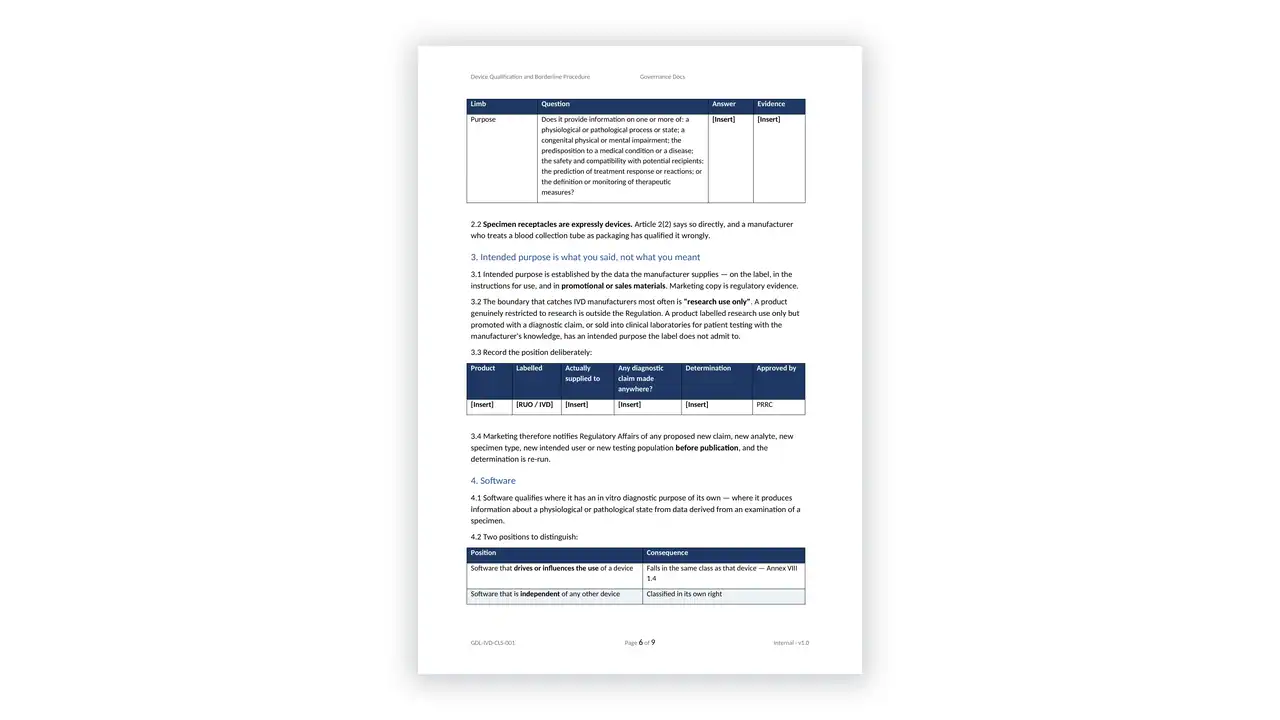
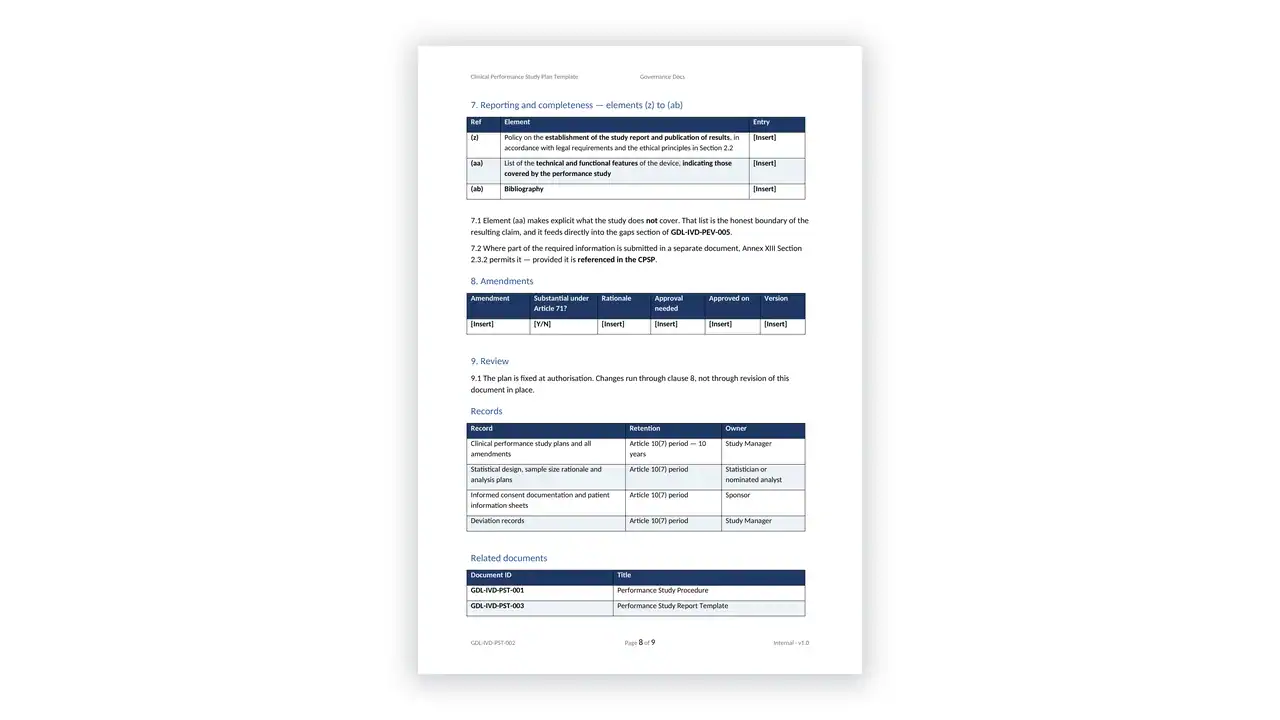
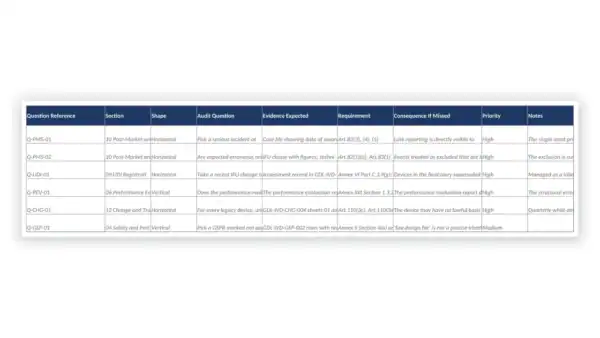
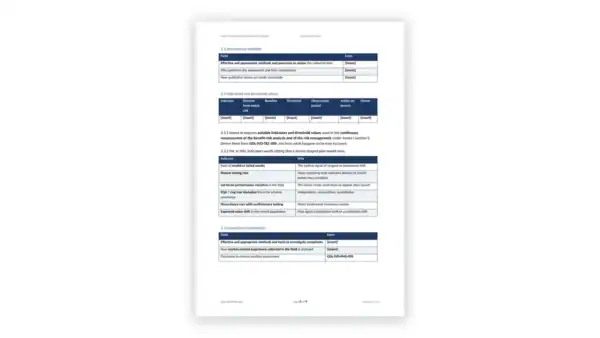
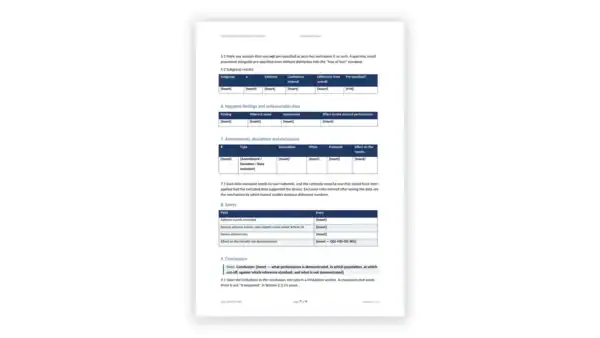
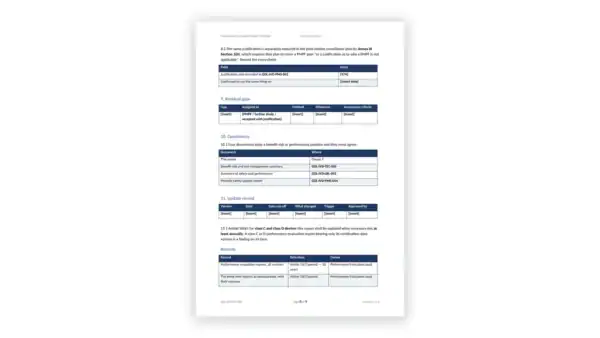
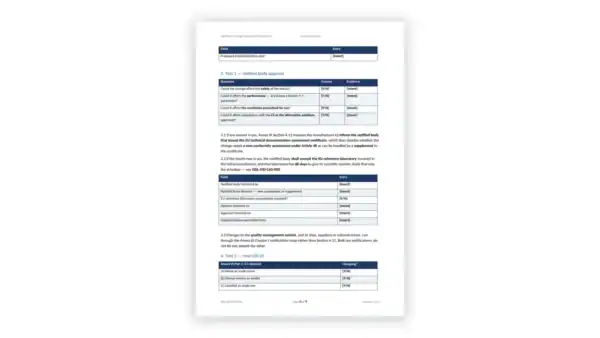
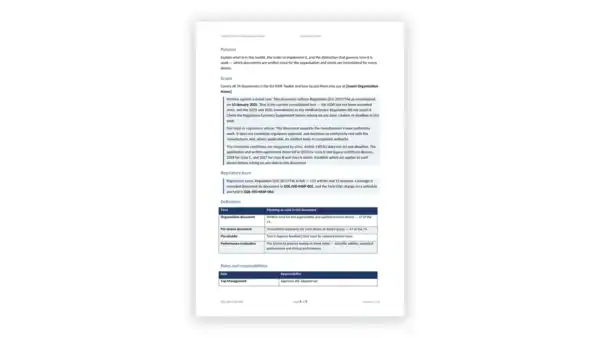
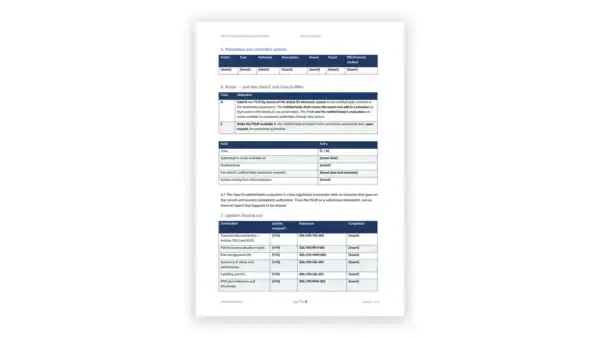
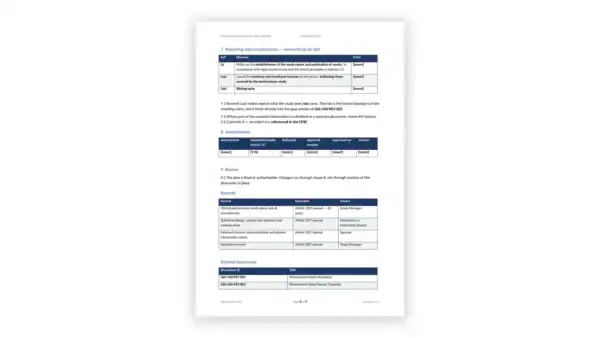
The Word documents carry a table of contents, document control fields, a definitions table, a roles table, a records table with Article 10(7) retention, and a related documents table. The workbooks carry an instructions sheet, controlled dropdowns, worked example rows, conditional formatting and a validation sheet.
The Regulation requires technical documentation per device. It also requires systems and procedures that run across the organisation. The toolkit separates the two and the register records which each document is: 27 organisation documents and 47 per-device documents.
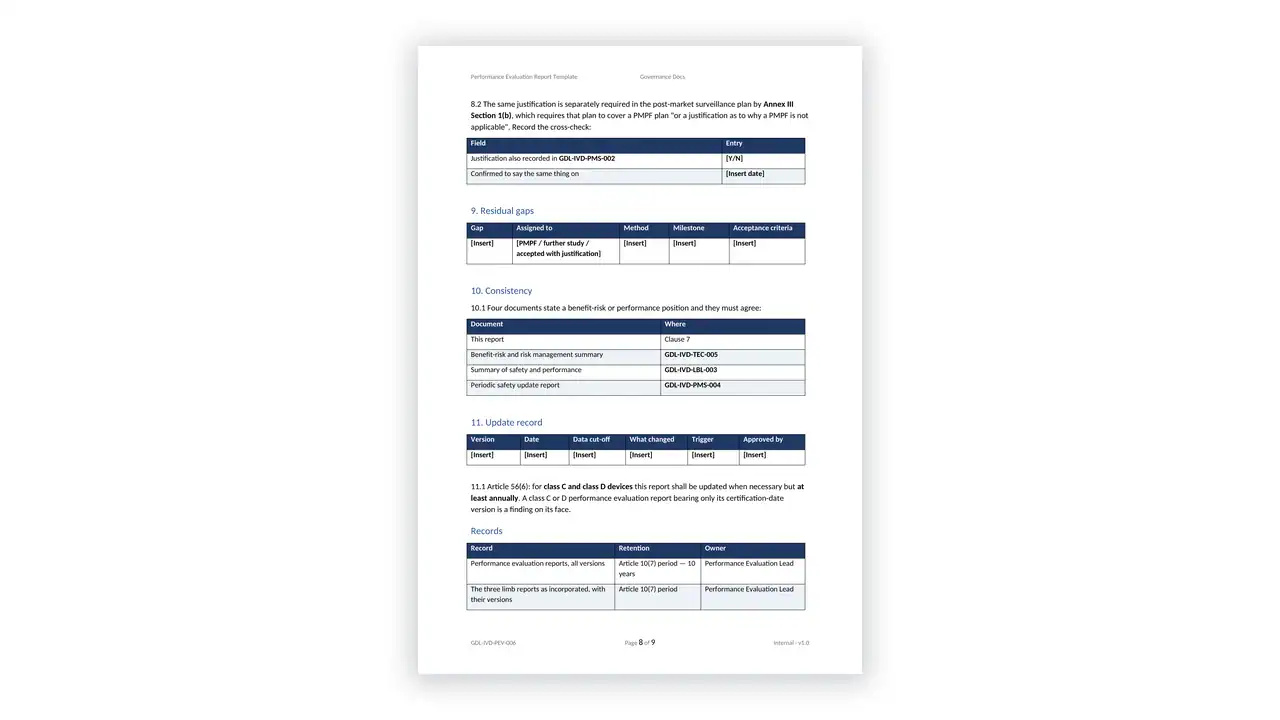
A single portfolio-wide GSPR checklist is the commonest structural error in an IVD file, and it makes the checklist evidence for nothing in particular. The same applies to the performance evaluation report, which is per device and — for class C and class D — must be updated at least annually under Article 56(6).
The heaviest section is performance evaluation (9 documents), because that is where an IVD file is won or lost and where nothing can be borrowed from a medical device pack. Technical documentation (8 documents) follows Annex II’s own six sections with Annex III kept properly separate, and post-market and vigilance (8 documents) carries the 2-day, 10-day and 15-day reporting clocks, the trend reporting methodology and observation period, and the Article 84(8) field safety notice.
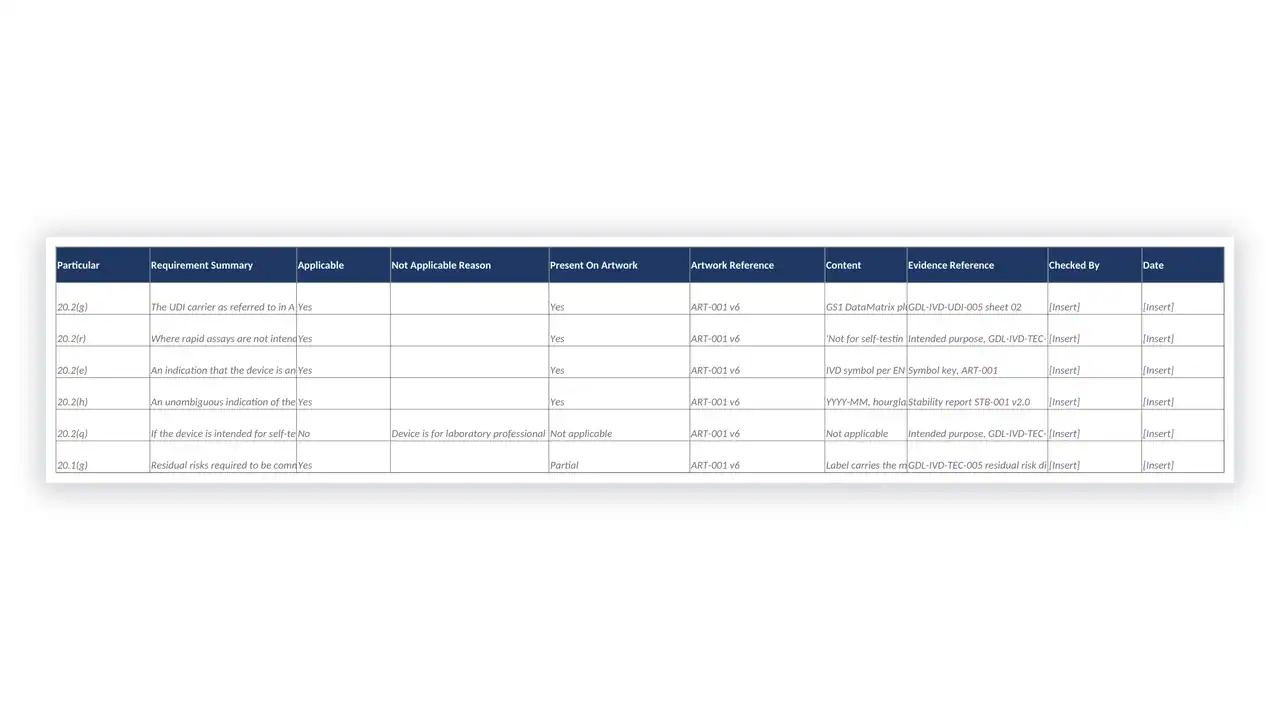
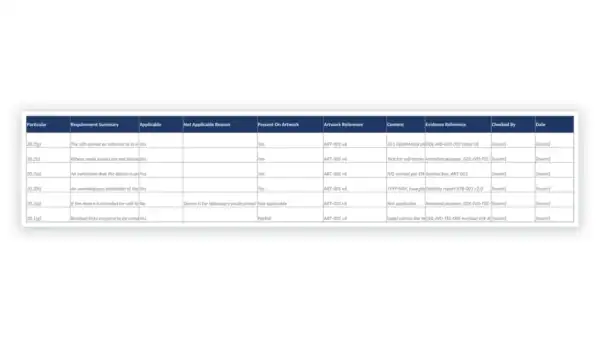
The GSPR conformity checklist ships Annex I as a controlled list across all three chapters, and insists on the two columns that actually fail review: a device-specific reason for every requirement marked not applicable, and a precise evidence reference. “See design file” is not one.
| # | Section | Documents |
|---|---|---|
| 01 | Programme and Scope | 4 |
| 02 | Economic Operators | 5 |
| 03 | Qualification and Classification | 5 |
| 04 | Safety and Performance | 5 |
| 05 | Technical Documentation | 8 |
| 06 | Performance Evaluation | 9 |
| 07 | Performance Studies | 3 |
| 08 | Conformity Assessment | 6 |
| 09 | UDI Registration and EUDAMED | 6 |
| 10 | Post-Market and Vigilance | 8 |
| 11 | Labelling and Transparency | 4 |
| 12 | Change and Transition | 4 |
| 13 | Mapping Audit and Evidence | 7 |
Annex I Section 20.4.1 runs to thirty-four lettered particulars. Four of them have no medical device counterpart, and they are precisely where an adapted MDR instructions-for-use template comes up short:
Section 20.2(r) adds one more that is simply absent from device labelling: where a rapid assay is not intended for self-testing or near-patient testing, the label must carry the explicit exclusion. Silence is not exclusion.
The consolidation date, the amendments, the Article 110 deadline calendar, the UDI carrier dates by class, the harmonised standards list and its generation date, the EUDAMED derived dates, the common specifications, the EU reference laboratory designations and the language determinations all live in a single Regulatory Currency Supplement, each entry with a verified-on field and a scheduled re-check against primary sources.
Everything else in the pack defers to it. The other 73 documents state mechanisms — “the date derived under Article 113(3)(f)”, “the current harmonised reference” — rather than dates. When the Regulation is next amended you update one document and let it drive the rest, instead of hunting a date through sixty procedures and missing one.
The toolkit owns the regulatory file. It does not re-author the quality management system or the risk management file, and it says so.
Article 10(8) requires a quality management system; ISO 13485:2016 is the harmonised route to demonstrating it, and the toolkit includes a cross-reference matrix showing what the standard covers and — the useful column — what the Regulation adds on top, starting with the fact that ISO 13485 has no performance evaluation requirement at all. Annex I Section 3 requires a risk management system; EN ISO 14971:2019 is the harmonised standard, and the interface procedure defines what the file must contain for IVDR purposes.
If you also need those, our ISO 13485 Toolkit covers the medical device quality management system and our ISO 14971 Toolkit covers the risk management file.
Simply add your organisation’s name, replace the bracketed placeholder values with your own detail, and implement the documented policies and procedures within your operational framework.
It is a set of 74 ready-to-edit documentation templates covering Regulation (EU) 2017/746 on in vitro diagnostic medical devices — 59 Word documents and 15 Excel workbooks across thirteen sections, from the compliance policy and economic operator obligations through classification under the seven Annex VIII rules, the Annex I GSPR checklist, Annex II and Annex III technical documentation, performance evaluation and PMPF, performance studies, conformity assessment, UDI and EUDAMED, post-market surveillance and vigilance, labelling and the summary of safety and performance, the Article 110 transition, and internal audit.
No, and the two are not interchangeable. The IVDR uses classes A to D against the MDR’s I to III, seven classification rules against twenty-two, performance evaluation under Article 56 and Annex XIII against clinical evaluation under Article 61 and Annex XIV, and performance studies against clinical investigations. It adds EU reference laboratories and batch verification for class D, metrological traceability, and a definition of “incident” that reaches harm caused by a clinical decision taken on a result. Article numbers do not correspond. If you make medical devices, you want the EU MDR Toolkit.
Regulation (EU) 2017/746 as consolidated on 10 January 2025 (CELEX 02017R0746-20250110). That includes Regulation (EU) 2024/1860, which inserted the Article 10a supply-interruption obligation and rewrote the Article 110 transition into its current staggered form. Every document states the consolidation date it was written against, and the Regulatory Currency Supplement carries the re-check procedure.
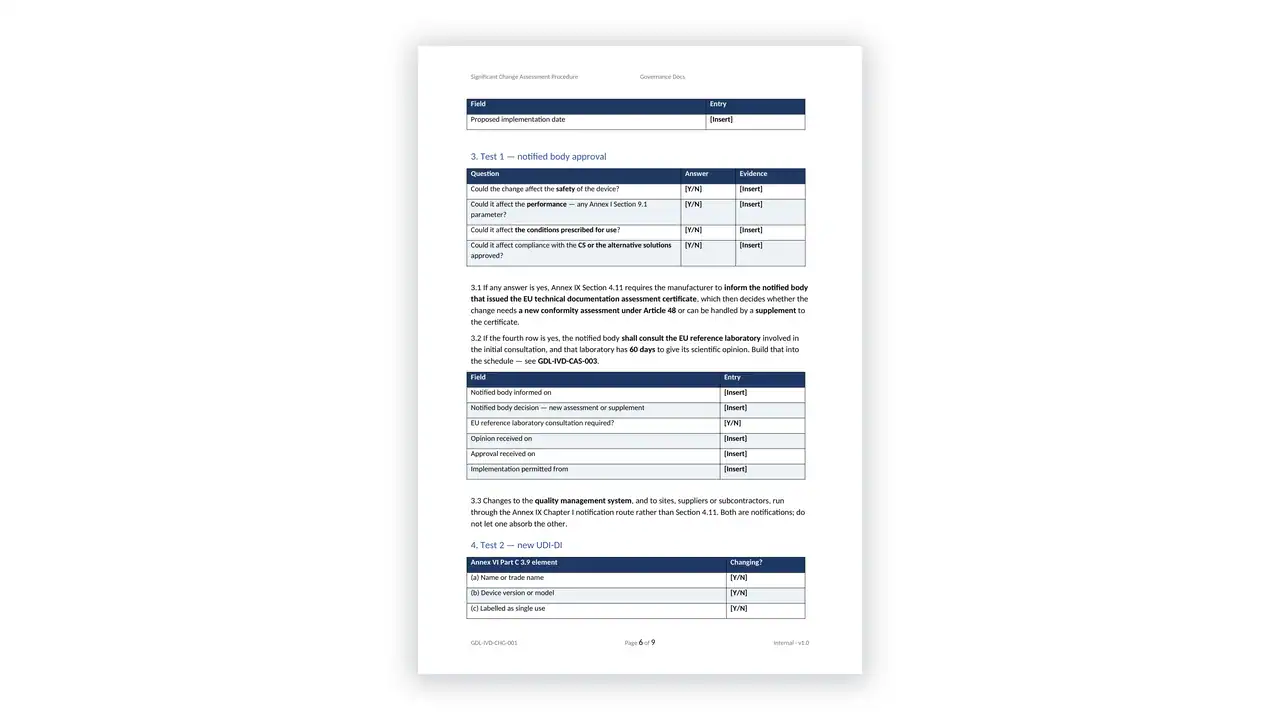
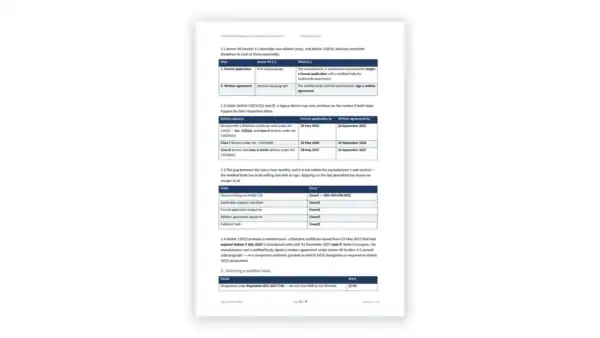
Yes, in detail. It covers the 31 December 2027, 2028 and 2029 end dates by category, all six Article 110(3c) conditions with evidence fields rather than tick boxes, both Annex VII Section 4.3 milestones with their separate deadlines — including the 26 September 2026 written-agreement deadline for class C devices — the significant change test that ends a transition immediately with no remediation, and Article 110(3d), which applies IVDR post-market surveillance, market surveillance, vigilance and registration to legacy devices now.
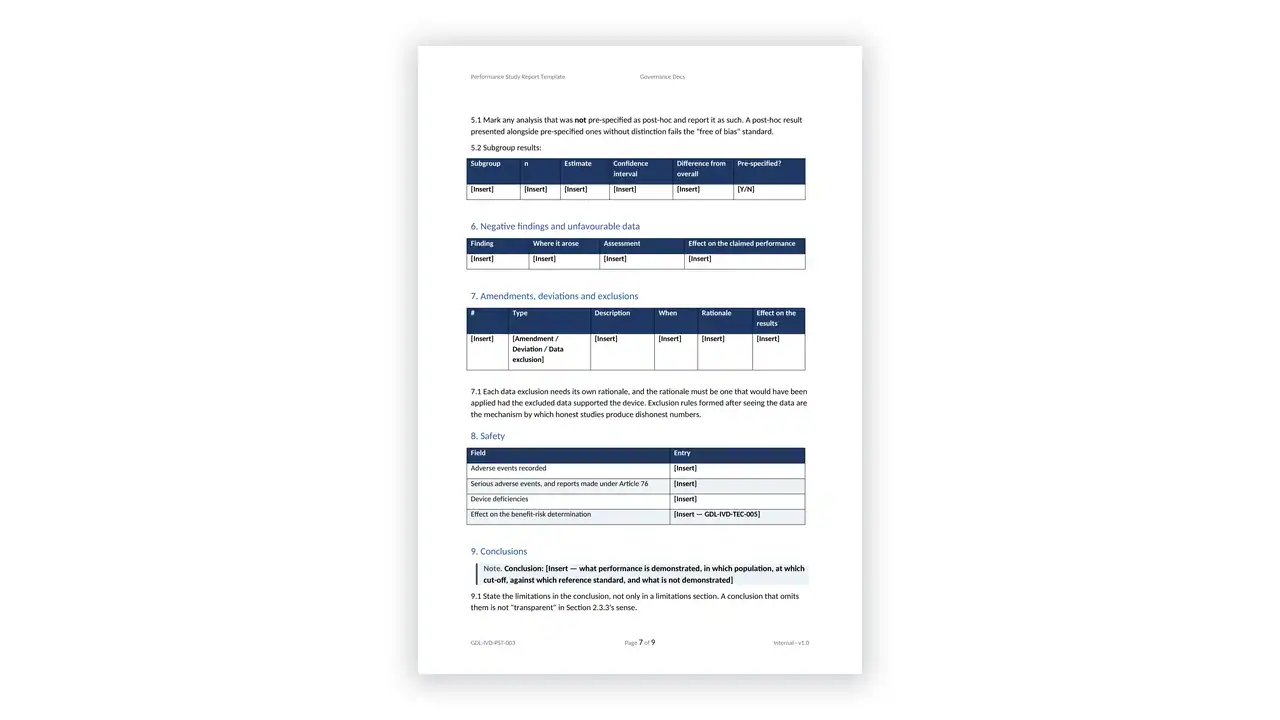
That is the section the pack was built around. Nine documents cover Article 56 and Annex XIII: scientific validity from the five sources Section 1.2.1 permits, analytical performance against every Annex I Section 9.1(a) parameter with the trueness hierarchy where no certified reference material exists, clinical performance against every Section 9.1(b) parameter with the justification required if no clinical performance study is run, the performance evaluation report that must contain all three, and PMPF against Annex XIII Part B’s five aims and eight required plan contents.
Yes, and as a live obligation rather than a forthcoming one. Four modules became mandatory on 28 May 2026 following Commission Decision (EU) 2025/2371 — an MDR decision that binds IVD manufacturers through Article 113(3)(f). The toolkit covers actor registration and the Single Registration Number, device registration and the Annex VI Part A and Part B data sets, EUDAMED data governance and access control, and a module status log that tracks the derived dates and the Article 113(3)(fa) six-month follow-on for legacy device registration.
No. Article 10(8) requires a quality management system and Annex I Section 3 requires a risk management system; ISO 13485:2016 and EN ISO 14971:2019 are the harmonised routes to demonstrating both. This toolkit owns the regulatory file and includes bridge documents to each — a cross-reference matrix for the QMS and an interface procedure for the risk file — rather than duplicating them. The matrix is explicit that ISO 13485 has no counterpart to performance evaluation, metrological traceability or the Article 15 person responsible for regulatory compliance.
No. IEC 62304, IEC 62366-1 and EN ISO 20417 do not appear on the Commission’s list of harmonised standards for this Regulation, verified against the summary list generated 17 June 2026. They remain the state of the art and are expected by notified bodies, but no presumption of conformity arises from them. The toolkit explains what to write in a technical file instead, and tracks citation status per standard. EN ISO 17511 and EN ISO 20916 are harmonised and have no MDR counterpart.
Covered as its own procedure. For class D devices with a designated EU reference laboratory, the notified body must request verification of the claimed performance by laboratory testing, and shall not deliver the certificate if the scientific opinion is unfavourable — the one point in the Regulation where a third party can veto certification outright. The toolkit also covers batch verification under Annex IX Section 4.12, including the 30-day release clock that runs from the notified body’s reception of the samples, not from despatch.
59 Microsoft Word documents and 15 Microsoft Excel workbooks. The Word documents carry a table of contents, document control fields and a consistent structure; the workbooks include instruction sheets, controlled dropdown lists, worked example rows, conditional formatting and validation checks. Nothing is locked and no password is required.
No. Regulation (EU) 2017/746 is published free of charge on EUR-Lex in all 24 official languages, so the toolkit quotes article and annex numbers directly and you can check any of them in one click. You may still want the harmonised standards themselves, which are sold by the standards bodies.
 Comprehensive EU IVDR Toolkit – 74 In Vitro Diagnostic Regulation Templates$99.00




Reviews
There are no reviews yet