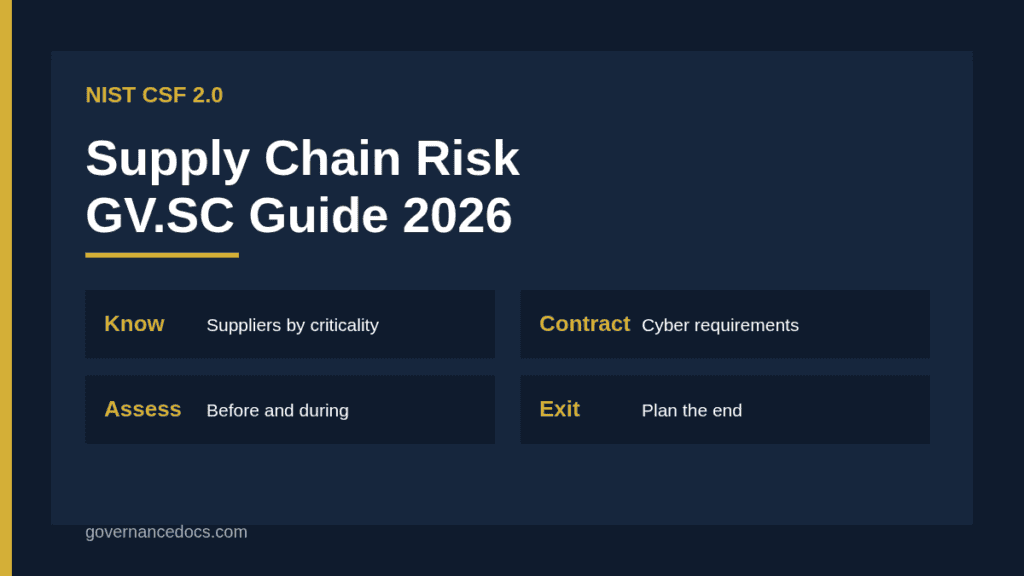
NIST CSF supply chain risk management became a named category in version 2.0 of the framework, sitting under the Govern function as GV.SC. It asks whether you know your suppliers, whether contracts carry cybersecurity requirements, and whether you plan for the moment a relationship ends. This guide explains the ten outcomes in plain terms and shows how to turn them into a working programme.
The outcome wording below comes from the published CSF 2.0 categories and subcategories. For context on the new function, read our guide to the NIST CSF Govern function, and for the version differences see CSF 2.0 versus 1.1.
Free gap assessment
What does your CSF 2.0 Current Profile look like?
Score all 106 subcategories across the six functions, free, including the 31 under Govern that version 1.1 never asked about.
GV.SC has ten subcategories. They move from programme design, through supplier selection and contracts, to monitoring and exit. The table paraphrases each one.
Outcome
In plain terms
GV.SC-01
A supply chain risk management programme, strategy, objectives, policies and processes are agreed by stakeholders
GV.SC-02
Cybersecurity roles for suppliers, customers and partners are established and communicated
GV.SC-03
Supply chain risk is integrated into cybersecurity and enterprise risk management
GV.SC-04
Suppliers are known and prioritized by criticality
GV.SC-05
Cyber requirements are built into contracts and agreements
GV.SC-06
Planning and due diligence happen before entering relationships
GV.SC-07
Supplier risks are understood, recorded, assessed, responded to and monitored throughout
GV.SC-08
Suppliers are included in incident planning, response and recovery
GV.SC-09
Supply chain practices are integrated into risk programmes and monitored across the life cycle
GV.SC-10
Plans cover activities after a partnership or service agreement ends
Start with the programme and the inventory
The first three outcomes set up the programme. Write a short policy that states the objectives of supplier risk management, assigns an owner and links to your enterprise risk register. Then build a supplier inventory. Include software vendors, cloud and managed service providers, hardware suppliers, contractors with system access and open source components that you rely on. Capture what each supplier does for you, what data or systems it touches and who in the business owns the relationship.
Free third-party risk assessment
How much risk does this vendor bring?
Tier the vendor, check the evidence, rate the risks from 30 third-party scenarios and choose controls referenced to ISO 27001, NIST CSF 2.0 and DORA. You get a tier, a heat map and the findings an auditor would raise, free.
The inventory feeds GV.SC-04, which asks that suppliers be known and prioritized by criticality. Tier suppliers by impact: those whose failure or compromise would stop a critical service or expose sensitive data are top tier. This tiering decides how much due diligence, contract control and monitoring each one gets. If you use organizational profiles, our guide to the CSF organizational profile shows how to record target outcomes for the category.
Contracts and due diligence for NIST CSF supply chain risk management
GV.SC-05 and GV.SC-06 turn the programme into concrete actions. Before you sign, perform due diligence proportionate to the tier. That may include a security questionnaire, review of independent assurance reports, financial stability checks and testing of critical claims. Then put cybersecurity requirements in the contract. Sensible clauses cover:
Minimum security controls and a right to see evidence of them.
Incident notification within a defined time.
Subcontractor approval and flow-down of requirements.
Data handling, location and return or deletion.
Audit or assessment rights for critical suppliers.
Business continuity and recovery commitments.
Keep the contract standard consistent with your control framework, so that requirements are traceable. The mapping between CSF and NIST SP 800-53 helps when you need detailed controls to reference in supplier agreements.
Monitoring suppliers over the relationship
GV.SC-07 asks that supplier risks be understood, recorded, prioritized, assessed, responded to and monitored over the course of the relationship. Practical monitoring includes annual reassessment for top-tier suppliers, review of new assurance reports, tracking of public security incidents, and tracking of remediation for findings. Record the outcomes in your risk register, with owners and dates.
GV.SC-09 adds the life-cycle view: monitor performance throughout the technology product and service life cycle, not only at onboarding. Product end-of-life, vendor acquisitions and major changes in ownership all belong in the monitoring plan.
Bringing suppliers into incident response
GV.SC-08 expects relevant suppliers to be included in incident planning, response and recovery. Identify which suppliers you would need to call in an incident, keep current contacts, and include them in exercises. If a supplier holds your data or runs a key service, test how quickly they can give you logs and status information. Agree the notification route in the contract, and check it works.
Fourth parties and concentration risk
Your suppliers have suppliers of their own. Ask top-tier providers which subcontractors handle your data or services, and whether a single fourth party, such as one cloud platform, supports several of your critical suppliers. Concentration of this kind can turn one outage into many. Record it in the risk register, and decide whether to diversify, add contract protections or accept the risk with approval.
Planning the exit
GV.SC-10 is often forgotten: plans should include activities after the relationship ends. For each critical supplier, record how you would retrieve or delete data, revoke access, transfer service to another provider and confirm that copies are destroyed. Exit plans are also useful when a supplier fails or is acquired, because the same steps apply. Write them before you need them.
Keep the whole set of records tidy: the inventory, tier decisions, assessment results, contract clauses used and exit plans. An assessor or auditor will ask to trace one supplier from tiering to monitoring, and a tidy record makes that quick.
A practical roadmap
Month 1. Name an owner, draft the policy and start the inventory.
Month 2. Tier suppliers, and pick the top tier for detailed review.
Month 3. Update contract templates with cyber clauses.
Month 4. Assess the top tier, log findings and agree remediation.
Month 5. Add suppliers to incident response contacts and run an exercise.
Month 6. Write exit plans for critical suppliers and report progress.
To show that the programme works, choose a small set of measures and report them quarterly. Useful examples include the percentage of top-tier suppliers assessed in the last twelve months, the share of new contracts that include cyber clauses, the number of open supplier findings past their due date, the time taken to contact suppliers in the last exercise, and the number of critical suppliers with a tested exit plan. Trends matter more than single numbers, so keep the definitions stable from one period to the next.
Present the numbers to the same forum that reviews other cyber risks. That reinforces GV.SC-03, which asks for integration with enterprise risk management, and it helps leaders decide where to invest. If a metric stays poor, look for the cause. Often it is a resourcing issue in procurement or a gap in ownership, not a lack of policy.
Roles across the business
NIST CSF supply chain risk management is not only a security task. Procurement holds the commercial levers, legal drafts the clauses, business owners know how the supplier is used, finance watches viability and security assesses technical controls. Write the roles down, following GV.SC-02, and agree who decides when a supplier fails an assessment. A simple RACI table avoids arguments in the middle of an incident. Review it when the organization restructures or when a new type of supplier, such as an AI service, enters the inventory.
A hypothetical example
A hypothetical regional logistics firm lists 140 suppliers and finds that twelve handle customer shipment data or run systems that would stop deliveries. It treats those as top tier, adds notification and audit clauses at renewal, and reviews their assurance reports. When one tier-one provider is acquired, the firm’s monitoring picks up the change, triggers a reassessment and prompts a check of the exit plan. The example is invented for illustration.
Common mistakes with NIST CSF supply chain risk management
Treating every supplier the same, so effort is spread too thinly.
Collecting questionnaires without acting on the answers.
Signing contracts with no security or notification clauses.
Forgetting open source and subcontractors.
Having no exit plan for critical suppliers.
The primary source is the framework itself on the NIST Cybersecurity Framework site. Use it to confirm the wording of the outcomes before you cite them in policy.
Templates for NIST CSF supply chain risk management
If you prefer not to write the policy, supplier tiering method and contract clauses from scratch, the NIST CSF Toolkit provides documents you can adapt to your organization.
NIST CSF supply chain risk management FAQ
What is GV.SC?
It is the cybersecurity supply chain risk management category in the Govern function of CSF 2.0, with ten subcategories.
Was supply chain risk in CSF 1.1?
Version 1.1 had supply chain content under other categories. Version 2.0 gives it a dedicated category under Govern.
Do we need to assess every supplier?
No. Tier by criticality and scale the depth of assessment. Lower tiers may need only basic checks.
Does it cover open source?
Yes, to the extent that open source components are suppliers of products you depend on. Include them in your inventory and monitoring.
Who should own the programme?
A named owner, often in risk or security, with input from procurement, legal and business owners of each relationship.