

The second edition is planned for mid-2027, and IATF has already said what it is aiming at. Simplification, software quality assurance, Tier N supply chain management, launch management and customer-specific requirements — which tells you exactly which clauses to get into shape now.
This assessment scores only the automotive supplemental requirements, because the ISO 9001 base is assessed separately. Sixty-six questions across the clauses IATF adds, including customer-specific requirements, product safety, the control plan and the core tools. It is free, it saves as you go, and you can stop and come back to it.
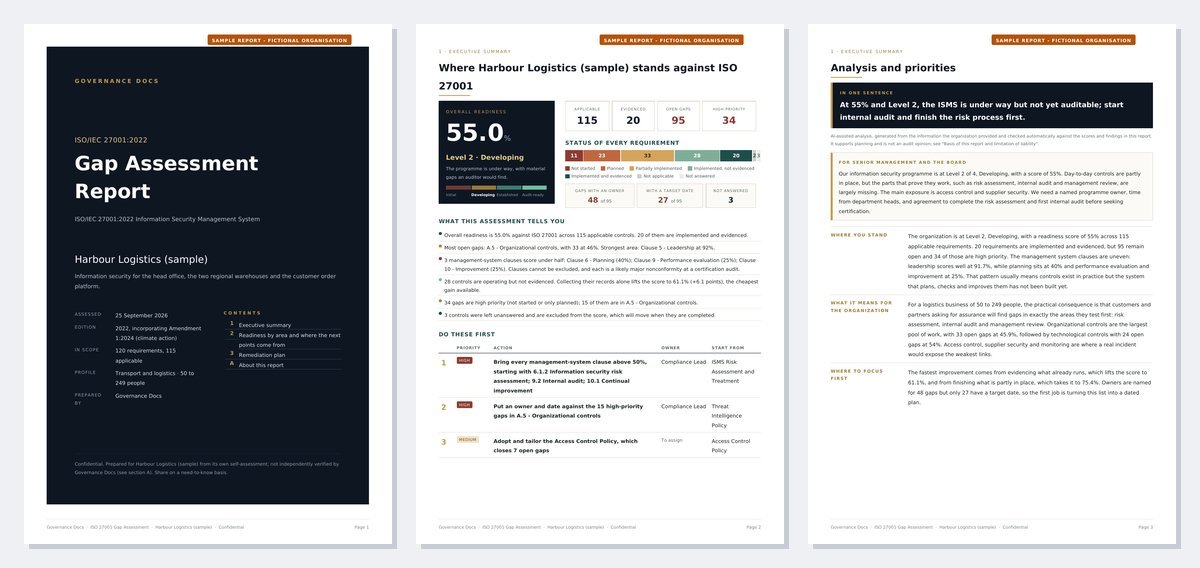
Premium report
See what the premium gap assessment report looks like
A worked sample for a fictional organization: readiness by area, every open gap in a remediation plan, an AI-assisted analysis with priorities and a 30/60/90-day roadmap, plus the live Excel workbook.
What this is
IATF 16949:2016 is still the only published and certifiable edition. Stakeholder Communiqué SC-2024-006 announced the revision in October 2024, and SC-2026-005 of 30 July 2026 set the timeline: drafting and external feedback through 2026, validation and translation in 2027, publication planned mid-2027. On transition IATF says only that the end will align with the end of the ISO 9001 transition. There is no transition end date, no date audits begin against the second edition, and no instruction to certified organisations — the communiqué is informational.
The core tools have moved, though, and this is where certified organisations most often fall behind. APQP went to 3rd Edition in March 2024 and the control plan content was removed from it — Control Plan is now a standalone manual, 1st Edition, March 2024. The AIAG and VDA SPC Manual, 1st Edition, was released on 1 July 2026 and is the second harmonised core tool after FMEA. Adoption is driven by customer-specific requirements rather than an IATF deadline. PPAP remains at 4th Edition from 2006 and MSA at 4th Edition from 2010.
The background is elsewhere — the standard explained, the core tools, what certification costs, the second edition and customer-specific requirements. Come here when you want a score.
What it covers
66 questions, about 45 minutes.
| Section | Questions |
|---|---|
| Clause 4 – Context, customer requirements and product safety | 7 |
| Clauses 5 and 6 – Leadership, risk and contingency | 8 |
| Clause 7 – Support, competence and measurement systems | 8 |
| Clauses 8.1 to 8.3 – Customer requirements and design | 9 |
| Clause 8.4 – Supplier management | 7 |
| Clauses 8.5 to 8.7 – Production, control plan and nonconformity | 12 |
| Clauses 9 and 10 – Performance, audit and problem solving | 8 |
| Core tools, scheme rules and the second edition | 7 |
How the scoring works
| Status | Weight | Means |
|---|---|---|
| Not started | 0% | No policy, process or activity exists |
| Planned | 25% | Agreed and scheduled, nothing in place yet |
| Partially implemented | 50% | In place for part of the scope, or applied inconsistently |
| Implemented, not evidenced | 75% | Operating as intended, but you could not prove it today |
| Implemented and evidenced | 100% | Operating as intended, with records someone could sample |
| Not applicable | — | A justified exclusion, removed from the score |
This assessment deliberately does not repeat ISO 9001. If you want the base management system scored, run the ISO 9001 assessment alongside it — that one is already written to the 2026 edition.
Free score, or the full report
The assessment and your overall score are free. The full report is a one-off $39 and gives you every question with your status and notes, the score broken down by section, a prioritised gap list, and the documents from the IATF 16949 Toolkit that close each gap — as a PDF and a working Excel file.
How long does it take?
About 45 minutes. Clause 8 is the largest block by a wide margin, and supplier management within it usually takes the longest to evidence.
What to do with your score
Below 40% — start with customer-specific requirements. Clause 4.3.2 brings them inside your quality system and clause 9.2.2.2 puts them inside your internal audit scope, so a CSR failure is a certification issue rather than a commercial one.
40–70% — the usual shape. Production controls and the core tool outputs are in place; contingency planning, supplier development, product safety flow-down and the three-audit internal programme are where the score drops.
Above 70% — check the internal audit programme covers all three audit types — quality management system, manufacturing process and product. Programmes that cover only the management system are one of the most common nonconformities in the scheme.
Frequently asked questions
Is this assessment really free?
Yes. All 66 questions, the breakdown by clause and your overall score cost nothing. The $39 report is optional.
Why does this not cover ISO 9001?
Because IATF 16949 is written to be applied with ISO 9001, not instead of it. Scoring both in one assessment would double the length and blur which findings are automotive.
Should I be preparing for the second edition now?
A watching brief, not a migration project. There is no transition end date yet. But the five priority areas IATF has named are a fair guide to which clauses are worth strengthening while you have time.
Do I have to adopt the new SPC manual?
That depends on your customers. Adoption of the AIAG and VDA SPC Manual is driven by customer-specific requirements rather than by an IATF deadline, and a roughly two-year practical transition is expected as OEMs update their CSRs.
Can I use this for a client?
Yes. Run one assessment per client organisation.
What happens to my answers?
They are stored against your account so you can come back to them, and they are never shared. You can delete them at any time.