AMLR politically exposed persons rules tell you what to do differently when a customer, or the beneficial owner behind one, holds or has held a prominent public function. Regulation (EU) 2024/1624, the EU Anti-Money Laundering Regulation, entered into force on 9 July 2024 and applies from 10 July 2027, according to a professional-body factsheet. Firms that already screen for politically exposed persons should now check their procedures against the directly applicable text, because a regulation replaces the patchwork of national transpositions.
What AMLR politically exposed persons rules require
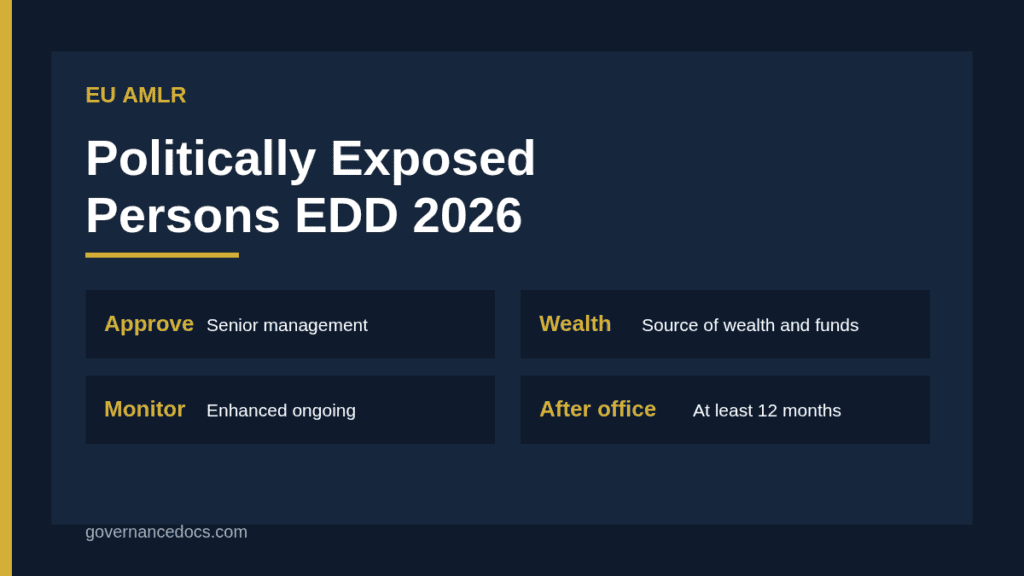
Summaries of the regulation agree on the core measures for PEPs and for their family members and known close associates.
Measure
What it means in practice
Risk management systems
Have a way to determine whether a customer or beneficial owner is a PEP
Senior management approval
Approval before establishing or continuing a business relationship
Source of wealth and funds
Establish where the person’s wealth and the funds in the relationship come from
Enhanced ongoing monitoring
Monitor the relationship more closely than for standard customers
After leaving office
Continue measures for at least 12 months
The provisions on PEPs sit together in a group of articles in the regulation, and commentators number and describe them differently. Read the articles in the Official Journal text directly, and use the article numbers from there in your procedures.
Who counts as a PEP under the AMLR
A PEP is a person who holds, or has held, a prominent public function. Family members and persons known to be close associates are also covered, so screening cannot stop at the named individual. Close associates include people who jointly own legal entities or arrangements with the PEP. Build screening to cover three groups: the PEP, family members and close associates, and apply it to both the customer and its beneficial owners. Our guide to the 25 percent beneficial owner threshold explains how ownership is determined, and the same analysis identifies PEPs behind corporate structures.
Screening customers and beneficial owners
Effective PEP screening depends on data quality. Screen at onboarding, at trigger events such as a change in ownership, and periodically. Use a commercial list or your own research, and record the sources and dates. False positives are common because names repeat, so set out how analysts clear a match using date of birth, nationality and role, and keep a record of the reasoning.
Senior management approval
Before you take on or continue a relationship with a PEP, obtain approval from senior management. The commentary suggests this need not always involve the board. Define who counts as senior management in your organization, set a clear approval form with the customer profile, risk rating, source of wealth analysis and monitoring plan, and record the decision with the date. Avoid delegating approval to the relationship manager who brought the customer, because independence matters.
Source of wealth and source of funds
These are separate concepts. Source of funds is where the money in this relationship comes from. Source of wealth is how the person built their overall wealth. For a PEP you need both. Collect evidence proportionate to risk: for example company accounts, sale contracts, inheritance documents or tax filings, and check them against public information. If the story does not fit the person’s known career and salary, escalate. Record what you asked for, what you received and why you accepted it.
Enhanced ongoing monitoring for AMLR politically exposed persons
Enhanced monitoring means tighter thresholds, more frequent reviews and closer attention to unusual patterns. Set a review cycle, typically annual for higher-risk relationships, and tune transaction monitoring for typical PEP typologies such as large cash movements, complex structures or payments involving high-risk jurisdictions. Link monitoring alerts to the suspicious transaction report deadline so analysts know how quickly to decide.
The 12-month rule after leaving office
When a person stops holding a prominent public function, the measures do not stop immediately. Factsheets on the regulation say enhanced due diligence must continue for at least 12 months after they leave office. The word “at least” matters: a risk-based view may justify keeping the measures longer. Document the decision to downgrade a former PEP, and include the reasons and approval.
Risk assessment and AMLR politically exposed persons
The regulation is risk-based, so your business-wide risk assessment should say how many PEP customers you expect, which products they use and which countries their functions relate to. Use it to set the depth of checks: a domestic official with a modest account is not the same as a foreign minister moving large amounts through a complex structure. Update the assessment annually and after major changes in customers or products.
Preparing for 10 July 2027
Map your current policy against the regulation text and note gaps.
Update definitions so family members and close associates are covered.
Refresh screening configuration and data sources.
Define approval roles and forms for senior management sign-off.
Standardise evidence for source of wealth and funds.
Train staff on PEP red flags and escalation.
Test the process with sample cases before the application date.
Ownership of the process should sit with your AML compliance officer, who reports on PEP numbers, approvals and exceptions to senior management.
Governance and record keeping for PEP relationships
PEP work generates decisions that a supervisor will want to revisit, so keep records that let someone else reconstruct what happened. For each PEP relationship, store the screening result, the analyst’s reasoning, the evidence for source of wealth and funds, the approval form, the monitoring plan and every review. Keep them in one case file, with version history, and apply the retention rules that apply to customer due diligence records in your jurisdiction. Confirm the period in the regulation and national rules.
Report on the programme too. A short quarterly summary to senior management should give the number of PEP relationships, new approvals, rejected applications, overdue reviews and alerts. When numbers move sharply, ask why. A sudden rise in AMLR politically exposed persons cases may point to a new product line, a change in screening data or a new customer segment.
Working with third parties and data providers
Most firms rely on a screening vendor or an outsourced onboarding service. That does not move the responsibility. Check how the vendor defines a PEP, whether it covers family members and close associates, how often it refreshes data and how it handles non-EU officials. Test the tool with known names and record the results. If you outsource part of the work, put PEP screening service levels, quality checks and audit rights in the contract, and review the provider’s performance at least annually.
Finally, agree how you will treat customers that cannot supply evidence. A written policy on when to decline or exit a relationship, with escalation to the compliance officer, prevents inconsistent decisions and protects staff from commercial pressure.
A hypothetical example
A hypothetical EU payment institution onboards a trading company. Screening of beneficial owners identifies a 30 percent owner who is the brother of a serving minister in a non-EU state. The analyst treats the customer as a PEP-linked relationship, requests financial statements and a sale agreement that explain the owner’s wealth, and asks for the origin of the initial deposit. The compliance officer prepares a summary and the chief risk officer approves onboarding with quarterly reviews. Twelve months later the minister leaves office; the firm keeps the measures in place until a documented review supports a change. The example is invented for illustration.
Common mistakes with AMLR politically exposed persons
Screening only the customer name and ignoring beneficial owners.
Skipping family members and close associates.
Relationship managers approving their own customers.
Accepting a source of wealth statement with no evidence.
Dropping enhanced measures on the day a PEP leaves office.
Failing to record why a false positive was cleared.
To avoid building PEP questionnaires, approval forms and monitoring plans from scratch, the EU AMLR Toolkit offers documents you can adapt. Have counsel or your compliance officer confirm them against the final text and local rules.
AMLR politically exposed persons FAQ
When does the AMLR apply?
It entered into force on 9 July 2024 and applies from 10 July 2027, according to a professional-body factsheet.
How long do PEP measures continue after someone leaves office?
For at least 12 months, and longer where risk justifies it.
Do the rules cover relatives of PEPs?
Yes. Family members and known close associates are covered, so screening should include them.
Is senior management approval always needed?
Summaries say approval is required for PEP relationships. Define who qualifies as senior management, and check your supervisor’s expectations.
What is the difference between source of wealth and source of funds?
Source of funds is the origin of money in the relationship. Source of wealth explains how the person accumulated their overall assets.