ISO 15189 method verification is how a medical laboratory shows, before reporting patient results, that an examination procedure performs in its own hands as the manufacturer or literature claims. The standard asks for verification of established procedures and validation of those that are modified or developed in house. Assessors read the plan, the data and the approval, so the difference between the two, and the records for each, matter more than the statistics you pick.
This guide explains when to verify and when to validate, which performance characteristics to test, how to plan the work and what evidence to keep. It complements our guides to ISO 15189, the 2022 changes and internal quality control.
Free gap assessment
Are you ready for the 2026 edition of ISO 9001?
Score yourself against the new edition, free, including the risk and opportunity split and the clause 10 renumbering that breaks converted checklists.
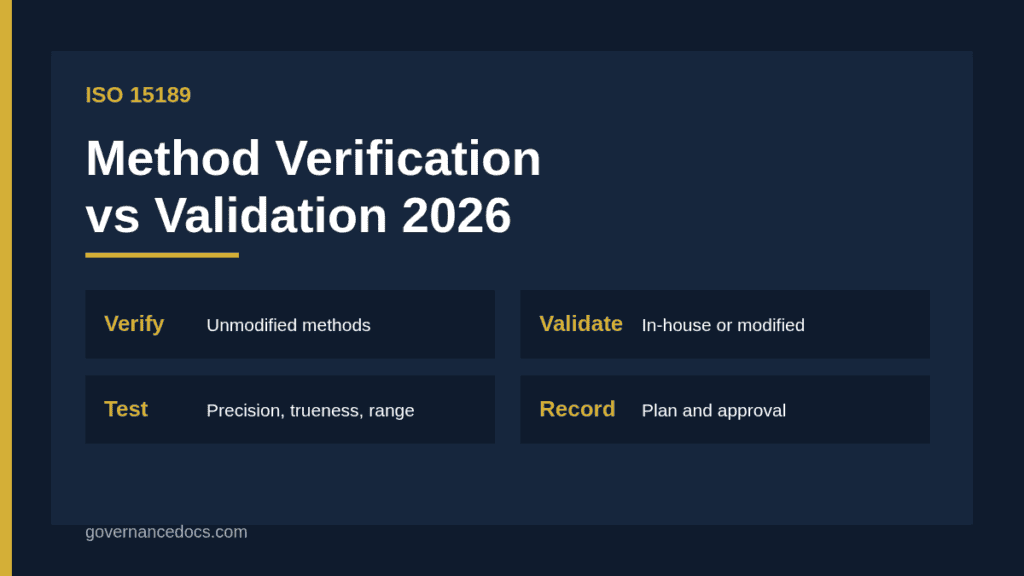
A practical summary published by the European Federation of Clinical Chemistry and Laboratory Medicine draws the line clearly. Verification applies when reliable performance data already exist, for example from the manufacturer, peer-reviewed literature or other accredited laboratories, and the laboratory confirms those characteristics in its own setting. Validation is required when the laboratory must collect its own data.
Situation
What you do
Unmodified commercial method with published performance
Verification
In-house developed procedure
Validation
Non-standard method
Validation
Validated method used outside its original scope
Validation
Modified procedure, for example a different sample type
Validation of the modification
Claims not available or failing acceptance criteria
Collect your own data, that is validate
The important sentence in the guidance is that if performance characteristics are not available or do not meet acceptance criteria, the laboratory collects its own data. In practice, that means verification can escalate to validation if results are poor.
Performance characteristics to consider
The guidance lists the characteristics a laboratory should consider. Not all apply to every method, so select those relevant to the intended use and justify your choices in the plan.
Precision. Repeatability and intermediate precision.
Trueness. Bias against reference values or a reference method.
Detection and quantitation limits. Where low results are clinically important.
Linearity and measuring interval. Proportional response across the reportable range.
Stability. Of samples, reagents and calibrators.
Carry-over. Contamination between samples.
Analytical interferences. Specificity and matrix effects, such as haemolysis, lipaemia and icterus.
Diagnostic characteristics. Sensitivity, specificity and decision limits where the result is a diagnosis.
The document does not specify sample sizes or one statistical approach. It says the work should be statistically sound and points to evaluation protocols from CLSI, such as EP5, EP7 and EP9, and to the Milan consensus on analytical performance specifications. Choose a recognised protocol, cite it, and follow it.
Plan first: the authorised protocol
Every verification or validation needs a written plan authorised by someone with appropriate authority before testing begins. The plan should state:
The intended use and the measurand.
The characteristics to be tested and why.
The protocol, sample types and numbers, and the statistical method.
The acceptance criteria, set in advance.
Who performs the work and who approves the results.
Setting acceptance criteria before you see the data is the point that separates a credible study from a rationalised one. Base them on analytical performance specifications, biological variation, manufacturer claims or clinical needs, and record the source. Our guide to measurement uncertainty shows how the results feed uncertainty estimates.
Carrying out the study
Run the study on the instrument, with the reagent lots, calibrators and operators that will be used in routine work. Use patient samples and control materials that cover the measuring range, including values near clinical decision points. Record raw data, calibration and control results for the run, deviations and any reagent or instrument problems. Store the data in a form that another person could recalculate.
Evaluate against the criteria
Compare each result with the pre-set acceptance criterion and record a clear pass or fail. If a characteristic fails, investigate before repeating. A repeated study without root cause analysis looks like data shopping. Where the method is acceptable only for a narrower range or sample type, restrict the intended use and document it.
Approval and go-live after ISO 15189 method verification
After the review, an authorised person signs the summary and approves the method for clinical use. The approval should cover the method version, the instrument, the reportable range, reference intervals or decision limits and any limits on use. Then update procedures, training records and the quality control plan, and confirm the laboratory information system is configured to match. Do not release patient results until all of these are in place.
Reference intervals and decision limits
If the method changes the way a result is reported, the reference interval or decision limit may need review. Laboratories often transfer intervals from the manufacturer, and verify them using a small group of reference individuals, or document a rationale for accepting the source. Record the choice and the evidence. Where a new method produces different results than the old one, tell clinicians about the change and how to interpret it.
Ongoing checks after go-live
Verification is a starting point. Monitor performance with internal quality control and external quality assessment, review trends, and re-verify after significant changes such as new reagent formulations, instrument relocation or major software updates. Link these events to your change control so that re-verification is not forgotten. Our page on proficiency testing explains how external assessment supports this, and laboratory quality indicators can flag problems early.
Documentation for ISO 15189 method verification
Good records make ISO 15189 method verification straightforward to defend. Keep a controlled record set for each method: the authorised plan, the raw data files, the calculation workbook or software output, the summary report with pass or fail statements, the approval signature and the effective date. Link the set to the method’s standard operating procedure and to the instrument record. Assessors will often pick a method at random and ask to see this whole chain, so keep it complete and easy to find.
Use a template so that every study looks the same. A standard template lists the intended use, the characteristics tested, the acceptance criteria and their source, the results and the conclusion. It also cuts the time needed to write each study and reduces the risk of omitting a required element. Review the template when the standard or your accreditation body’s guidance changes.
Building a verification calendar
Plan verification work as part of your annual schedule. List planned new methods, instrument replacements and major reagent changes, and give each a due date and an owner. Reserve time for the study before the go-live date, because pressure to start reporting is the most common reason studies are cut short. Review the calendar at each management review, and report progress against it. Where several sites use the same method, decide whether each site must verify locally, and document the rationale. Consistent ISO 15189 method verification across sites also makes comparison of results easier.
Training and competence
Only trained staff should plan, run and evaluate studies. Include statistics basics, protocol selection and the laboratory’s own templates in training, and assess competence by review of a completed study. Where the laboratory lacks statistical expertise, use an external adviser for the design and ask them to explain the choices, so that staff learn and the reasoning is recorded.
A hypothetical example
A hypothetical hospital laboratory installs a new immunoassay analyser for thyroid tests using a manufacturer’s kit. The quality manager writes a plan that names precision, trueness against certified material, the measuring interval and carry-over, cites the CLSI protocols, and sets acceptance limits from biological variation. The medical director approves it before work starts. Results pass for precision and range, but trueness shows a small positive bias at low concentrations. The laboratory documents the bias, confirms that it is clinically acceptable with the endocrinologists, adds a note to the report and approves the method with a restricted low range. The example is invented for illustration.
Common findings about ISO 15189 method verification
No authorised plan before testing.
Acceptance criteria written after the data were seen.
Only precision tested, with trueness and interference ignored.
Modified methods verified instead of validated.
Approval signed by the person who ran the study.
No re-verification after an instrument move or software update.
If you would rather not draft verification plans, data sheets and approval forms from scratch, the ISO 15189 Toolkit provides documents you can adapt to your laboratory. Ask your accreditation body whether it has additional requirements.
ISO 15189 method verification FAQ
When do we verify and when do we validate?
Verify unmodified methods with existing performance data. Validate in-house, non-standard or modified methods, or when existing data are missing or inadequate.
How many samples do we need?
The guidance summarised here gives no fixed number. Follow a recognised protocol, such as a CLSI evaluation protocol, and justify your design.
Who approves the study?
Someone with appropriate authority, before testing starts, and again for the final approval. It should not be the analyst alone.
Do we repeat verification after changes?
Assess the impact of each significant change and re-verify the affected characteristics. Record the decision even when you decide no repeat is needed.
Are acceptance criteria negotiable?
They should be set in advance from a documented source, and not adjusted to fit the results.