NIST Privacy Framework Govern-P is the function that turns privacy from a set of tasks into a managed programme: who decides, what risks are acceptable, how people are trained and how the organisation checks itself. Teams that jump straight to data maps and controls often find later that nobody owns the decisions those controls depend on.
This guide explains what Govern-P contains in version 1.0 of the framework, walks through its four categories, shows what evidence to prepare, and points to the changes proposed for version 1.1. For the framework overview, see our NIST Privacy Framework guide.
Free gap assessment
Is your privacy work built on the 2025 edition?
Score the standalone privacy management system, free, with privacy risk measured as risk to the individual rather than to you.
The framework’s core has five functions: Identify-P, Govern-P, Control-P, Communicate-P and Protect-P. NIST describes Govern-P as developing and implementing the organisational governance structure that enables an ongoing understanding of the organisation’s risk management priorities, informed by privacy risk. In plain language, it answers the questions of who is accountable for privacy risk, what the organisation is willing to accept, and how it keeps that decision-making going.
NIST Privacy Framework Govern-P is a management function, not a technical one. It draws on the understanding built in Identify-P, such as your data map, and feeds decisions to Control-P, Communicate-P and Protect-P. It is also the function auditors and executives are most likely to read, since it shows whether the programme is real.
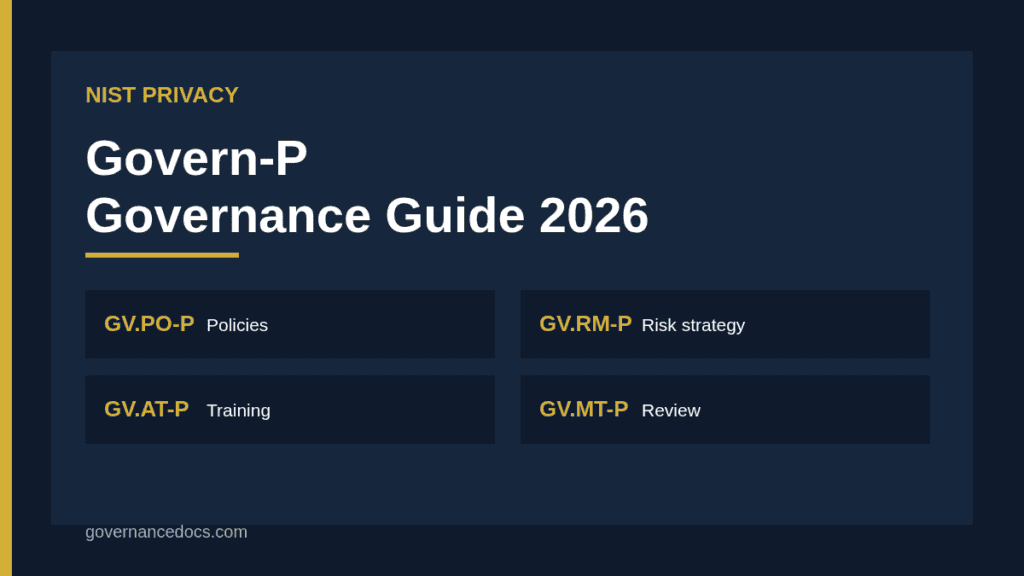
The four Govern-P categories
Category
Name
Purpose
Evidence to prepare
GV.PO-P
Governance policies, processes and procedures
Policies and procedures that manage regulatory, legal, risk, environmental and operational requirements informing privacy risk management
Organisational priorities, constraints, risk tolerances and assumptions that support operational risk decisions
Privacy risk strategy, risk tolerance statement
GV.AT-P
Awareness and training
Privacy education for the workforce and third parties engaged in data processing, aligned with roles and values
Training plan, completion records, role-based content
GV.MT-P
Monitoring and review
Ongoing review processes that assess the organisation’s privacy posture and inform risk decisions
Review schedule, metrics, audit and management review records
GV.PO-P: policies, processes and procedures
This category asks for the documents and roles that make privacy operate. That covers a privacy policy, procedures for handling requests and incidents, defined roles and responsibilities, and a way of tracking the legal and regulatory requirements that apply to you. Do not stop at a single policy. Each process, such as individual requests, vendor onboarding and new-product review, needs a procedure with an owner. Our comparison of the framework with the GDPR shows how legal obligations feed this category.
GV.RM-P: risk management strategy
This is the heart of the function. Set the priorities, constraints, risk tolerances and assumptions that let staff make consistent decisions. A risk tolerance statement for privacy might say what levels of harm to individuals the organisation will accept in pursuit of a business goal, how it treats sensitive data, and when a decision must be escalated. Privacy risk is about harm to individuals from data processing, which differs from cybersecurity risk to the organisation. See our note on privacy risk vs cybersecurity risk and the privacy risk register guide for the practical side.
Free privacy risk assessment
Which privacy risks would hurt the people whose data you hold?
List your personal data and processing, pick from 38 privacy risk scenarios, rate them for the people concerned and for you, and plan treatment with ISO 27701 controls. You get a heat map, a process score and the findings an auditor would raise, free.
The workforce and any third parties involved in data processing should receive education that fits their role. A developer needs to know about data minimisation and design choices, a support agent about identity checks and request handling, and a marketer about consent and profiling. Record who was trained, on what and when, and test understanding instead of only counting attendance.
GV.MT-P: monitoring and review
Governance in the NIST Privacy Framework is a loop. Set a schedule to review the privacy posture, using metrics, audit results, incidents and changes in law or business. Feed the results back into the risk strategy and the policies. Management review is the natural vehicle: a short, regular agenda with data, decisions and actions, minuted and followed up.
Building NIST Privacy Framework Govern-P in practice
Name accountable roles. Assign a senior owner for privacy risk and a lead who runs the programme, and set out responsibilities for everyone else.
Inventory obligations. List the laws, contracts and commitments that apply to your data processing.
Set the risk strategy. Write the priorities, tolerances and escalation rules, and have leadership approve them.
Create core procedures. Requests, incidents, assessments, vendors, new products and retention.
Train by role. Deliver and record training, including for third parties.
Set up review. Define metrics, a schedule and reporting to leadership.
Tiers describe how far your risk management practices have developed, and they should not be read as a ladder of maturity that everyone must climb. Govern-P is where the differences show most: a lower tier organisation makes privacy decisions case by case, while a higher tier one has integrated privacy risk into enterprise risk management with defined processes. Our article on implementation tiers explains how to choose a target tier that fits your risk.
Changes proposed for version 1.1
NIST has been developing version 1.1 of the framework, aligned with its Cybersecurity Framework 2.0. Our analysis, NIST Privacy Framework 1.1 vs 1.0, describes how categories and identifiers change. The important point for governance is that identifiers in your evidence may move, so record the outcome as well as the code, and keep a mapping table. Do not delay building the function while you wait, since the underlying practices are stable.
Measuring NIST Privacy Framework Govern-P
Leadership needs evidence that governance works. Choose a small set of measures for each category and report them at management review. For policies, track the share of core procedures that have an owner and were reviewed in the past year. For risk strategy, record how many decisions were escalated under the tolerance rules and how many were overturned. For training, report completion by role and results of short assessments. For monitoring, track how many actions from previous reviews were closed on time. Numbers of this kind turn a claim that the programme is in place into something a director or auditor can examine.
Roles that make governance real
A privacy steering group, meeting quarterly with representatives from legal, security, product, engineering, HR and marketing, gives the function a forum. Its charter should say what it decides, who chairs it and how it escalates to executives. In smaller organisations the same people can wear several hats, but the roles should still be written down. Where you have a data protection officer, align that role with the group and the reporting lines, so the person is not asked to run the programme and to oversee it at the same time.
A hypothetical example
A health app company with 150 staff has strong security but no privacy governance. It names the general counsel as accountable executive and a privacy lead as programme owner, writes a risk strategy that says it will not sell personal data, will treat health inferences as sensitive and will escalate any new use of that data to the executive. It builds procedures for individual requests and product reviews, trains engineers and support separately and holds a quarterly privacy review. Six months later, a product manager proposes sharing usage data with an analytics vendor. The review process flags the request, the risk tolerance rules it out, and the team designs an alternative. The example is illustrative only.
Common mistakes in NIST Privacy Framework Govern-P
No accountable owner. Privacy sits with IT or legal by default.
Policies without procedures. Documents exist, but nobody knows how to follow them.
No stated tolerance. Decisions depend on who is asked.
Training for staff only. Third parties handling data get none.
One-off review. The programme is assessed once and never revisited.
Confusion with security. Governance covers cyber risk but ignores harm to individuals.
Connecting NIST Privacy Framework Govern-P to other frameworks
Most organisations already run related programmes, and Govern-P should build on them. Your information security management system, your enterprise risk process, your compliance calendar and your vendor management all contain pieces of governance that can be reused. ISO 27701, for instance, extends an information security system with privacy controls, and our comparison of the NIST Privacy Framework and ISO 27701 shows where the two overlap. If you already hold a certification, map its governance evidence to the four categories, find the gaps and fill only those. That avoids duplicate committees and duplicate documents, and it keeps the privacy programme part of the way the organisation already manages risk.
Documents and templates
Govern-P is document heavy: a privacy governance charter, role descriptions, a legal requirements register, a risk strategy and tolerance statement, procedures, a training plan and a review calendar. The NIST Privacy Framework Toolkit includes templates for these, which you can tailor to your organisation. The primary text is the NIST Privacy Framework version 1.0, and you should check NIST’s site for the current status of version 1.1.
NIST Privacy Framework Govern-P FAQ
What does Govern-P cover?
Governance policies, processes and procedures, risk management strategy, awareness and training, and monitoring and review.
Is Govern-P the same as GDPR compliance?
No. The framework is voluntary and outcome-based, and it helps organise a programme that can support legal compliance but does not replace it.
Who should own Govern-P?
A senior executive should be accountable, with a privacy lead running the programme and contributors from legal, security, product and HR.
Do I need to wait for version 1.1?
No. Build governance on version 1.0 now and keep a mapping so evidence can move to any new identifiers.