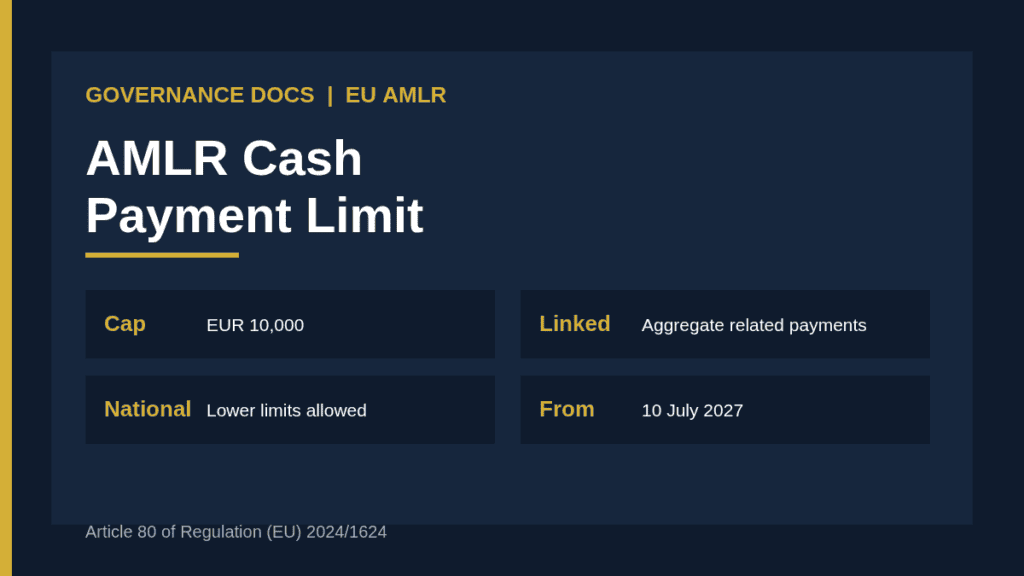
The AMLR cash payment limit is the rule in Article 80 of Regulation (EU) 2024/1624 that caps cash payments for goods and services at EUR 10,000, or the equivalent in another currency, whether the payment is made in one transaction or in several operations that appear to be linked. It applies across the European Union from 10 July 2027, and Member States may set lower limits of their own. For any business that accepts or makes large cash payments, the rule changes what can be sold for cash and how staff should respond when a customer arrives with a bag of banknotes.
This guide explains what Article 80 says, who it affects, what the exemptions are, how linked transactions work, and what to do now to prepare. The regulation itself is available on EUR-Lex, and this article is general information and not legal advice.
What the AMLR cash payment limit says
Article 80 limits large cash payments in exchange for goods or services. The text has seven paragraphs, and the main points are these.
Paragraph
What it does
1
Sets the limit at EUR 10,000 or equivalent, for single or linked payments
2
Lets Member States set lower limits, after consulting the European Central Bank and notifying the Commission
3
Keeps existing lower national limits in force
4
Exempts payments between individuals acting non-professionally and deposits at credit institutions, e-money issuers and payment service providers
5 and 6
Require Member States to apply proportionate and effective penalties
7
Allows temporary suspension if electronic payment is unavailable
Two features are worth noting. First, the cap applies to payments for goods and services, so it is about commercial transactions, not about holding cash. Second, it is a limit, not just a reporting threshold: above it, the cash payment should not be accepted, and the consequences of breach are set by national penalty rules.
Who the AMLR cash payment limit affects
Retailers of high-value goods, car dealers, jewelers, art and antique dealers, property developers, hospitality and service businesses, and anyone else who might be offered a large cash payment should look at the rule. The rule also concerns the customer, since a person making a cash payment above the cap is part of the breach. If you are an obliged entity under the wider regime, the cash limit sits alongside your customer due diligence and reporting duties. Our overview of the AMLR in 2027 explains the whole package, and the comparison of AMLR and AMLD shows how the regime differs from the earlier directives.
Linked transactions under the AMLR cash payment limit
The regulation refers to “several operations which appear to be linked.” A customer who buys a piece of jewelry on Monday for EUR 6,000 in cash and returns on Wednesday to pay another EUR 6,000 for a matching item has probably made linked payments that add up to more than the cap. The same applies to a deposit followed by a balance, or instalments paid in cash on a short cycle, if they relate to one purchase. Look at the timing, the goods, the parties and any sign that the payment was split to avoid the limit.
The following example is hypothetical. A car dealer agrees a price of EUR 14,000. The customer offers EUR 9,000 in cash today and EUR 5,000 in cash tomorrow. The dealer should treat this as a single payment for one sale exceeding the cap, refuse the cash structure, and offer a bank transfer or card payment for at least the excess. The deal is recorded, the reason is noted, and the compliance officer is told if the behavior looks like an attempt to evade the limit.
Lower national limits and exemptions
EUR 10,000 is a ceiling that Member States may lower. The text lets them set a lower limit after consulting the European Central Bank and notifying the Commission, and existing national limits below EUR 10,000 continue to apply. Businesses that operate in several countries therefore need a table of the limit in each country where they take payments, and a process to keep it current. If your national rule is stricter, follow it.
Article 80 does not apply to payments between natural persons who are not acting in a professional capacity, or to deposits made at credit institutions, electronic money issuers or payment service providers. In the case of a deposit above the limit, the text calls for reporting to the financial intelligence unit within the deadlines it sets, so financial institutions need to look at their own procedures. Confirm the scope of the exemptions with counsel for your business model.
How the AMLR cash payment limit fits with due diligence
The limit does not replace customer due diligence. Cash payments below the cap can still raise red flags, particularly where the customer has no clear source of funds, pays repeatedly just under the limit or wants to avoid paperwork. The AMLR also sets thresholds for identifying occasional customers, including lower cash-related thresholds for some businesses, so read the relevant customer due diligence articles for your sector. Our guide to CDD versus EDD explains how ordinary and enhanced measures differ, and the AML compliance officer role covers who should own the escalation.
Preparing for the AMLR cash payment limit
Map your cash exposure. Identify products, channels and sites where large cash payments could occur.
Find the national limits. List the limit in each Member State where you trade, and note whether it is below EUR 10,000.
Write a cash acceptance policy. State the maximum, how linked payments are aggregated and what staff should do when the limit is reached.
Configure systems. Flag payments and cumulative customer totals approaching the threshold in your point-of-sale and finance systems.
Train front-line staff. Use realistic scenarios, including split payments and customers who become aggressive when refused.
Set up escalation. Give staff a simple way to report suspicious behavior to the compliance officer, and record each case.
Offer alternatives. Make bank transfer, card and other traceable options easy so that refusing cash does not lose the sale.
Test and review. Run a check on the process, and update it when national rules change.
Handling the refusal well
Most customers who are told they cannot pay a large sum in cash are not criminals. They may simply not know about the rule. Give staff a short, friendly script that explains that the law limits cash payments above the threshold, and offer alternatives straight away. Keep a record of the conversation without accusing the customer of anything. If the customer becomes evasive, insists on splitting the payment or asks how to get around the rule, treat that as a sign to escalate to the compliance officer, and do not discuss suspicions with the customer. Manager backup matters: a junior employee should never be left to negotiate with a customer who is pressing to make a large cash payment.
Governance and reporting
Report the number of refused and escalated cash payments to senior management on a regular basis, together with any repeat customers or patterns. Trends can show where to add controls, for example by removing cash acceptance at a site or for a product line. Review the policy at least once a year and whenever national rules change, and keep the approval and review history so that you can show it to a supervisor.
Common AMLR cash payment limit mistakes
Assuming EUR 10,000 is the same everywhere. Some Member States already have stricter limits.
Ignoring linked payments. Treating each cash payment in isolation misses the aggregation rule.
Relying on staff memory. Without system prompts and clear scripts, the limit will be applied inconsistently.
Weak records. A refused payment with no note leaves you unable to show that the rule works.
Forgetting the effect on suppliers. Businesses that pay suppliers in cash are also within the rule.
Documenting your AMLR cash payment limit approach
An auditor or supervisor will ask for a written policy, a risk assessment that covers cash, training records and a log of refused or escalated payments. The EU AMLR Toolkit offers AML compliance templates that you can adapt to your organization, including policy and procedure documents that support the limit. Adapt the wording to your national rules and keep the evidence where you can find it in a hurry.
AMLR cash payment limit FAQ
When does the AMLR cash payment limit apply?
The AMLR applies from 10 July 2027. Some Member States already have national cash limits in force, which continue to apply.
Is the limit per transaction or per customer?
It applies to a payment for goods or services, whether made in one transaction or in several operations that appear to be linked. Treat related payments by the same customer for the same purchase as one.
Can a Member State set a lower limit?
Yes. It may set a lower limit after consulting the European Central Bank and must notify the Commission. Existing lower national limits stay in force.
Does the limit apply to payments between friends?
No. Payments between natural persons who are not acting in a professional capacity are exempt, as are deposits at credit institutions, electronic money issuers and payment service providers.
What happens if a business breaches it?
Member States must provide appropriate measures, including penalties, that are proportionate and dissuasive. The actual penalties depend on national law, so ask local counsel.