CART
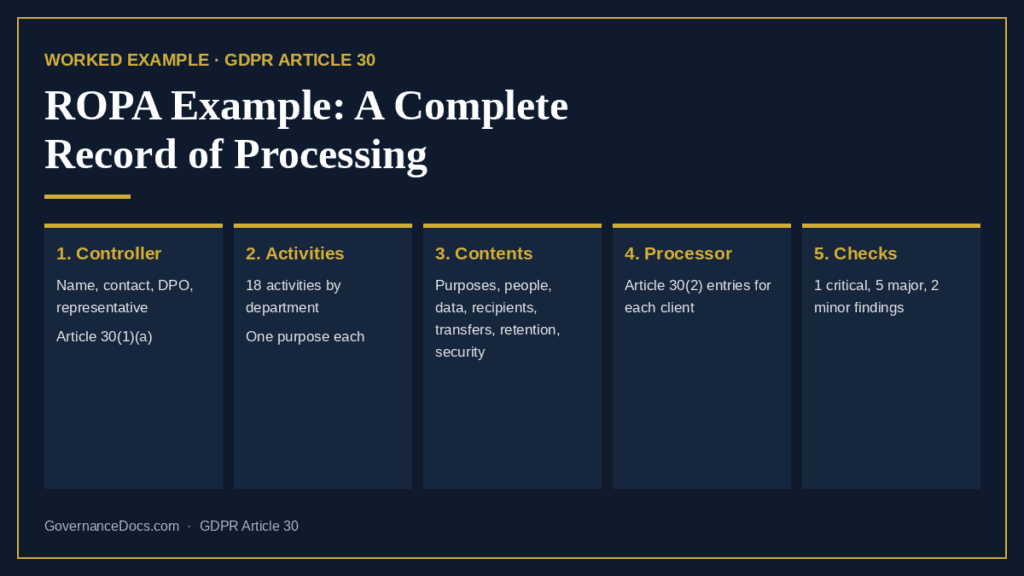
A ROPA example is the quickest way to see what a finished record of processing activities looks like, because Article 30 of the GDPR lists what the record must contain but never shows one filled in. This guide walks through a complete ROPA example for a fictional delivery company, from the controller’s details and the exemption check to three activities in full, the processor record and the gaps the checks found.
It follows the structure of our guide to records of processing: the controller record in Article 30(1), the processor record in Article 30(2), and the extra fields supervisory authorities recommend. The legal text is in Article 30 of the GDPR, and the same article applies under the UK GDPR.
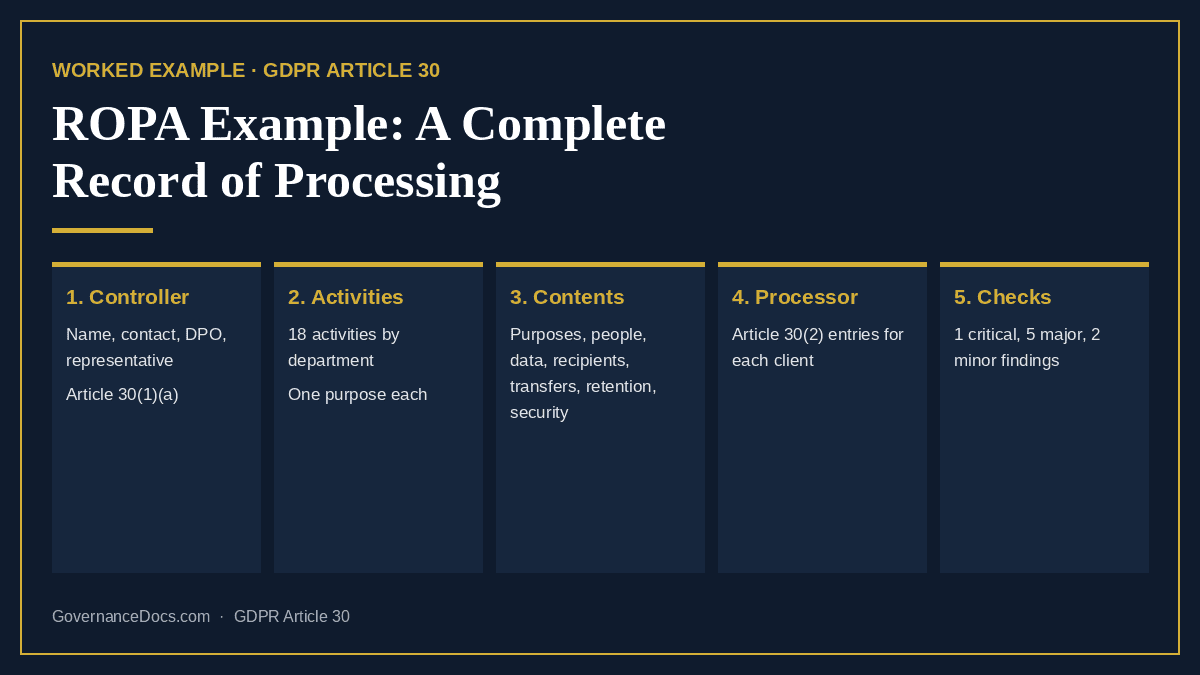
Harbour Logistics (a fictional company) employs about 320 people and runs parcel deliveries from three depots. It is a controller for its own staff, customers and suppliers, and a processor for the retailers and the pharmacy group whose parcels it delivers. It has appointed a data protection officer because it monitors drivers’ vehicles on a large scale.
| Controller detail, Article 30(1)(a) | What Harbour recorded |
|---|---|
| Name and contact details | Harbour Logistics, 14 Quay Road, Portside; privacy@ mailbox |
| Representative | Not applicable: established in the EU |
| Data protection officer | Data Protection Lead, with a dedicated mailbox |
| Joint controllers | None |
| Role | Controller for its own data, processor for clients |
The exemption in Article 30(5) covers organizations with fewer than 250 people, and only for processing that is occasional, unlikely to result in a risk and free of special category or criminal offence data. With 320 people, Harbour is outside the exemption altogether. A smaller business would still need a record in almost every case, because payroll and customer records are regular processing, not occasional.
Harbour started from a list of typical activities by department and kept 18: six in HR, two customer activities, two in marketing, three in IT and security, one in finance, three in legal and compliance, and one operational activity that no template had, vehicle telematics. The test for each entry is whether it has one purpose. “Customer data” is not an activity; “customer contracts and deliveries” and “customer support and complaints” are.
These three entries show the range: an ordinary HR activity, a monitoring activity with a DPIA behind it, and an activity with a transfer outside the EEA.
| Content | Payroll, pensions and benefits | Vehicle telematics and driver tracking | Customer support and complaints |
|---|---|---|---|
| Purposes, 30(1)(b) | Pay staff, deduct and report tax and social security, run pensions | Plan routes, give delivery times, monitor driving safety | Answer questions, resolve complaints |
| Data subjects, 30(1)(c) | Employees, former employees | Drivers, delivery recipients | Customers, members of the public |
| Personal data, 30(1)(c) | Salary, bank details, tax and social security numbers | Location, speed, driving events, proof-of-delivery photos | Contact details, correspondence, call notes |
| Lawful basis | Legal obligation (tax law) | Legitimate interests, with an LIA | Contract |
| Recipients, 30(1)(d) | Tax authority, pension provider, payroll bureau | Operations managers, telematics provider, clients (status only) | Outsourced support centre, helpdesk provider |
| Transfers, 30(1)(e) | None | None | India, no transfer tool recorded |
| Retention, 30(1)(f) | 6 years after the end of the tax year | Location 90 days; safety events 12 months | 3 years after the case closes |
| Security, 30(1)(g) | General description, plus restricted payroll access | General description | General description |
| DPIA | Not needed | Done: monitoring, profiling and employees | Not needed |
Harbour wrote one general description of its security measures and reused it for every activity, adding anything specific. Article 30(1)(g) asks only for a general description “where possible”, so this is enough; the detail belongs in the security policy.
As a processor, Harbour keeps a second, shorter record under Article 30(2). It has two entries: one for retail clients under the standard parcel delivery agreement, and one for the pharmacy group, whose deliveries reveal that a patient receives prescriptions and therefore involve health data. For each, the record names the client and its contact, the categories of processing, the sub-processors, transfers and the security measures, and whether the Article 28 contract is in place. Our comparison of controller vs processor ROPA records explains the difference in detail.
A ROPA example is also useful for what it gets wrong. Running the record through the checks in our free ROPA template gave a record score of 90 out of 100, held at Developing because of one critical finding:
None of these is visible in a spreadsheet that only lists activities. They show up because each entry records the lawful basis, the transfer tool, the retention period and the assessments behind it, which is why supervisory authorities recommend those fields even though Article 30 does not list them all.
Most organizations can reach a first complete draft in a few working sessions this way. The slow part is not the writing but getting accurate answers about recipients, transfers and retention, which is exactly where the findings in this ROPA example came from.
Use its structure, not its content. Your activities, bases, recipients and retention periods will differ, and a record copied from someone else describes their processing, not yours.
Enough that each has one purpose. A small business typically ends up with 15 to 30; a large group with several hundred, often split by business unit.
No. Article 30(3) requires it in writing, including in electronic form. A spreadsheet or a tool is fine, provided you can produce it for the supervisory authority on request.
Breaches of Article 30 fall under Article 83(4), with fines of up to 10 million euros or 2% of worldwide annual turnover, whichever is higher. In practice, a missing or out-of-date record is usually found during an investigation into something else.
To build your own in the same order, use our free ROPA template, which checks every entry as you go. The GDPR Toolkit includes an editable Records of Processing Activities register and the procedure for keeping it, and our sample reports include the full Harbour Logistics record.

September 30, 2026