GDPR data mapping means tracing the personal data your organization holds: where it comes from, where it is stored, who it is shared with, where it travels and when it is deleted. The GDPR never uses the words “data map”, but almost every obligation depends on one. You cannot keep records of processing, answer an access request, assess a transfer or scope a breach without knowing where the data is. This guide covers what GDPR data mapping should capture, how it relates to your records of processing, and a practical way to do it.
Free gap assessment
Could you demonstrate GDPR compliance today?
Score yourself against what a supervisory authority actually asks for, free — the records, not the policy.
The map is the evidence base for several obligations at once:
Records of processing.Article 30 requires a record of purposes, categories of people and data, recipients, transfers, retention and security. The map is where those answers come from; our guide to records of processing covers the record itself.
Privacy notices. Articles 13 and 14 require telling people what you collect, why, who receives it and how long you keep it.
Data subject rights. An access or erasure request has to reach every system that holds the person’s data, including backups and suppliers. See our guide to GDPR data subject rights.
Transfers. Chapter V needs a safeguard for every transfer outside the EEA, including remote access and sub-processors.
DPIAs and breaches. A data protection impact assessment starts with a description of the data flows, and a breach assessment starts with knowing what was in the affected system.
GDPR Data Mapping vs Records of Processing
Data map
Records of processing (ROPA)
Required by the GDPR?
Not by name
Yes, Article 30
Organized by
Systems, data stores and flows
Processing activity and purpose
Shows
Where data sits and moves, between systems and organizations
Why data is processed, whose, who receives it, transfers, retention, security
Typical format
Inventory plus flow diagrams
Register, one row per activity
Main audience
Privacy, IT and security teams
Supervisory authority, auditors, management
Changes when
A system, integration or supplier changes
A purpose, process or recipient changes
The two describe the same processing from different angles. Most organizations start with the activities, because the ROPA is the legal requirement, and map systems and flows for each one. Others start from a system inventory and group it into activities. Either works if they end up consistent.
What GDPR Data Mapping Should Capture
The activity and its purpose, such as payroll, customer support or email marketing.
The people the data is about: staff, applicants, customers, prospects, website visitors, children.
The data by category, flagging special category and criminal offence data.
The source: collected from the person, from another organization, or from public sources.
The systems and locations where it is stored, including backups, paper files and spreadsheets.
The flows: internal teams, processors, other controllers, authorities.
Transfers: every country outside the EEA or UK the data reaches, and the transfer tool.
Retention: how long each category is kept, and how it is deleted.
The owner of each activity and system.
A Practical GDPR Data Mapping Process
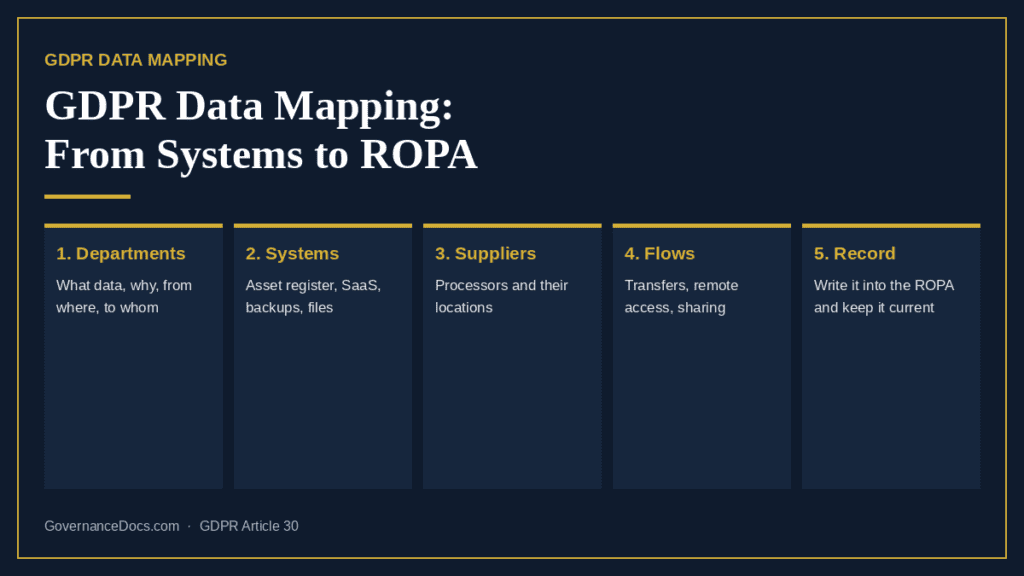
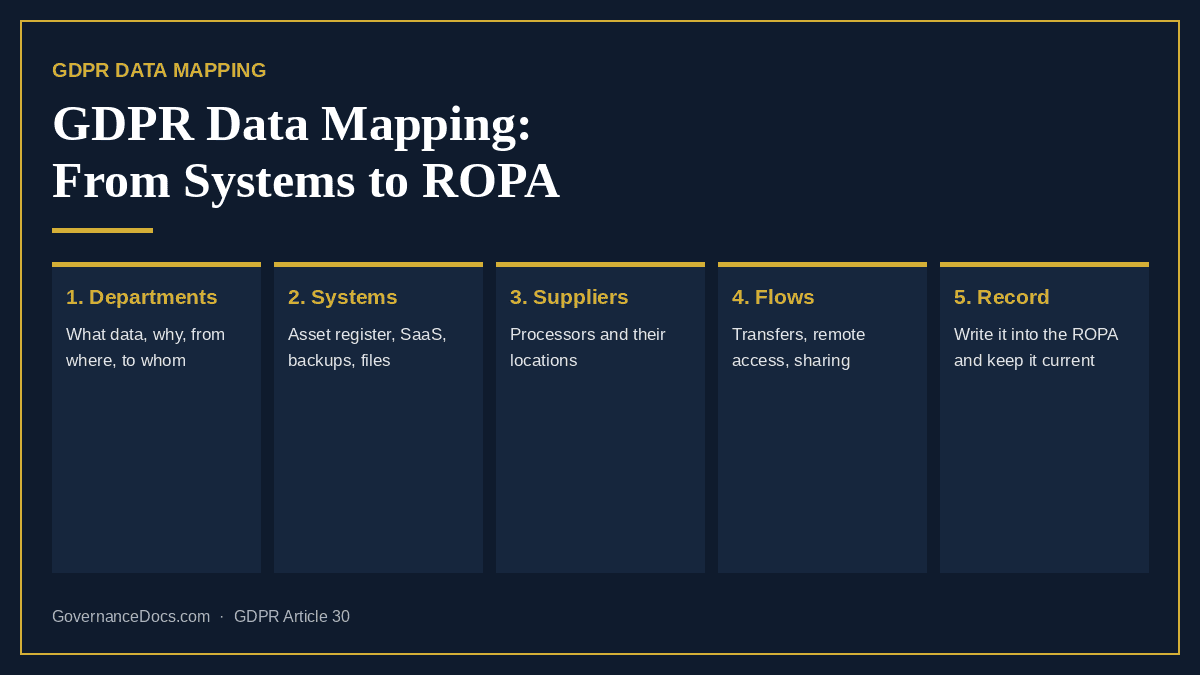
Start with departments, not systems. Interview each department head with a short questionnaire: what personal data do you handle, why, where does it come from, where does it go, and how long do you keep it?
Pull the system inventory. Your IT asset register, SaaS subscriptions and expense records show systems nobody mentioned. Our guide to the IT asset inventory covers building one.
List suppliers and their locations. Accounts payable is the fastest source for processors; each one’s sub-processor list shows where the data goes next.
Reconcile activities and systems. Every system should serve at least one activity, and every activity should name its systems. Gaps on either side are findings.
Draw flows where they matter. A diagram is worth it for high-risk activities, cross-border flows and anything going into a DPIA, not for every activity.
Write it into the record of processing. The ROPA is the output the GDPR requires, so the map should feed it directly.
Keep it current. Link updates to procurement, new projects and supplier changes, and review the whole map at least once a year.
Tools for GDPR Data Mapping
Spreadsheets work well for small and mid-sized organizations, provided each activity has one row and each column has a defined meaning. Dedicated privacy platforms add automated discovery and workflows, which pay off when there are hundreds of systems. In between, a structured builder that asks the Article 30 questions and checks the answers gives most of the benefit without a platform project. Frameworks can help too: the NIST Privacy Framework treats data inventory and mapping as a core activity, as our guide to the NIST Privacy Framework data map explains.
Common GDPR Data Mapping Mistakes
Mapping systems only. A list of applications does not say why data is processed, which is what the GDPR asks about.
Forgetting shadow data. Exports, spreadsheets, shared drives and email attachments often hold more personal data than the systems they came from.
Ignoring backups and logs. They hold personal data and have their own retention periods.
Missing remote access. A support team in another country viewing data is a transfer, even if the data never moves.
A one-off project. A map that was accurate eighteen months ago misleads everyone who relies on it now.
Frequently Asked Questions
Is GDPR data mapping mandatory?
The term is not in the regulation, but the records of processing in Article 30 are, and they cannot be completed without mapping the data. In practice, GDPR data mapping is how organizations meet Article 30.
How long does GDPR data mapping take?
For a small business, a first map can be done in a few weeks of part-time work. A larger organization with many systems and departments should expect a project of several months, followed by ongoing maintenance.
Who should own the data map?
The data protection officer or privacy lead usually coordinates it, but each activity needs a business owner who knows the process and keeps the entry current.
Our free ROPA template turns your GDPR data mapping into a record of processing activities, with a library of typical activities by department and checks for missing bases, transfer safeguards, retention and DPIAs. For the questionnaires, policies and registers behind it, see the GDPR Toolkit.