CART
No products in the cart.
ISO Compliance Insights & Best Practices
Is ISO 20000 worth it? For most IT departments the honest answer is no, and for most managed service providers it is a qualified yes that depends almost entirely on who is asking you for it. That is a less comfortable answer than the one certification bodies give, but the certificate numbers support it, and so does the audit-time table. This is the cost-benefit case for ISO/IEC 20000-1 in 2026, built on what ISO publishes rather than on what registrars put in brochures.
ISO/IEC 20000-1:2018 is the service management system (SMS) requirements standard. It is the only ITSM standard an organization can actually be certified against, it is stable, and it is cheap to audit compared with almost anything else in the catalogue. It is also, outside one country, a small scheme. Both halves of that matter to the decision.
Free gap assessment
How much of your service management system could you evidence?
Score every clause of ISO/IEC 20000-1, free, including the service management plan, service reporting and knowledge requirements generic checklists miss.
Run the free ISO 20000 gap assessment → or View premium report sample
Is ISO 20000 worth it? There is no single answer, only five, and they turn on your commercial position rather than on your process maturity.
| Your situation | Verdict | Why |
|---|---|---|
| MSP or outsourcer with the certificate named in live tenders or a customer contract | Yes, clearly | The fee is small against a single contract, and nothing else satisfies the request. ITIL certificates belong to individuals, not to your company. |
| MSP bidding into public sector or enterprise supply chains where it is scored but not mandatory | Probably | Evaluation weighting is worth real money, and the audit is priced off your SMS headcount, not your company headcount. |
| Internal IT function with no external customers | Rarely | You are paying an external auditor to tell your own employer that you run a tidy service desk. Use the standard as a framework and skip the certificate. |
| Already certified to ISO/IEC 27001 and selling managed services | Often yes | Roughly half the SMS is the harmonized structure you already run, and an integrated audit prices accordingly. |
| Reseller or broker that subcontracts the entire service | No — you may not be eligible | Clause 8.2.3 does not permit other parties to provide or operate every service, service component and process inside your SMS scope. |
If your row says yes, the rest of this post is about sizing the spend. If it says no, stop at the framework and keep the money.
This is the part almost nobody writes, and it is the single most useful fact in the decision. ISO/IEC 20000-1 looks like a major standard in the league table and behaves like a niche one in most markets.
ISO’s own subcommittee for IT service management, ISO/IEC JTC 1/SC 40, publishes an analysis of the ISO Survey written by the project editor of the standard itself. Its figures for 2022, the most recent year with a 20000-1-specific commentary, are worth reading slowly:
Read the third and fourth bullets together. Take China out and roughly three thousand certificates are spread across ninety-one other countries. In the United States, the United Kingdom or Germany, an ISO/IEC 20000-1 certificate is not a widely understood signal the way an ISO 27001 certificate is. Procurement teams will recognise it; they will not usually have a box waiting for it.
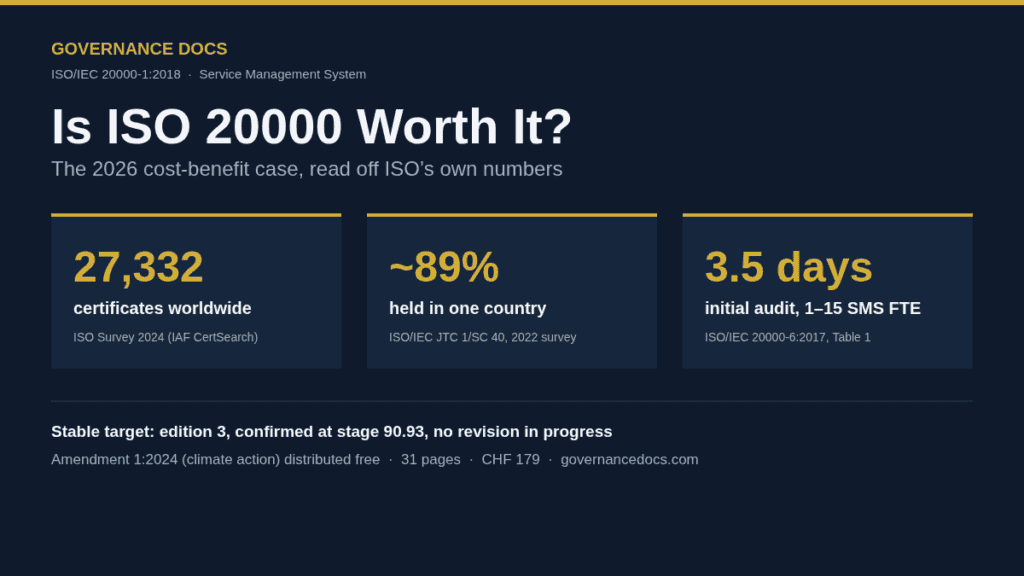
The growth story has also stopped. The ISO Survey for 2024, now compiled from IAF CertSearch data, reports 27,332 certificates across 43,277 sites — essentially flat on 2022 after that 129% jump. A standard whose worldwide total has not moved in two years is not a bandwagon you are late for.
None of that makes the standard bad. It means the value has to come from a specific buyer in your specific pipeline, not from general market recognition. When someone asks whether ISO 20000 is worth it and the honest answer is “who asked you for it?”, that is not evasion — it is the whole analysis.
Four things, and only the first of them is the reason most buyers end up deciding that ISO 20000 is worth the fee.
ITIL is guidance and certifies people. No organization is certified against ITIL, so a customer asking for evidence of service management control cannot be satisfied with your staff’s personal certificates. ISO/IEC 20000-1 is written in “shall”, is auditable, and produces a certificate with an accreditation mark on it. If you have ever lost a bid on a governance question, that gap is the thing the certificate closes. Our comparison of ISO 20000 vs ITIL maps the two onto each other clause by clause.
Clause 8.2.3, control of parties involved in the service lifecycle, is the requirement most ITSM teams underestimate and the one that earns its keep. You have to identify every other party in the delivery chain, apply selection criteria, and stay accountable for work you do not perform. For an MSP built on cloud platforms and subcontracted field engineers, that is a genuine capability, not paperwork — and it is exactly what an enterprise customer is trying to test when it asks how you manage fourth parties.
Teams running good ITIL practices normally sail through clause 8 and stall on the management system around it: the service management plan, service reporting, the documented scope, knowledge requirements and management review. That is where certification adds discipline rather than ceremony. Our breakdown of the ISO 20000 mandatory documents lists what has to exist in writing before a Stage 2 audit.
ISO/IEC 20000-1:2018 is at edition 3, was confirmed by ISO at stage 90.93 with no revision project in progress, and runs to 31 pages on the ISO catalogue entry at CHF 179. The only change since publication is Amendment 1:2024, the climate action text, which ISO distributes at no charge. Compare that with ISO 9001 and ISO 14001, which both moved to 2026 editions and carry transition work for every existing certificate holder. There is no transition audit to budget for here.
Cost is the smaller half of whether ISO 20000 is worth it, and it is already broken out in detail elsewhere on this site, so here is the short version. The audit fee is auditor days times a day rate, and the day count is published. ISO/IEC 20000-6:2017 is the standard accreditation bodies hold registrars to, and its Table 1 sets initial audit time from the effective number of personnel — counted as full-time equivalents within the SMS scope, not across your company. That distinction is the largest lever a buyer controls: a thirty-person service delivery team inside a five-hundred-person business is audited as thirty.
| Effective personnel in SMS scope (FTE) | Initial audit, Stage 1 + 2 (days) | Annual surveillance (days) | Recertification (days) |
|---|---|---|---|
| 1–15 | 3.5 | 1.17 | 2.33 |
| 16–25 | 4.5 | 1.5 | 3 |
| 26–45 | 5.5 | 1.83 | 3.67 |
| 46–65 | 6 | 2 | 4 |
| 86–125 | 8 | 2.67 | 5.33 |
| 176–275 | 10 | 3.33 | 6.67 |
Three rules from the same source discipline the quote: adjustments may not cut more than 30% off the table time, the initial audit has a floor of 2.5 days however small you are, and the audit delivered must be at least 80% of the calculated time. A registrar quoting far below the table is either miscounting your people or is not accredited for this scheme.
At the $1,200 to $2,500 per auditor day that accredited bodies typically charge in the US market, a 1–15 FTE scope puts the initial audit at roughly $4,200 to $8,750, and the first three years of certification body invoices at something like $7,500 to $17,000 once two surveillance visits and the application and certificate fees are added. Total programme cost over three years, including consultant help, training, documentation and the internal hours nobody logs, realistically lands between $19,000 and $45,000 at that size and between $80,000 and $150,000 for a 176–275 FTE scope. Those totals are our arithmetic off the published day table and typical day rates, not a survey. The full component-by-component build is in our ISO 20000 certification cost breakdown, and the sequence of events is in how ISO 20000 certification actually works.
Take a twelve-person managed service provider with an average contract worth $60,000 a year at a 25% gross margin. Three-year programme cost at the low-to-mid end of the band above: call it $28,000, of which maybe $10,000 is cash out the door and the rest is your own team’s time.
That spend is repaid by two additional contracts won over three years, on gross margin alone. One contract retained that you would otherwise have lost on a governance question pays for it. So the question is not whether $28,000 is a lot of money. It is whether you can name a single deal in your pipeline where the certificate would have changed the outcome. If you can name one, the answer to is ISO 20000 worth it is yes and the payback is inside eighteen months. If you cannot name one, no amount of process benefit closes that gap, because the process benefit is available to you free — the standard is a framework you may implement without ever being audited against it.
The same arithmetic run for an internal IT function produces no revenue line at all, which is why the verdict table says rarely. Internal teams that want external validation usually get more from an ISO 27001 certificate, which customers and insurers do ask about by name. We ran that comparison in Is ISO 27001 worth it?
Four situations where the answer to is ISO 20000 worth it is a straight no and the money is better spent elsewhere:
If you have decided ISO 20000 is worth it, three levers change the return materially. In order of size:
Scope the SMS to the services you sell, not to the IT department. Because the day count keys off personnel inside the SMS, every person you correctly leave out of scope is money saved for the life of the certificate — and you save it again at every surveillance visit and every recertification. This is the one decision to get right before you approach a registrar.
Audit it alongside ISO/IEC 27001. Clauses 4 to 7, 9 and 10 are the harmonized management system structure the two standards share, so an integrated audit does not pay to examine leadership, planning, support, evaluation and improvement twice. ISO/IEC 20000-6 permits a reduction for an existing certified system on three conditions: the other standard is relevant to the SMS being audited, the certificate has been audited by an accredited certification body within the last twelve months, and its scope is the same as or broader than the ISO/IEC 20000-1 scope. Our side-by-side on ISO 20000 vs ISO 27001 shows where the two overlap.
Do not buy the documentation twice. Consultant fees are the largest controllable line in the programme, and most of what a consultant delivers in the first six weeks is documents. The ISO 20000 Toolkit covers the certifiable SMS end to end — scope, service management plan, the clause 8 practice procedures, service reporting and the internal audit and management review records — as editable Microsoft Office files at $99, which is roughly one hour of consultant time. Use the consultant for the judgement calls and the gap closure instead.
One further lever worth knowing about: ISO/IEC TS 20000-16:2025 gives guidance on sustainability within a service management system. If your customers are asking ESG questions in tenders, that work can ride on the SMS you are already building.
Being ITIL-aligned makes certification cheaper, not unnecessary. Good ITIL practice evidences most of clause 8, so your gap is usually the management system wrapper — documented scope, the service management plan, service reporting, management review. What ITIL cannot give you is the certificate itself, because ITIL certifies individuals. If a customer is asking for organizational proof, alignment is not an answer.
For a team with functioning ITSM processes, four to eight months from decision to certificate is realistic: two to four months to close documentation and evidence gaps, a month of running the SMS so there is something to audit, then Stage 1 and Stage 2 with a gap of several weeks between them. Starting from no documented processes, plan on nine to twelve months.
No. An unaccredited certificate costs less and proves less, and a customer running your registrar through IAF CertSearch will find nothing. If the point of the exercise is to answer someone else’s question, the accreditation mark is the part they check. Ask the registrar which accreditation body signs its scope for ISO/IEC 20000-1 before you accept a quote.
The certificate runs on a three-year cycle with annual surveillance audits and a recertification audit in year three. Surveillance is at least a third of the initial audit time each year and recertification at least two-thirds, so the ongoing cost is predictable — roughly a third to a half of the initial audit fee every year, forever.
It can, if a single SMS genuinely runs across them. Multi-site sampling adds audit time rather than multiplying it, but the head office has to hold real authority over the sites, including the power to require corrective action. Federated IT departments that call themselves one service provider are where this falls apart at Stage 1.
Usually not. The standard is about operating and improving services across a lifecycle, and a product company that ships software without running it for customers has little to certify. A SaaS business that operates the platform is a different case and often a good fit, though those buyers are typically asked for SOC 2 or ISO 27001 first.
Is ISO 20000 worth it? It is worth it when a customer or a tender asks for it, and it is unusually cheap to obtain when that happens: a small, stable, 31-page standard with a published audit-day table, priced off the headcount inside your service scope rather than your whole business. It is not worth it as a general market signal, because outside China the scheme is small and has stopped growing. Decide it on your pipeline, scope it tightly, audit it with your ISO 27001 certificate if you have one, and do not pay a consultant to write templates. For the wider picture of what a service management system is supposed to achieve, start with aligning IT service management with the business.

September 30, 2026
September 30, 2026