CART
EU AI Act compliance cost depends almost entirely on one classification decision: whether any AI system you provide or deploy is high-risk. For everything else — a chatbot, a content generator, an internal analytics model — the obligations are a transparency notice, an AI-literacy programme and a screening against the prohibitions, and the cost is measured in days of effort.
For a high-risk system, the Commission’s own impact assessment put the direct per-system cost at €6,000 to €7,000 plus €3,000 to €7,500 for conformity assessment, and critics put the all-in cost for a small company with no quality management system at up to €400,000. Both figures are from 2021, and both are worth understanding before you believe either.
This guide sets out what the official estimates actually say, what they leave out, the cost lines a real programme has in 2026, and the 2026 Digital Omnibus changes that reduce the bill for smaller companies.
The European Commission’s impact assessment accompanying the 2021 proposal (SWD(2021) 84) built its numbers on a Standard Cost Model with an assumed average AI system development cost of €170,000. Its conclusions, taking business-as-usual into account:
The Center for Data Innovation’s July 2021 response argued the assessment understated the burden: a small business (up to 50 employees or €10 million turnover) could expect total compliance costs of up to €400,000 for one high-risk product requiring a new quality management system, cutting profit by 40% at a typical 10% margin, and the Act would cost the European economy €31 billion over five years. CEPS, which produced the Commission’s supporting study, published a rebuttal contesting the reading of the assessment behind those figures.
Read both EU AI Act compliance cost figures with two facts in mind. The per-system figures assume the quality management system already exists — building one is the large fixed cost neither number isolates well. And both were estimated against the 2021 proposal; the adopted Regulation and its 2026 amendment changed scope, added general-purpose model obligations, and introduced SME simplifications.
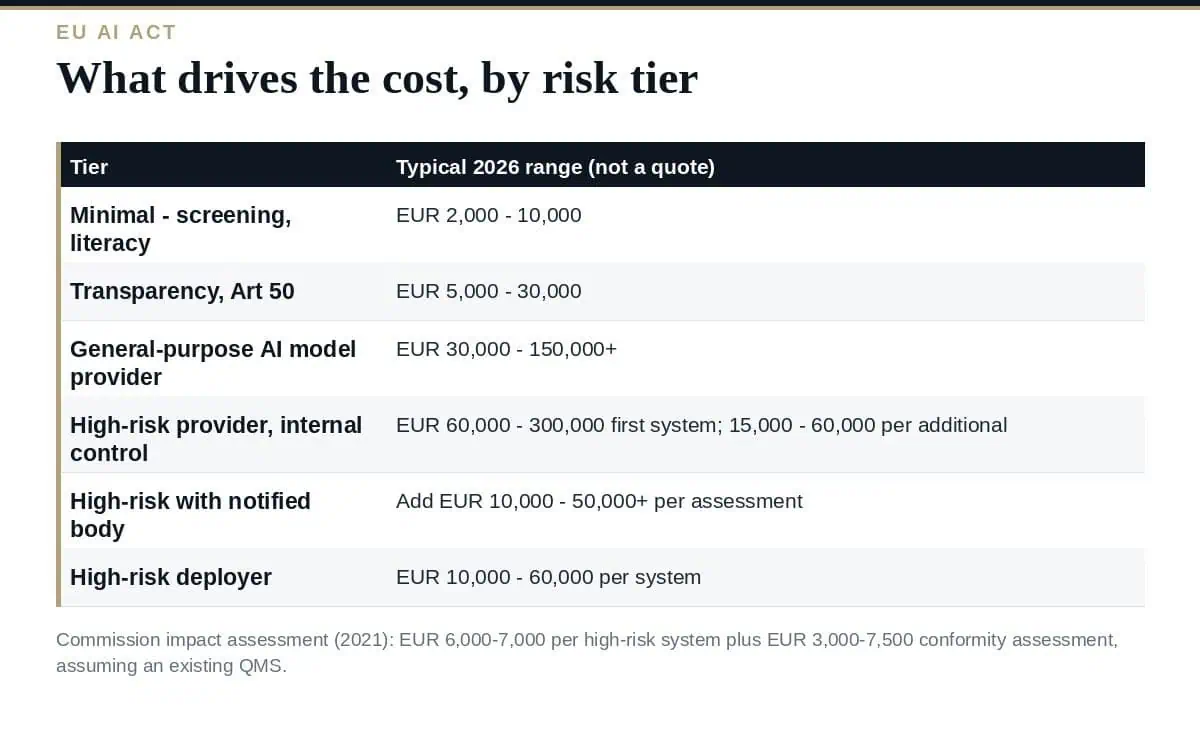
| Tier | Obligations | Typical 2026 cost range (not a quote) |
|---|---|---|
| Minimal or no specific obligations | Screen against Article 5 prohibitions; AI literacy (Art 4); voluntary codes | €2,000 – €10,000 for an inventory, screening record and training programme |
| Transparency (Art 50) | Disclose AI interaction; machine-readable marking of synthetic content; deepfake and public-interest text labelling | €5,000 – €30,000: engineering for marking and labels, plus policy and records; higher where content pipelines are complex |
| General-purpose AI model provider (Chapter V) | Technical documentation, downstream information, copyright policy, training-content summary; systemic-risk duties above the threshold | €30,000 – €150,000+ for a first documentation set; systemic-risk models are a different order |
| High-risk provider (Annex III), internal control | Risk management, data governance, technical documentation, logging, transparency, human oversight, accuracy/robustness/cybersecurity, QMS, conformity assessment, registration, post-market monitoring | €60,000 – €300,000 first system with a new QMS; €15,000 – €60,000 per additional system |
| High-risk provider with notified body (biometrics without harmonised standards; Annex I products) | As above, plus third-party QMS and technical documentation assessment | Add notified-body fees, typically €10,000 – €50,000+ per assessment, and certificate renewal every 4–5 years |
| High-risk deployer (Art 26) | Use per instructions, human oversight, input data control, log retention, worker information; FRIA for certain deployers (Art 27) | €10,000 – €60,000 per system for oversight design, records and the impact assessment |
The EU AI Act compliance cost ranges above are typical market figures for 2026, built up from the cost lines below; your own will move with the number of systems, whether a management system already exists, and whether you develop models or buy them. Which tier applies is covered in our EU AI Act risk categories guide.
Regulation (EU) 2026/1744, in force since 27 July 2026, reduces the EU AI Act compliance cost of high-risk systems for smaller providers in three ways: a simplified technical documentation form for SMEs and small mid-caps under Article 11; a proportionate approach to the quality management system under Article 17; and extension of the SME simplification measures in Article 63 to small mid-caps, with priority access to regulatory sandboxes.
It also moved the Annex III high-risk application date to 2 December 2027 and Annex I to 2 August 2028, which spreads the spend over more budget cycles without reducing it. The transparency obligations in Article 50, applying since 2 August 2026, were not deferred, so their cost is due now — see our guide to the EU AI Act transparency obligations.
Article 99 fines run to €35 million or 7% of worldwide turnover for a prohibited practice and €15 million or 3% for most other obligations — lower of the two for SMEs — on top of market withdrawal orders. Against a five-figure transparency programme or a six-figure high-risk one, the arithmetic is not close. Our guide to EU AI Act penalties sets out the tiers.
How much does EU AI Act compliance cost for a small company?
For non-high-risk uses, typically €2,000–€30,000 for screening, transparency and literacy work. For a first high-risk system with no existing management system, typical 2026 programmes run €60,000–€300,000; the 2021 critics’ figure of up to €400,000 assumed a new QMS built from scratch.
What is the Commission’s own estimate?
Around €6,000–€7,000 per high-risk system for compliance plus €3,000–€7,500 for conformity assessment, assuming an existing QMS — from the 2021 impact assessment, SWD(2021) 84.
Does a deployer pay as much as a provider?
No. Deployer obligations are narrower — oversight, input control, logs, worker information and in some cases a fundamental rights impact assessment — and cost a fraction of a provider’s conformity programme.
Are there fees for registering in the EU database or for CE marking?
No fee for registration or for affixing the CE marking. Costs arise from the work behind them and, where required, from the notified body.
Did the Omnibus reduce EU AI Act compliance cost?
For SMEs and small mid-caps, yes, through simplified documentation and proportionate QMS requirements; for everyone, it delayed the high-risk dates, which spreads cost rather than removing it.
Start the EU AI Act compliance cost estimate with classification, because nothing else is decidable until you know how many high-risk systems you have. Then price the quality management system honestly — it is the fixed cost the official per-system figures leave out — and build documentation and logging into the development pipeline rather than after it. Treat the 2021 estimates as bounds, not budgets, and use the Omnibus simplifications if you qualify for them.
The QMS, technical documentation, risk management and monitoring templates that make up most of the fixed cost are in the EU AI Act Toolkit (60 templates), or start with the free templates.

September 14, 2026
September 14, 2026

September 14, 2026
September 14, 2026
September 14, 2026

