A vendor security questionnaire is the moment a sales cycle stops being about your product and starts being about your paperwork. The deal is agreed, legal is drafting, and then a spreadsheet arrives from the buyer’s security team with two hundred questions, a two-week deadline and no obvious owner on your side. Handled badly, it adds a month to the close. Handled well, it is a formality you complete in two days.
This guide covers what a vendor security questionnaire actually contains, why the same questions keep appearing in different clothes, how to build an answer library once instead of improvising every time, and which answers reliably stall a deal. It is written for the vendor answering the questionnaire, not the buyer sending it.
Free gap assessment
Where do you actually stand against ISO 27001?
Score every management system clause and all 93 Annex A controls, free, and get a prioritised gap list back.
What a vendor security questionnaire is really asking
Behind the format, every vendor security questionnaire asks the same three things: can you describe your security controls, can you evidence them, and is anyone independent checking. The question count varies enormously; the underlying intent does not.
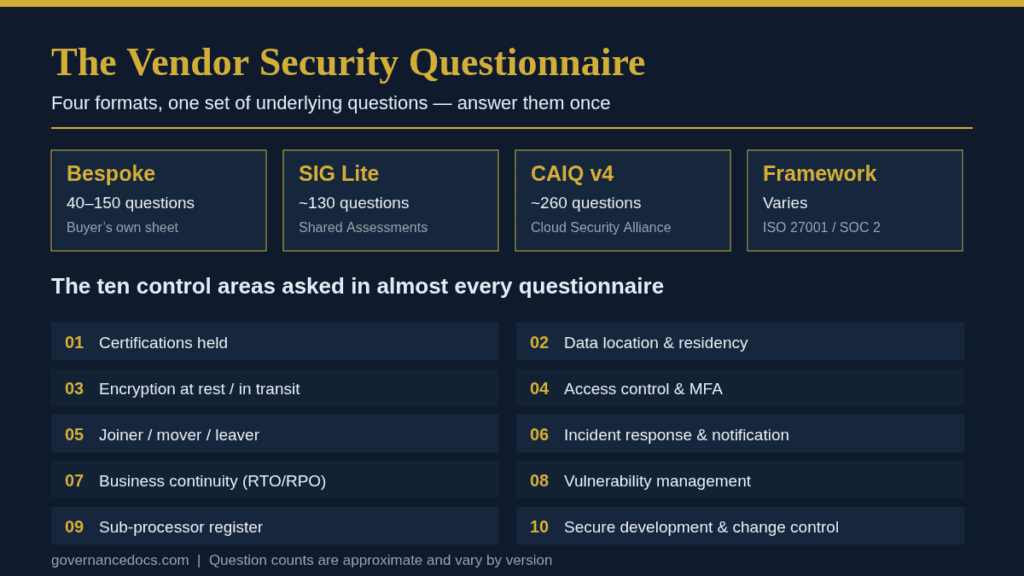
You will typically meet one of four formats:
A bespoke spreadsheet. The buyer’s own list, usually 40–150 questions, often assembled from a template someone edited in 2021. Highly variable quality.
SIG and SIG Lite. The Shared Assessments Standardized Information Gathering questionnaire. SIG Lite runs to roughly 130 questions; the full SIG is several times that and is usually reserved for critical suppliers.
CAIQ. The Cloud Security Alliance’s Consensus Assessments Initiative Questionnaire, mapped to the Cloud Controls Matrix. CAIQ v4.1 carries 283 questions across 17 domains; CAIQ Lite is a condensed subset.
A framework-derived list. Questions lifted straight from ISO 27001 Annex A, SOC 2 Trust Services Criteria or a NIST control family.
The practical consequence is that the same underlying control gets asked about in four different phrasings. That is exactly why an answer library beats answering each vendor security questionnaire from scratch.
The questions that appear in almost every vendor security questionnaire
Across formats, a stable core recurs. If you can answer these ten cleanly and attach evidence, you have covered most of what any buyer will ask.
Question area
What the buyer is checking
Evidence to have ready
Certifications held
Independent assurance exists
ISO 27001 certificate, SOC 2 report, scope statement
Data location and residency
Legal and regulatory exposure
Sub-processor list, hosting regions
Encryption
Data at rest and in transit
Encryption standard, key management approach
Access control and MFA
Who can reach customer data
Access control policy, MFA enforcement evidence
Joiner / mover / leaver
Offboarding actually happens
Onboarding-offboarding procedure, access review records
Incident response
Notification timelines
Incident response plan, last test date
Business continuity
Recovery objectives
BCP, RTO/RPO figures, last exercise report
Vulnerability management
Patch cadence and scanning
Patch policy, scan cadence, pen test summary
Sub-processors
Fourth-party risk
Current sub-processor register
Secure development
Code review and change control
SDLC policy, change management records
Notice how many of those rows are documents rather than technology. Buyers are not usually testing your stack in a vendor security questionnaire — they are testing whether the control is governed, written down and reviewed.
Build the vendor security questionnaire answer library once
The single highest-return move is to stop treating each questionnaire as a project. Build a reusable source of truth and the marginal cost of the next one falls to a few hours.
Create a canonical answer bank. One row per control area, with a short answer, a long answer, and a link to the supporting document. Version it and give it an owner.
Write the answers against a framework, not against a customer. If your answers map to ISO 27001 Annex A or the SOC 2 criteria, they will translate into any questionnaire format you are sent.
Assemble an evidence pack. Certificate, scope statement, latest pen test summary letter, sub-processor list, insurance certificate, architecture diagram, and your top ten policies as PDFs.
Publish a trust page. A public page carrying the certificate, sub-processor list and a security overview deflects a surprising share of questionnaires entirely, and shortens the rest.
Set an SLA internally. Name one owner, agree a five-business-day turnaround, and route only genuinely new questions to engineering.
Our guide to third-party risk management covers the same process from the buyer’s side, which is useful context — knowing how your answers get scored changes how you write them.
Vendor security questionnaire answers that stall deals
Reviewers are not looking for perfection. They are looking for consistency and honesty. Four patterns reliably trigger escalation.
Blank cells and “N/A”. An unexplained N/A reads as evasion. If a control genuinely does not apply, say why in one sentence: “Not applicable — we do not process payment card data; card handling is delegated to our payment provider.”
“Yes” without evidence. Claiming a control you cannot evidence is the worst possible outcome, because it converts a minor gap into a trust problem when the reviewer asks for the document.
Contradicting your own certificate. If your ISO 27001 scope covers one product line and your questionnaire answers imply company-wide coverage, a competent reviewer will notice. Keep your Statement of Applicability and your questionnaire answers aligned.
Overclaiming on certifications. “SOC 2 compliant” is not a thing — SOC 2 is an attestation issued by a CPA firm, and you either have a report or you do not. Similarly, HIPAA is a legal obligation, not a certification. Buyers’ security teams know the difference and treat sloppy language as a signal.
Where a gap is real, the strongest answer is a dated commitment: the control is not in place, here is the plan, here is the target date. Reviewers accept roadmaps far more often than they accept vagueness.
What the buyer does with your answers
Understanding the other side of the process explains why certain answers get chased and others sail through. Most buyers run four steps.
Tiering. Before the questionnaire is even sent, you are classified by the data you will hold and how critical you are to the buyer’s operations. A tier-one vendor gets the long questionnaire, evidence requests and an annual reassessment; a low-risk vendor may get a short form and never be revisited. If you can argue credibly for a lower tier — you hold no personal data, you are not in the critical path — do it early, because tiering decides how much work follows.
Scoring. Answers get scored against the buyer’s own control expectations, usually with a small number of hard fails: no MFA, no encryption at rest, no incident notification commitment, no independent assurance. Everything else generates findings rather than rejections.
Remediation and exceptions. Findings become either a remediation request with a date, or a documented exception signed off by someone senior on the buyer’s side. This is where a clear roadmap answer is worth more than a defensive one; you are helping the reviewer write the exception.
Reassessment. Most programmes reassess annually, and many trigger an off-cycle review when you have a security incident, change sub-processors, or let a certificate lapse. Keeping your answer bank current is cheaper than rebuilding it every twelve months.
Does certification remove the vendor security questionnaire?
Not entirely, but it changes the conversation. An ISO 27001 certification against ISO/IEC 27001:2022 lets you answer a large block of questions with a certificate plus a scope statement, and it gives the reviewer an accredited third party to lean on rather than your word.
In practice, certified vendors report shorter questionnaires, fewer follow-up calls and fewer requests for bespoke security addenda in the contract. Buyers still send a questionnaire — procurement processes rarely allow otherwise — but it becomes a mapping exercise instead of an interrogation. If you are weighing ISO 27001 against SOC 2 for this reason specifically, our ISO 27001 vs SOC 2 comparison covers which buyers ask for which.
Frequently asked questions
How long should a vendor security questionnaire take to complete?
A first questionnaire without an answer library commonly takes 15–40 hours spread across security, engineering, legal and HR. With a maintained answer bank and evidence pack, the same questionnaire usually takes two to four hours.
Who should own it?
One named owner, usually whoever owns the ISMS or compliance function, with subject-matter reviewers on call. Distributed ownership is the main cause of inconsistent answers, and inconsistency is what reviewers escalate.
Can we refuse to complete one?
You can, and some vendors with strong market position do, offering a trust page and a certificate instead. It works when the buyer needs you more than you need them. For most vendors it is a fast way to lose a deal to a competitor who simply filled in the spreadsheet.
Should we answer using AI?
Drafting from your own approved answer bank is reasonable and saves real time. Generating answers from nothing is not — the output will confidently describe controls you do not have, and you will have made a written representation to a customer. Every answer needs a human owner before it is sent.
What if the questionnaire asks about controls we genuinely lack?
Say so, give the compensating control if one exists, and give a date. A reviewer who finds one honest “not yet, here is the plan” will trust the other answers more, not less.
Where to start
Most of the work in a vendor security questionnaire is not answering questions — it is producing the underlying policies the questions point at. If your policy set is thin, that is where the weeks go.
If you are the one sending the questionnaire rather than answering it, the TPRM Toolkit ships three already written, at 21, 84 and 136 questions with the evidence expected against each, plus the scoring guide that makes two reviewers agree; our guide to the third-party risk assessment explains which one to send. The same TPRM Toolkit carries the due diligence procedure and contract checklist the questionnaire feeds.
Free third-party risk assessment
How much risk does this vendor bring?
Tier the vendor, check the evidence, rate the risks from 30 third-party scenarios and choose controls referenced to ISO 27001, NIST CSF 2.0 and DORA. You get a tier, a heat map and the findings an auditor would raise, free.
Our ISO 27001 Toolkit gives you 165 editable templates covering the access control, incident response, supplier, continuity and development policies that questionnaires ask for repeatedly, for $99. Answer the control once, in a document, and every subsequent vendor security questionnaire becomes a copy-and-attach exercise.
If your buyers are increasingly asking about your suppliers as well as about you, our supply chain security guide is the natural next read.