CART
A combined internal audit covers two or more management system standards in one visit, against one plan, with one report. Organizations running quality, health and safety, environment and security separately audit the same process four times a year and ask the same manager the same questions each time — which is why the combined approach is the first thing most QHSE programmes should fix.
This guide covers what can genuinely be merged, what cannot, how to plan the programme, and the competence problem that decides whether it works.
Free gap assessment
Are you ready for the 2026 edition of ISO 9001?
Score yourself against the new edition, free, including the risk and opportunity split and the clause 10 renumbering that breaks converted checklists.
Run the free ISO 9001 gap assessment → or View premium report sample
The unit of audit changes. Instead of auditing ISO 9001 clause 8.4 and later ISO 45001 clause 8.1.4, you audit procurement — once — and test it against every requirement that lands on it. The auditor asks how suppliers are selected, and the same answer feeds the quality, safety and environmental findings.
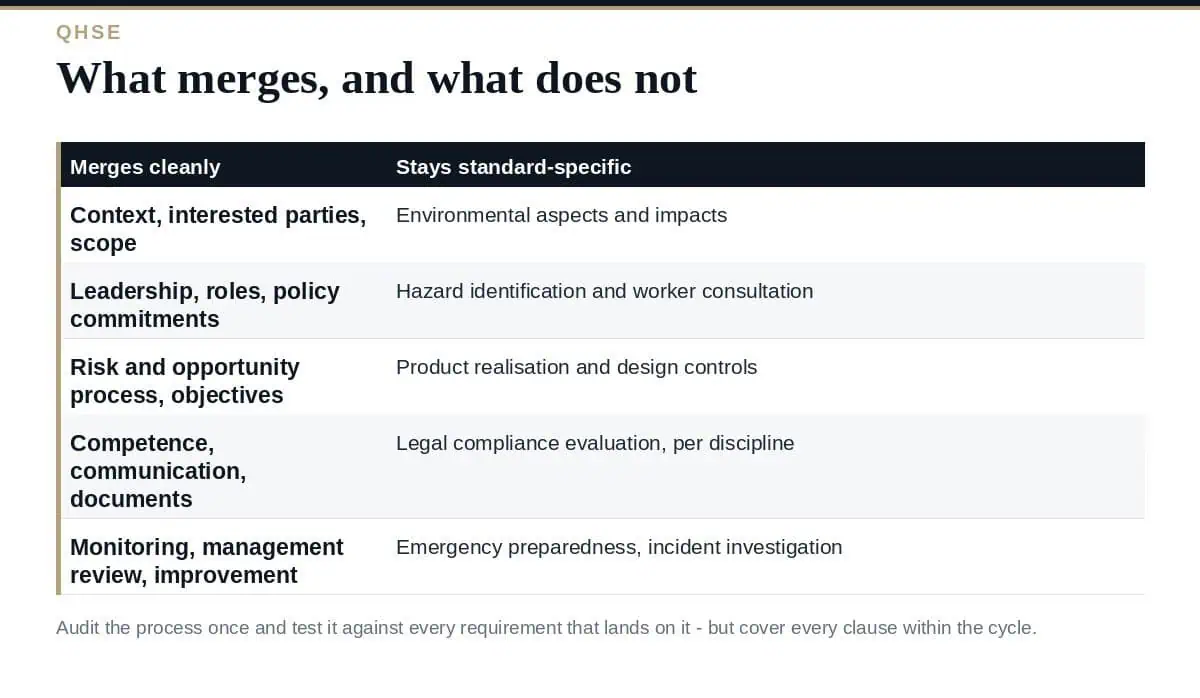
| Merges cleanly | Stays standard-specific |
|---|---|
| Context, interested parties, scope | Environmental aspects and impacts |
| Leadership, roles, policy commitments | Hazard identification and worker consultation |
| Risk and opportunity process, objectives | Product realisation and design controls |
| Competence, awareness, communication, documents | Legal compliance evaluation, per discipline |
| Monitoring, management review, improvement | Emergency preparedness, incident investigation |
Roughly two-thirds of the clause content is shared because the standards are written to a common structure — the same reason an integrated management system manual is possible at all. The remaining third is where a combined internal audit needs discipline, because that is where a generalist auditor runs out of depth.
A combined internal audit needs auditors who understand every standard in the visit, and most organizations have a quality auditor who is uncomfortable with hazard controls or a safety auditor who has never read a calibration record. Two workable answers: pair auditors and let each lead their discipline within one visit, or train a small core team properly and accept that it takes a year. What does not work is sending one auditor with four checklists and hoping.
The gains are real: fewer interruptions for the business, findings that reflect how work actually happens, and an end to the situation where the same weak procurement process generates three unrelated corrective actions. Audit time typically falls, though less than people expect — the saving is in travel, setup and repeated interviews, not in the testing itself.
The cost is concentration. One weak auditor now weakens three standards at once, and one badly scoped visit leaves gaps across the whole system. The programme needs a review at the end of each cycle asking which clauses were actually tested, not just which visits happened.
Is a combined internal audit allowed?
Yes. No management system standard requires separate audits per standard. Each requires an internal audit programme covering its own requirements at planned intervals — one programme can satisfy several.
Does it mean one certification audit too?
Combined external audits are normal where one certification body holds all the standards, and audit days are reduced rather than merged. That is the body’s decision, not yours.
Do we need one report or several?
One report works for the business. Keep findings tagged by standard so each management system can still demonstrate coverage and trends.
Can the same person audit quality and safety?
Only with competence in both. Auditor competence is an explicit requirement, and a combined programme raises the bar rather than lowering it.
How do we prove full clause coverage?
Maintain a matrix of clause against audit, updated as the cycle runs. It is the document a certification auditor asks for when the programme is process-based rather than clause-based.
Build the combined internal audit programme around your processes, map every applicable clause onto them, and keep a coverage matrix so nothing falls between visits. Set frequency by risk rather than by standard, pair auditors where competence is thin, and report once with findings tagged. The point is not to save audit days — it is to stop asking the same manager the same question four times and getting four disconnected corrective actions out of it.
Audit programmes, process checklists and the coverage matrix are in the QHSE Documentation Bundles, or start with the free ISO templates.

October 24, 2026
October 24, 2026
October 23, 2026
October 23, 2026
October 22, 2026

