CART
DORA subcontracting stopped being a matter of judgement in 2025. Commission Delegated Regulation (EU) 2025/532 — adopted on 24 March 2025 and published in the Official Journal on 2 July 2025 — specifies what a financial entity has to determine and assess when ICT services supporting critical or important functions are subcontracted.
This guide covers what the RTS requires, why the chain rather than the contract is now the unit of analysis, and what has to change in agreements that were signed before it existed.
Free gap assessment
How much of DORA could a supervisor already test?
Score all five pillars, free, including the register of information and the Article 30 contract terms.
Run the free DORA gap assessment → or View premium report sample
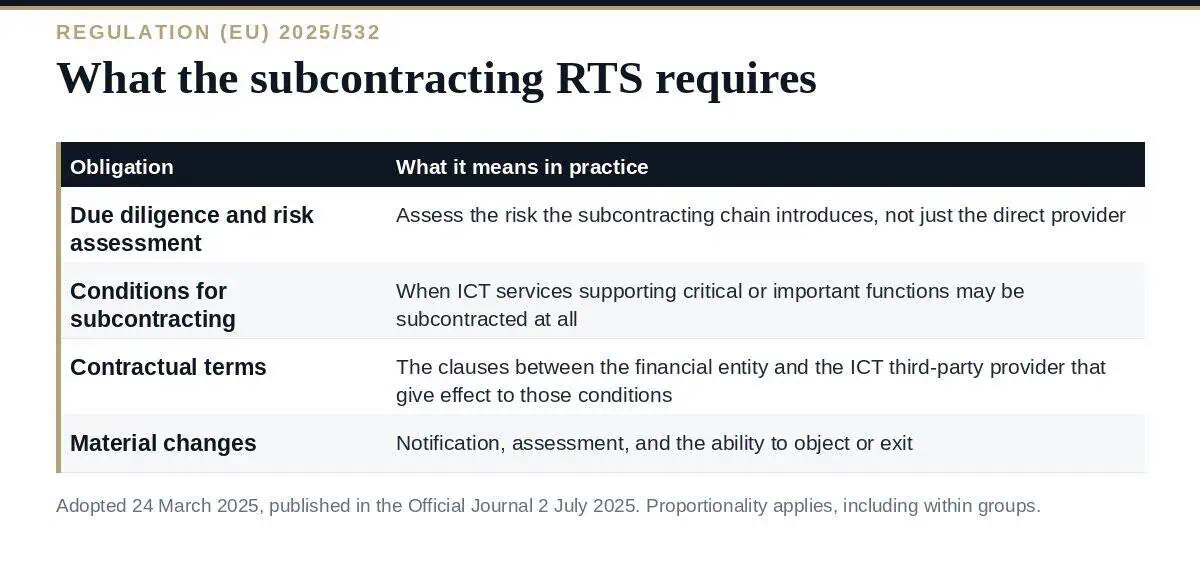
The DORA subcontracting RTS supplements the Regulation on the elements a financial entity must determine and assess when subcontracting ICT services that support critical or important functions. Three groups of obligation matter in practice:
Proportionality runs through it, including how the requirements apply within groups, so a small entity is not held to the same depth of analysis as a systemic one. Proportionality is not an exemption, though: the assessment still has to exist and be evidenced.
The change of frame is the point. Before the RTS, most third-party risk programmes stopped at the direct contract — you assessed your provider, and their suppliers were their problem. Under DORA the question is whether the function is resilient, and a function delivered through four tiers of subcontractor is only as resilient as the weakest tier you cannot see.
Practically, that means three things your register has to carry:
That last one is the finding organizations dislike most: two providers, both diversified on paper, both ultimately hosted in the same region of the same hyperscaler. Our guide to ICT concentration risk covers how to test for it.
Free ISO 27001 risk assessment
Which of your risks sit above your appetite line?
Set your own risk criteria, pick from 61 information security risk scenarios, rate likelihood and impact, and decide how to treat each one. You get a heat map, a process score and the findings an auditor would raise, free.
Run the free risk assessment → or View premium report sample
Most agreements in force predate the DORA subcontracting RTS. The clauses to look for, and add where missing:
Renegotiating a hyperscaler’s standard terms is not realistic for most financial entities, and the RTS does not pretend otherwise. Where you cannot obtain a clause, the honest response is a documented risk acceptance at the right level, with compensating measures — enhanced monitoring, a tested alternative, tighter data placement — rather than a contract summary that implies you have rights you do not have.
Subcontracting sits inside the third-party risk pillar alongside three things you are already doing. The register of information is where the chain is recorded and reported. The critical ICT third-party provider regime supervises the largest providers directly, but does not transfer your accountability. And incident reporting obligations run regardless of which tier of the chain caused the disruption — a subcontractor’s outage that makes your function unavailable is your incident to classify and report.
Which regulation sets the DORA subcontracting rules?
Commission Delegated Regulation (EU) 2025/532, adopted 24 March 2025 and published in the Official Journal on 2 July 2025, supplementing Regulation (EU) 2022/2554.
Does it apply to all subcontracting?
It addresses ICT services supporting critical or important functions. Subcontracting that does not touch those functions is outside its scope, which is why the criticality determination has to be defensible.
How deep into the chain do we have to look?
As deep as the function’s resilience actually depends on. That is a judgement you have to make and document, not a fixed number of tiers.
What if a provider will not accept the clauses?
Assess and document the residual risk, apply compensating measures, and take the acceptance decision at a level with the authority to make it. Recording rights you do not hold is the worse outcome.
Does it apply within a group?
Yes, with proportionality provisions covering how the requirements apply in group structures — intra-group provision is not automatically outside the regime.
Treat DORA subcontracting as a chain-mapping exercise rather than a contract review. Fix the critical-or-important determination first, map the delivery path for each of those functions to the depth that resilience actually depends on, and test for convergence between chains you believe are independent. Then close the contractual gaps where you can, document risk acceptances honestly where you cannot, and make sure the register reflects the chain as it is today rather than as it was at signature.
Contractual clause sets, the register and the assessment templates are in the DORA Compliance Toolkit, or start with the free ISO templates.

October 25, 2026
October 24, 2026
October 24, 2026
October 23, 2026
October 23, 2026

