CART

The NQA-1 graded approach is the mechanism that stops a nuclear quality assurance
programme collapsing under its own weight. Applied well, it directs the heaviest controls at the items
whose failure matters most and lets everything else be governed proportionately. Applied badly, it
becomes the justification for doing less — which is how organisations end up with a finding
against the one item they graded down.
It sits in Part I, Requirement 2, Quality Assurance Program, alongside the
requirement to establish the programme itself. That placement is deliberate and worth pausing on: the
graded approach is not an exemption bolted onto the standard. It is part of how the programme is
required to be designed.
The principle is that the controls applied to an item, service or activity should be commensurate
with its importance to safety — with the consequences of its failure. A pressure boundary
component and a general-purpose office procedure do not warrant the same design verification, the same
inspection regime or the same records retention, and a standard that demanded otherwise would be
ignored in practice.
The corresponding regulatory hook is 10
CFR 50 Appendix B Criterion II, Quality Assurance Program, which requires the programme to take
into account the need for special controls and the importance to safety of what is being controlled.
For DOE work the equivalent expectation runs through 10 CFR 830 and DOE O 414.1.
Three misreadings account for most of the trouble.
The asymmetry matters. Grading something up costs you effort. Grading something down and being wrong
costs you a finding, a corrective action, and potentially a re-examination of everything else graded on
the same reasoning. That asymmetry should show in how carefully the downgrades are argued.
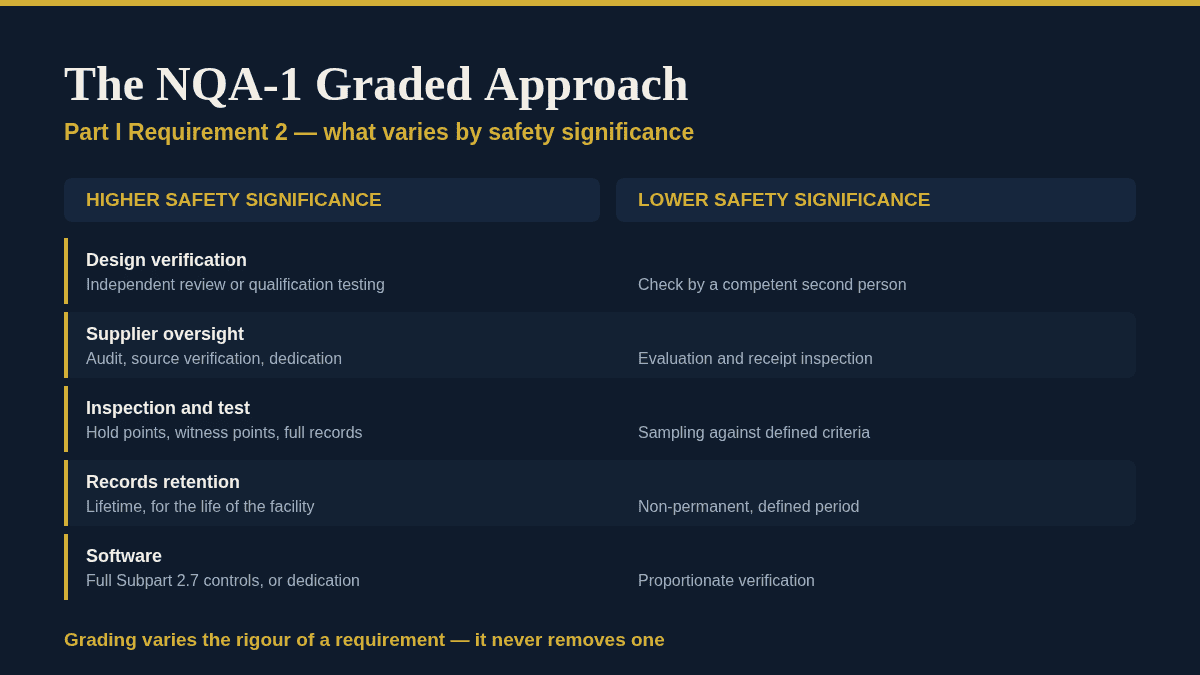
| Control | Higher safety significance | Lower safety significance |
|---|---|---|
| Design verification | Independent review or qualification testing, formally documented | Checking by a competent second person, proportionate record |
| Supplier oversight | Audit, source verification, dedication where commercial | Evaluation and receipt inspection |
| Inspection and test | Hold points, witness points, full documentation | Sampling against defined criteria |
| Records retention | Lifetime records, retrievable for the life of the facility | Non-permanent, defined retention period |
| Software | Full Subpart 2.7 lifecycle controls, or dedication | Proportionate verification and configuration control |
The table is illustrative, not a template to copy. The point is the shape: every row names a control
and says how it differs by level, which is exactly what an auditor will ask you to produce.
Grading is not a standalone procedure. It sets the input to almost everything else — which
suppliers get audited, which items need
commercial grade dedication,
which software falls under the full weight of
Subpart 2.7, and which
records are lifetime records. If your grading procedure does not name those downstream processes, the
classifications are being made in one place and ignored in another.
Grading, written as a procedure rather than as an intention.
The NQA-1:2024 Nuclear Quality Assurance Toolkit ships 100+ editable MS Office templates including the Graded Approach to Quality Application Procedure, the Quality Assurance Program document it hangs from, and the design control, procurement, inspection, dedication and records procedures the grading feeds — each mapped to its NQA-1 requirement and 10 CFR 50 Appendix B criterion.
Nobody audits grading in the abstract. An auditor picks an item that has been graded down and works
backwards, and the sequence is predictable enough that you can rehearse it internally.
Question four finds more problems than the rest combined. Inconsistency between two items at the
same level indicates that the classification is a label applied after the fact rather than a decision
that drives behaviour, and that undermines every other grading decision in the programme.
The point of all this rigour is not paperwork; it is that a well-argued graded approach is what makes
a nuclear quality programme affordable. Supplier audit programmes are the clearest case. Auditing every
supplier annually is unaffordable for most organisations, and auditing them by spend rather than by
safety significance is indefensible. A documented grading that puts audit effort where failure would
matter most gives you a programme that is both cheaper and easier to justify than either alternative
— which is why the NQA-1 graded approach repays being done properly rather than being treated as
a formality.
Where is the graded approach in NQA-1?
Part I, Requirement 2, Quality Assurance Program. It is part of how the programme is designed, not an
exemption applied afterwards.
Can the NQA-1 graded approach remove a requirement entirely?
No. It varies the rigour with which requirements are applied — depth of verification, level of
independence, extent of documentation and records — not whether they apply.
How many quality levels should we define?
Two or three is typical and workable. More levels than you can meaningfully differentiate by control
produce classification arguments rather than proportionate control.
Who approves grading decisions?
Whoever your Quality Assurance Program document says, with the qualification to make the safety
judgement, and with someone independent able to challenge downgrades. The route needs to be written
down before it is used.
Does the graded approach apply to suppliers?
Yes, and it is one of its most useful applications. The oversight applied to a supplier should reflect
the safety significance of what they provide, which is what makes an audit programme affordable.
Grading is a design decision about your programme, made once and then honoured everywhere. Define
two or three levels, attach real differences in control to each, record the reasoning behind every
classification, and let someone independent argue with the downgrades. Do that and the programme
becomes both defensible and affordable. Skip the reasoning and you have a set of labels that will not
survive the first auditor who asks why.
All of these are covered by the NQA-1 Toolkit, or start with the free ISO templates.


August 31, 2026

August 31, 2026

August 31, 2026

August 31, 2026

August 31, 2026