CART

Commercial grade dedication is the process by which an item bought from an ordinary
commercial supplier is accepted for use in a safety-related nuclear application. It is the single
discipline that most often defeats suppliers arriving from aerospace, defence or general
manufacturing — not because it is conceptually hard, but because it inverts the instinct that a
good part from a good supplier is enough.
Almost nothing you need arrives with nuclear pedigree. Fasteners, relays, valves, instruments and
software are manufactured to commercial catalogues under commercial quality systems. Commercial grade
dedication is the acceptance process that closes the gap, so that the item is deemed equivalent to one
designed and manufactured under a full NQA-1 programme.
Two points about ownership matter more than any technical detail:
In NQA-1 the requirements sit in Part II, Subpart 2.14, Quality Assurance Requirements for
Commercial Grade Items and Services. The regulatory weight behind it comes from
10 CFR 50 Appendix B, and from 10 CFR
Part 21, under which a dedicated item becomes a basic component and attracts defect reporting
obligations.
Everything in commercial grade dedication rests on identifying critical characteristics: the
properties of the item whose variation could cause it to fail its safety function. This is engineering
work, done in a technical evaluation, and it is done before any verification is planned.
The discipline is in the word critical. A dedication that lists thirty characteristics
because they were easy to measure has usually missed the two that matter. The test is whether failure
of the characteristic would prevent the item performing its safety function — not whether it is
convenient to check.
Get this wrong and everything downstream is wasted: you will have verified, at length and at
expense, properties that were never the risk.
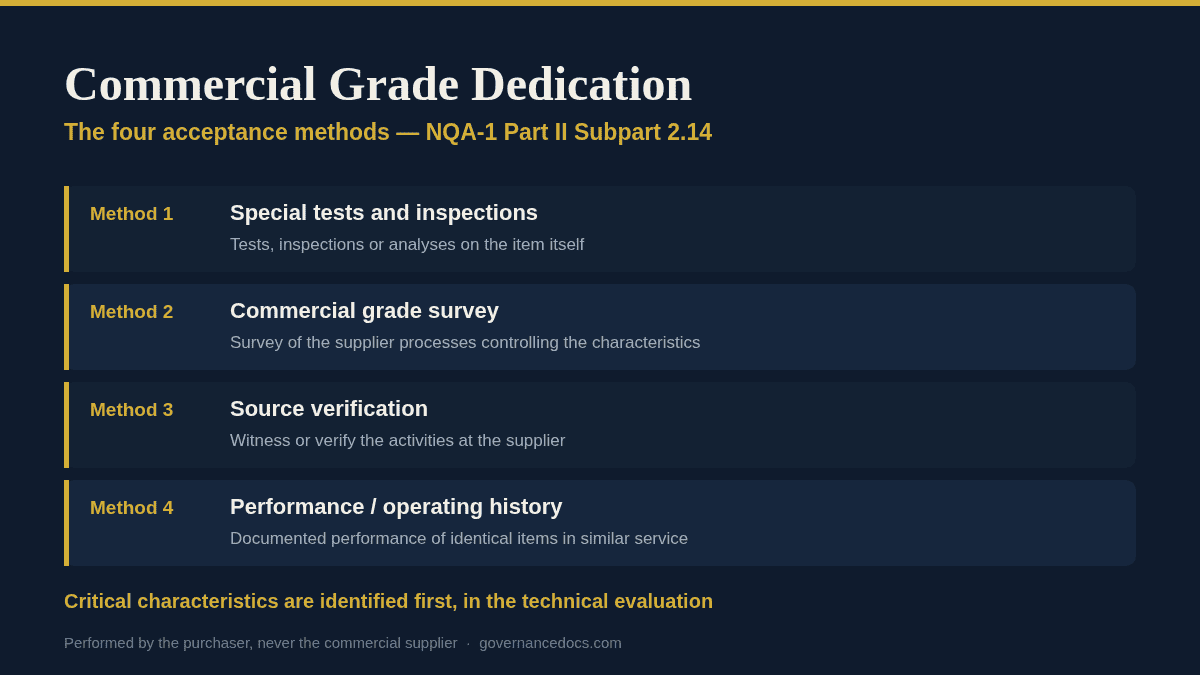
Once critical characteristics are identified, each is verified by one or more accepted methods. The
four are long-established in the industry, originating in EPRI’s dedication guidance and conditionally
endorsed by the NRC.
| Method | What it involves | Where it fits |
|---|---|---|
| 1 — Special tests and inspections | Tests, inspections or analyses performed on the item itself to verify its critical characteristics | Measurable physical characteristics; the default for hardware |
| 2 — Commercial grade survey | A survey of the supplier’s own processes controlling those characteristics | Characteristics you cannot test after the fact, such as material processing |
| 3 — Source verification | Witnessing or verifying the relevant activities at the supplier’s premises | One-off or build-specific items where the evidence exists only during manufacture |
| 4 — Performance or operating history | Documented acceptable performance of identical items in similar service | Supporting evidence; rarely sufficient by itself |
Method selection is not a preference. It is justified in the technical evaluation, characteristic by
characteristic, and for complex or design-significant characteristics more than one method is normally
required. Guidance in this area is explicit that no single method — testing alone, or performance
history alone — will generally suffice.
This is the misunderstanding that produces findings. Checking that the right quantity of the right
part number arrived undamaged is receipt inspection, and every organisation does it. Method 1 means
special tests and inspections directed specifically at the critical characteristics, planned in the
technical evaluation and performed against acceptance criteria you defined. If your dedication package
contains nothing a normal goods-in process would not have produced, you have not dedicated anything.
Software deserves separate mention. Software not produced under a compliant quality assurance
programme has to be dedicated too, which is a route many organisations discover late. Our guide to
NQA-1 software quality
assurance covers how Subpart 2.7 and Subpart 2.14 interact.
The dedication chain, from evaluation to record.
The NQA-1:2024 Nuclear Quality Assurance Toolkit ships 100+ editable MS Office templates including the Commercial Grade Dedication procedure, critical characteristics identification and acceptance procedure, technical evaluation plan, commercial grade survey procedure and dedication record template — each mapped to NQA-1 Part II Subpart 2.14 and its 10 CFR 50 Appendix B criterion.
If a commercial grade dedication package is going to be challenged, it will be challenged at the
technical evaluation. Everything else is execution; the evaluation is where the judgement lives, and
judgement is what a reviewer tests.
A defensible evaluation establishes, in order: what the item does in the safety function; how it
could fail to do it; which properties govern those failure modes; which of those properties are
therefore critical characteristics; what acceptance criteria apply to each; and which verification
method is capable of demonstrating each criterion, with the reasoning for choosing it. Written that
way, the method selection falls out of the analysis instead of being asserted.
The most common weakness is skipping straight from the item to a characteristic list, with no
statement of the safety function and no failure analysis in between. That evaluation may well arrive
at the right characteristics, but it cannot demonstrate that it did, and a reviewer has nothing to
assess except the author’s reputation.
That last point deserves emphasis. Commercial suppliers change things without telling you, because
you are one customer among thousands and they have no obligation to notify. Any dedication that relies
on a commercial grade survey or on performance history carries an assumption about supplier stability,
and that assumption needs periodic re-testing rather than being made permanent by filing.
Who performs commercial grade dedication?
The purchaser, or a dedicating entity it designates. The commercial supplier does not dedicate its own
product, and responsibility stays with the purchaser regardless of who performs the activity.
Where is commercial grade dedication in NQA-1?
Part II, Subpart 2.14, Quality Assurance Requirements for Commercial Grade Items and Services.
Can we dedicate using performance history alone?
Rarely. Established guidance is that no single method generally suffices, and performance history is
usually supporting evidence rather than primary verification.
Does dedication make the item a basic component?
Yes, and that brings 10 CFR Part 21 defect reporting obligations with it. That is a feature of the
process, not a side effect — it is what makes the item usable in a safety-related application.
Do we need commercial grade dedication for software?
If the software was not produced under a compliant quality assurance programme and is used in a
safety-related application, yes. Dedication under Subpart 2.14 is the route.
Commercial grade dedication rewards engineering judgement and punishes process theatre. A short,
well-reasoned technical evaluation that identifies three genuinely critical characteristics and
verifies each by an appropriate method is worth more than a thick package that checks thirty
convenient ones. Build the process around the evaluation, keep the dedication record traceable back to
it, and revisit the assumption that your commercial supplier has not changed anything.
All of these are covered by the NQA-1 Toolkit, or start with the free ISO templates.


August 31, 2026
August 31, 2026

August 31, 2026

August 31, 2026
August 31, 2026