CART
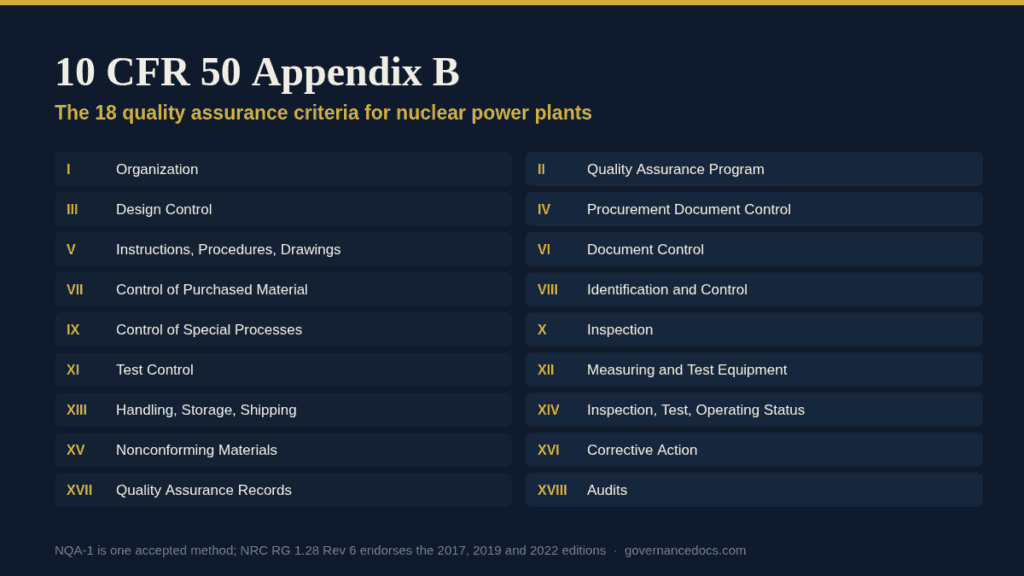
10 CFR 50 Appendix B is the regulation. NQA-1 is the standard people actually build
their quality assurance programme from. Suppliers new to nuclear work routinely confuse the two, and
the confusion is expensive, because the regulation is what binds you and the standard is only one
accepted way of satisfying it.
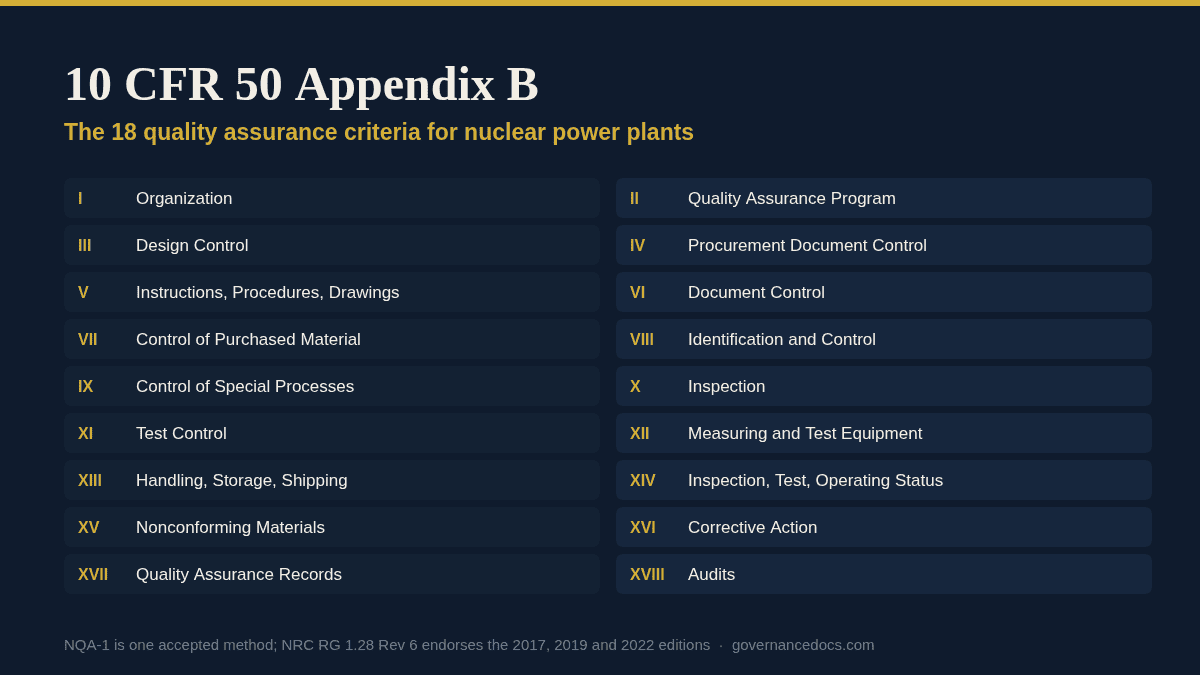
Its full title is Quality Assurance Criteria for Nuclear Power Plants and Fuel Reprocessing
Plants. It sets out eighteen criteria, numbered I to XVIII, that a quality
assurance programme must satisfy. It is short — a few pages — and it is deliberately
written as criteria rather than as a method.
| # | Criterion | # | Criterion |
|---|---|---|---|
| I | Organization | X | Inspection |
| II | Quality Assurance Program | XI | Test Control |
| III | Design Control | XII | Control of Measuring and Test Equipment |
| IV | Procurement Document Control | XIII | Handling, Storage and Shipping |
| V | Instructions, Procedures, and Drawings | XIV | Inspection, Test, and Operating Status |
| VI | Document Control | XV | Nonconforming Materials, Parts, or Components |
| VII | Control of Purchased Material, Equipment, and Services | XVI | Corrective Action |
| VIII | Identification and Control of Materials, Parts, and Components | XVII | Quality Assurance Records |
| IX | Control of Special Processes | XVIII | Audits |
Read that list next to ISO 9001 and the family resemblance is obvious. Read it carefully and the
differences are the point: procurement document control, control of special processes and inspection
and operating status are all called out as criteria in their own right, which tells you where the
regulator’s attention sits.
Appendix B says what a programme must achieve. It does not say how. ASME NQA-1 is the consensus
standard the industry wrote to fill that gap, and its structure maps onto the eighteen criteria
closely enough that most nuclear QA programmes are written to NQA-1 and cross-referenced back to
Appendix B.
The link is made formal by the NRC through Regulatory Guide 1.28, which endorses
specified editions of NQA-1 as an acceptable means of complying with 10 CFR 50 Appendix B, subject to
stated exceptions and clarifications.
Here is the detail that catches people out. RG 1.28 Revision 6 extends NRC endorsement to
NQA-1-2017, NQA-1-2019 and NQA-1-2022. ASME’s current published edition is NQA-1-2024. Being
on the newest ASME edition therefore does not automatically mean being on an NRC-endorsed one, and
that gap is real: it is not an error in either document, it is simply the lag between a standards body
publishing and a regulator endorsing.
This is the practical reason our guide to
which NQA-1 edition binds you insists that the answer
comes from your licensing basis, contract or customer flow-down rather than from ASME’s catalogue.
RG 1.28 endorses NQA-1 “subject to the exceptions and clarifications” the NRC sets out.
A programme that says “we comply with NQA-1” and stops there has not addressed those
conditions. Read the regulatory guide alongside the standard, and record in your programme document
how each exception is handled.
Most organisations meeting 10 CFR 50 Appendix B for the first time are not licensees. They are
suppliers, and the regulation reaches them through the purchase order rather than directly. Three
consequences follow.
A programme mapped to the criteria, not just to the standard.
The NQA-1:2024 Nuclear Quality Assurance Toolkit ships 100+ editable MS Office templates — the Quality Assurance Program document, design control, procurement, inspection and test, nonconformance and corrective action, records, commercial grade dedication and software quality assurance — each cross-referenced to its NQA-1 requirement and its 10 CFR 50 Appendix B criterion.
Most organisations approaching 10 CFR 50 Appendix B for the first time hold ISO 9001. It is a
genuine head start, and being precise about how much of one prevents both over-confidence and wasted
rebuilding.
| Criterion | How far ISO 9001 gets you |
|---|---|
| VI Document Control, XVII Records, XVIII Audits | Most of the way. The machinery exists; retention horizons and retrievability expectations are heavier |
| XV Nonconforming items, XVI Corrective Action | Structurally similar, but the linkage to defect reporting under 10 CFR Part 21 has no ISO 9001 equivalent |
| III Design Control | Partly. Independent design verification at nuclear depth goes well beyond ISO 9001 design review |
| IV Procurement Document Control, VII Purchased material | Partly. Flow-down of quality requirements into procurement documents is far more prescriptive |
| IX Special Processes, XIV Inspection and Operating Status | Little. These are called out as criteria in their own right for a reason |
| Commercial grade dedication | Nothing. ISO 9001 has no equivalent concept at all |
The honest summary is that an ISO 9001 certificate supplies perhaps half the management system and
none of the nuclear-specific disciplines. Treat the overlap as reusable and the remainder as the real
scope of work.
Not every organisation encountering nuclear quality assurance is inside the NRC’s remit. Work for the
Department of Energy runs under 10 CFR 830 and DOE O 414.1 rather than under 10 CFR 50 Appendix B, with
its own criteria and its own endorsement of NQA-1. The disciplines are recognisably the same family,
and the documents that invoke them are not interchangeable — so establish which regime you are in
before writing a quality assurance programme that cites the wrong one.
How many criteria are in 10 CFR 50 Appendix B?
Eighteen, numbered I to XVIII, from Organization through to Audits.
Does an ISO 9001 certificate satisfy 10 CFR 50 Appendix B?
No. ISO 9001 is a genuine head start on document control, records, audit and corrective action, but it
does not reach design control at nuclear depth and has no concept of commercial grade dedication.
Is NQA-1 mandatory?
Appendix B is the requirement; NQA-1 is an accepted means of meeting it, endorsed by the NRC through
Regulatory Guide 1.28 for specified editions and subject to exceptions. Your contract or licensing
basis is what makes a particular edition binding on you.
Which NQA-1 editions does the NRC currently endorse?
RG 1.28 Revision 6 endorses NQA-1-2017, NQA-1-2019 and NQA-1-2022, with exceptions and clarifications.
ASME’s current published edition, NQA-1-2024, is newer than the endorsed set.
Does 10 CFR 50 Appendix B apply to small modular reactors?
The Appendix B framework applies to the licensing of production and utilization facilities, and SMR
developers and their supply chains are working inside it. ASME states NQA-1 applies to all large light
water reactors and to future advanced reactors including SMRs.
Keep the two documents in their proper places and most of the confusion disappears. 10 CFR 50
Appendix B is the regulation, with eighteen criteria and no method. NQA-1 is the method, endorsed for
specified editions and subject to the NRC’s exceptions. Your contract or licensing basis is what makes
a particular edition binding on you, and it will not always be the newest one ASME has published. Get
those three facts written down at the start of a programme and every later argument about scope,
edition and evidence becomes a short one.
All of these are covered by the NQA-1 Toolkit, or start with the free ISO templates.

August 31, 2026
August 31, 2026

August 31, 2026

August 31, 2026
August 31, 2026