CART
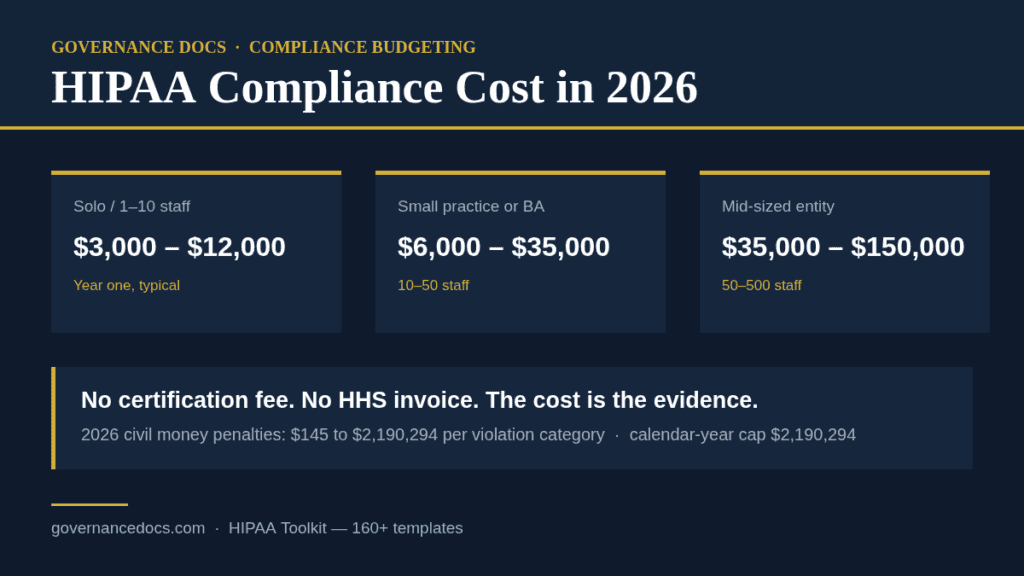
HIPAA compliance cost is the one figure no vendor will quote you honestly, because the honest answer starts with an awkward fact: HIPAA itself charges you nothing. There is no certification body to pay, no audit fee, no registration, no annual license from the Department of Health and Human Services. Every dollar you spend is a dollar you chose to spend on the controls, documents and evidence that would satisfy an investigator if one ever knocked.
That is why the numbers you find online range from $39 a month to six figures. They are all describing different purchases. This breakdown separates what the rule actually requires from what the market sells you, gives typical 2026 HIPAA compliance cost bands by organization size, and prices the one thing most budgets ignore — the cost of getting it wrong.
Free gap assessment
Could you evidence your HIPAA safeguards today?
Score every standard and implementation specification, free, including the addressable ones that still need a decision on file.
Run the free HIPAA gap assessment → or View premium report sample
ISO 27001 has a price because a certification body issues a certificate and invoices you for the audit days. HIPAA has no equivalent. It is a federal legal obligation enforced by the HHS Office for Civil Rights (OCR), usually after a breach report or a complaint. Nobody validates you in advance, and no one can sell you a government-recognized HIPAA certificate — if a vendor offers one, that is a marketing claim, not a regulatory status.
What HIPAA does require is specific and auditable. A security risk analysis is a required implementation specification under 45 CFR 164.308(a)(1)(ii)(A). Policies and procedures must be documented and retained for six years from creation or last effective date under 164.316(b)(2)(i). Workforce training, business associate agreements, breach notification procedures and sanction policies all have to exist on paper. Your HIPAA compliance cost is simply the price of producing and maintaining that evidence to a standard an investigator would accept.
The practical consequence: two organizations of identical size can spend $4,000 and $80,000 respectively and both be defensible. The difference is almost never regulatory. It is how much of the work they bought instead of doing.
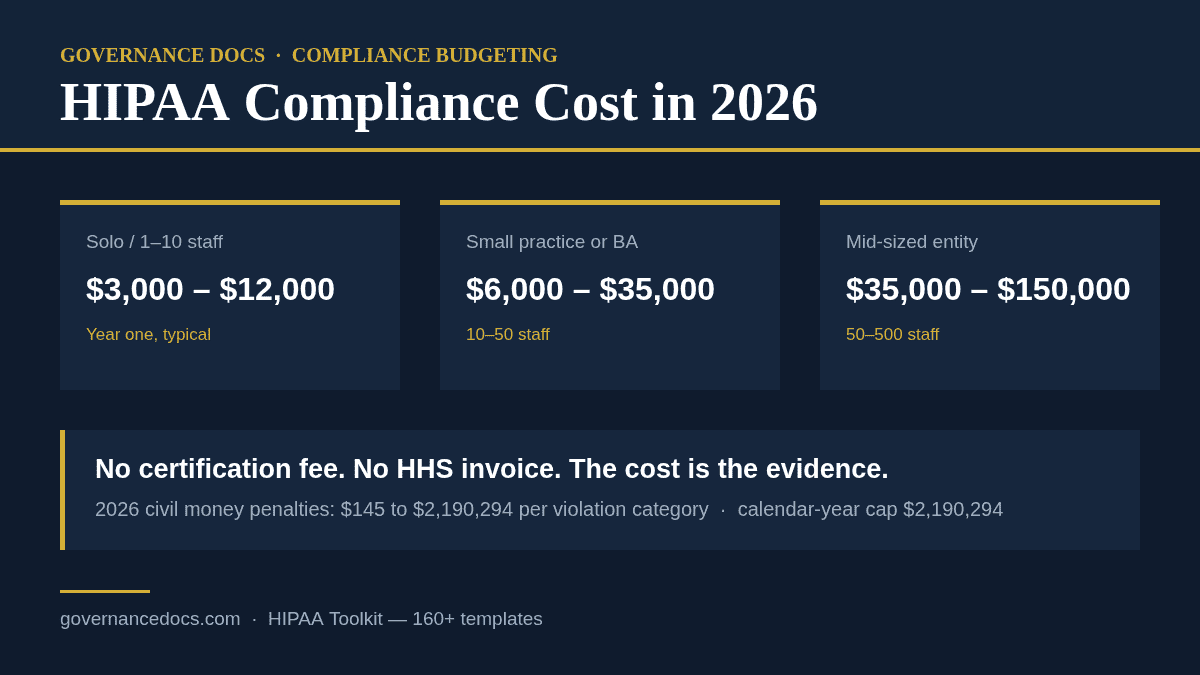
The bands below reflect typical 2026 US market pricing for the components listed further down — consultant day rates, risk analysis engagements, training platforms and document sets. They are not a published survey, and your position inside a band depends almost entirely on how much of your security tooling you already pay for.
| Organization | Year-one typical range | Ongoing annual typical range |
|---|---|---|
| Solo practitioner or 1–10 staff | $3,000 – $12,000 | $1,500 – $5,000 |
| Small practice or business associate, 10–50 staff | $6,000 – $35,000 | $3,500 – $18,000 |
| Mid-sized provider, plan or vendor, 50–500 staff | $35,000 – $150,000 | $20,000 – $75,000 |
| Hospital system or large health plan, 500+ staff | $150,000 and up | $75,000 and up |
One useful reality check comes from HHS itself. In the regulatory impact analysis for its proposed Security Rule overhaul, the Department estimated the annualized cost of the new requirements at roughly $1,235 per regulated establishment, across 1,822,600 regulated entities. That figure covers only the incremental changes, not baseline compliance — but it is a reminder that the government’s own arithmetic assumes a per-site number in the low four figures, not the five-figure retainers that dominate search results.
Break the budget into components and the spread stops being mysterious. Each line has a genuine do-it-yourself floor and a genuine outsourced ceiling.
| Component | Do it in-house | Buy it in |
|---|---|---|
| Security risk analysis | $0 using the free HHS/ONC SRA Tool, plus 15–40 staff hours | $2,000 – $15,000 per engagement |
| Policies, procedures and forms | $0 written from scratch, 40–120 hours | $99 for a template set, or $5,000 – $20,000 consultant-written |
| Workforce training | $0 delivered internally with your own deck | $10 – $60 per person per year on a platform |
| Technical safeguards (MFA, encryption, logging, backup) | Often $0 incremental — already in your Microsoft 365 or Google Workspace tier | $5,000 – $40,000 to add tooling you do not have |
| Business associate agreements | $0 using a standard template | $250 – $1,500 legal review per negotiated BAA |
| Breach readiness and incident response | $0 for a self-run tabletop exercise | $3,000 – $10,000 for a facilitated exercise and plan |
| Annual review and evidence retention | 10–30 hours a year of internal time | $3,000 – $12,000 a year for managed compliance |
Two lines dominate the variance. The first is the risk analysis. It is the single most cited failure in OCR enforcement, and it is also the item most often sold as an annual subscription when the rule asks for it to be accurate, current and repeated when things change — not necessarily monthly. Our guide to the HIPAA risk assessment sets out what the analysis has to cover before you decide whether to buy it.
Free ISO 27001 risk assessment
Which of your risks sit above your appetite line?
Set your own risk criteria, pick from 61 information security risk scenarios, rate likelihood and impact, and decide how to treat each one. You get a heat map, a process score and the findings an auditor would raise, free.
Run the free risk assessment → or View premium report sample
The second is technical safeguards, and this is where most HIPAA compliance cost estimates go wrong in the other direction. The Security Rule’s addressable specifications are not optional, but they also do not mandate a specific product. If you already pay for a business tier of a mainstream productivity suite, encryption at rest and in transit, multi-factor authentication, audit logging and backup are usually already licensed. The work is configuring and documenting them, not buying them. We covered that distinction in detail in HIPAA safeguards: addressable does not mean optional.
OCR published a notice of proposed rulemaking on 6 January 2025 that would remove the addressable/required distinction and mandate encryption, multi-factor authentication, asset inventories, network segmentation, annual penetration testing and twice-yearly vulnerability scanning. HHS put the first-year cost to the industry at approximately $9 billion, with roughly $6 billion a year for recurring activities in years two through five. You can read the estimate in the Department’s own Federal Register notice of proposed rulemaking.
The rule has not been finalized. Following more than 4,000 comments, HHS moved it to its long-term regulatory agenda, with final action currently anticipated in July 2027. Nothing in the proposal binds you today. What it does tell you is where enforcement expectations are heading, and any HIPAA compliance cost model built for the next three years should assume those controls become mandatory rather than assume they will not. We track the detail in the HIPAA Security Rule overhaul.
Civil money penalties were adjusted for inflation effective 28 January 2026. The tiers below are taken from the HHS annual civil monetary penalties inflation adjustment rule.
| Tier | Culpability | Minimum per violation | Maximum per violation | Calendar-year cap |
|---|---|---|---|---|
| 1 | Did not know, reasonable diligence exercised | $145 | $73,011 | $2,190,294 |
| 2 | Reasonable cause, not willful neglect | $1,461 | $73,011 | $2,190,294 |
| 3 | Willful neglect, corrected within 30 days | $14,602 | $73,011 | $2,190,294 |
| 4 | Willful neglect, not corrected | $73,011 | $2,190,294 | $2,190,294 |
In practice OCR applies lower annual caps to tiers 1 to 3 under a 2019 notice of enforcement discretion, which is a policy position rather than a regulation and could be withdrawn. Note the structure, because it is the whole argument for spending anything at all on HIPAA compliance cost in the first place. Tier 1 is what a documented, imperfect program attracts. Tier 4 is what an undocumented one attracts. The gap between them is the return on your documentation spend.
Fines are rarely the largest number, though. Settlements under OCR’s Risk Analysis Initiative — twelve enforcement actions announced by early 2026 — routinely come with corrective action plans placing the organization under OCR monitoring for two years. Four ransomware settlements announced in April 2026, covering breaches affecting more than 427,000 individuals, together exceeded $1 million and all four carried two-year monitoring. Two years of supervised remediation on someone else’s timetable costs far more than the settlement line. And IBM’s Cost of a Data Breach Report 2026 puts the average healthcare breach at $6.64 million, the highest of any sector for the thirteenth consecutive year.
Four decisions account for most of the HIPAA compliance cost savings available to a small or mid-sized organization.
Do the risk analysis yourself the first time. The HHS and ONC Security Risk Assessment Tool is free, structured around the Security Rule, and produces a report you can defend. Buy an external assessment when your environment materially changes or when a customer contract demands independence — not annually by reflex.
Start from templates, not a blank page. Policy drafting is the largest hidden labor cost in year one, and it is the least differentiated work you will ever do. Every covered entity needs substantially the same sanction policy, contingency plan and workforce clearance procedure.
Inventory what you already license. Before approving any security purchase, list the safeguards your existing subscriptions already provide. Most small practices discover they are being sold encryption and MFA they already own.
Keep the evidence as you go. Six-year retention means the expensive scenario is reconstructing three years of training records and access reviews under a 30-day OCR data request. A shared folder and a calendar reminder cost nothing and eliminate that risk. Our ten-step HIPAA implementation plan sets out the order to do this in.
If the documentation layer is where you want to start, the HIPAA Toolkit covers it with 160+ editable templates for $99 — policies, procedures, risk analysis workbooks, BAA forms and training material. It is the cheapest line in the table above, and it is the one OCR asks to see first.
Is there a HIPAA certification fee I have to budget for?
No. HIPAA compliance cost never includes a certification fee, because HHS does not certify anyone. Third-party attestations and training certificates exist and can be useful commercially, but they carry no regulatory weight and are not required.
How much does a HIPAA security risk analysis cost?
Between nothing and about $15,000. Using the free HHS/ONC SRA Tool with internal staff costs you 15 to 40 hours. An external assessment for a small organization typically runs $2,000 to $15,000 depending on scope, number of locations and whether technical testing is included.
Do business associates face a different HIPAA compliance cost?
The direct obligations are narrower, but the commercial pressure is higher. Business associates are usually asked to evidence their program during customer due diligence, so they carry the same documentation burden plus the cost of answering security questionnaires. Budget at the same level as a covered entity of comparable size.
Will the proposed Security Rule changes increase what we spend?
Almost certainly, for organizations that have not already implemented encryption, MFA, asset inventories and regular testing. Organizations already running those controls face mainly documentation and testing-cadence work. The rule is not final and final action is currently expected in 2027.
Can compliance software make us compliant on its own?
No. Software can automate evidence collection and reminders, which is genuinely valuable at scale, but the risk analysis, the decisions recorded in it and the policies that follow are yours. A platform subscription that replaces thinking rather than supporting it is the most expensive mistake in this budget.

October 25, 2026
October 24, 2026
October 24, 2026
October 23, 2026
October 23, 2026

