CART
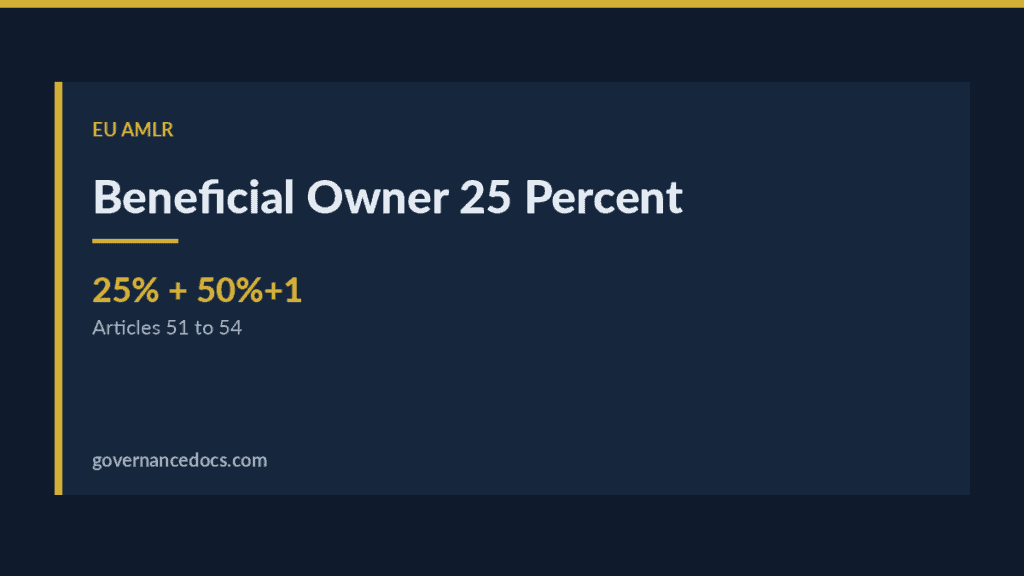
The beneficial ownership threshold under Regulation (EU) 2024/1624 is twenty-five per cent, which sounds like nothing has changed. What has changed is that the Regulation now prescribes how to calculate it, adds a second numeric test alongside it, and requires a search that runs in parallel rather than as a fallback. A procedure written against the old directive-era wording will produce the wrong answer on layered structures.
This is what Articles 51 to 54 actually require, with the arithmetic worked through.
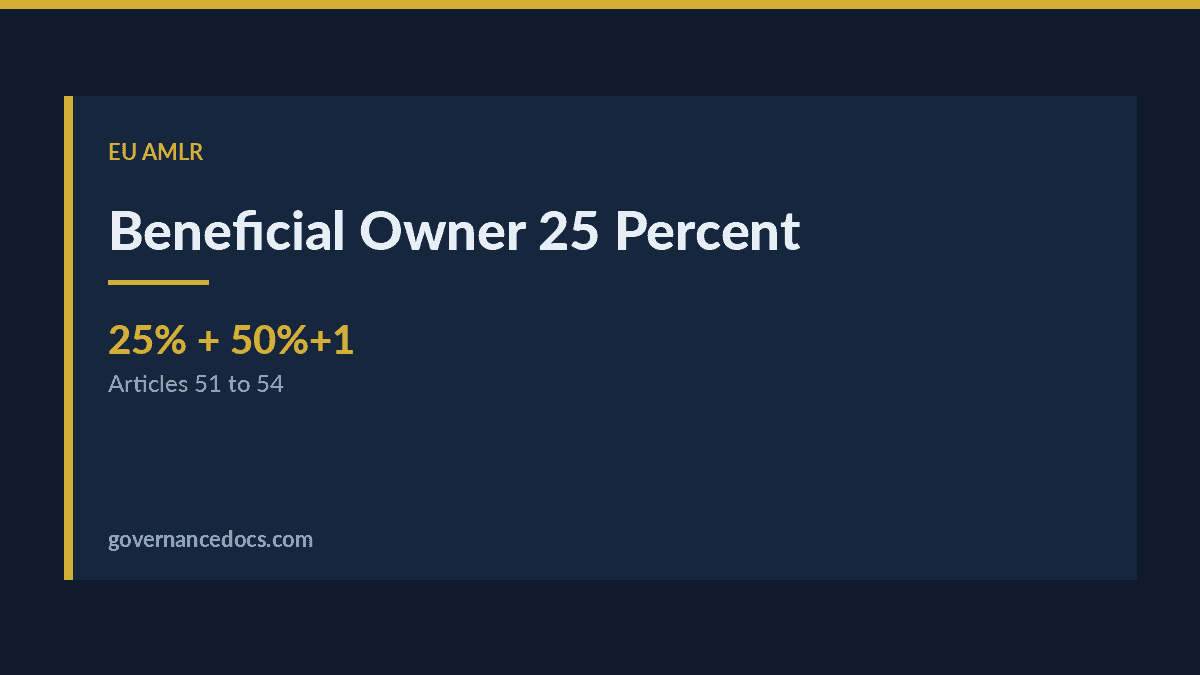
Article 51 defines beneficial owners of legal entities as the natural persons who have, directly or indirectly, an ownership interest in the corporate entity, or who control it, directly or indirectly, through ownership interest or via other means.
Article 52(1) then sets the beneficial ownership threshold: an ownership interest means direct or indirect ownership of 25% or more of the shares, voting rights or other ownership interest — including rights to a share of profits, other internal resources or the liquidation balance.
That final clause widens the test well beyond a share register. Instruments carrying economic rights without votes are inside it, which means a firm checking only shareholdings is applying the beneficial ownership threshold to the wrong denominator.
Article 52(1) does not leave the arithmetic to interpretation. Indirect ownership is calculated by multiplying the shares, voting rights or other ownership interests held by the intermediate entities in each chain, and adding together the results from the various chains. For the purpose of assessing whether an ownership interest exists, all shareholdings on every level of ownership are taken into account.
Two rules follow, and the second is the one legacy procedures omit.
| Step | Rule | Common error |
|---|---|---|
| Within a chain | Multiply the holdings at each level | Reading only the top-level percentage |
| Across chains | Add the products together | Testing each chain separately against 25% |
| Depth | Every level counts | Stopping at the first corporate shareholder |
Work an example. A person holds 60% of Company A, which holds 25% of the customer — that chain yields 15%. The same person holds 40% of Company B, which holds 30% of the customer — that chain yields 12%. Neither chain reaches the beneficial ownership threshold. Added together they total 27%, and the person is a beneficial owner.
A procedure that tests chains individually misses that person entirely, and nothing in the customer’s own disclosure will flag it.
Article 53(2) supplies three definitions and one of them is numeric. Control of the legal entity means the possibility to exercise, directly or indirectly, significant influence and impose relevant decisions. Indirect control means control of intermediate legal entities in the ownership structure, where direct control is identified on each level. And control through ownership interest means direct or indirect ownership of 50% plus one of the shares, voting rights or other ownership interest.
So there are two figures, doing different jobs. Twenty-five per cent establishes an ownership interest. Fifty per cent plus one establishes control through ownership interest. Quoting the beneficial ownership threshold as “25%” without the second test is an incomplete answer, and the indirect-control definition adds a further requirement: a chain with an unexplained gap does not establish indirect control, and that gap is itself a finding.
The second paragraph of Article 51 is short and consequential: control via other means shall be identified independently of and in parallel to the existence of an ownership interest or control through ownership interest.
This is not a waterfall. An analyst who finds a thirty per cent shareholder and stops has not performed the second search at all. Both exercises are required and both outcomes have to be recorded — including a nil outcome, because “we looked and found nobody” and “we never looked” produce identical-looking files otherwise.
Control via other means is where documents outside the corporate register matter: shareholder agreements, veto rights and reserved matters, rights to appoint or remove a majority of the management body, funding agreements, security arrangements and side letters. Those have to be asked for.
Three connected obligations turn on the same analysis, and firms often run them separately.
Sanctions. Article 20(1)(d) requires verification of whether the customer or beneficial owners are subject to targeted financial sanctions and, for a legal entity, whether designated persons control it or hold more than 50% of the proprietary rights or a majority interest — individually or collectively. That aggregation across designated persons is a different sum from the beneficial ownership threshold and a name-matching tool will not do it. Two designated persons holding thirty per cent each are inside the test; neither is individually.
Register discrepancies. Article 24 requires reporting differences between what the central register holds and what the firm establishes. That comparison happens after the firm has reached its own conclusion, not instead of reaching one, and an absence of information in the register is a discrepancy too.
Nominees. Article 22(1)(b)(iv) requires the names of persons holding shares or a directorship in nominee form and their status as nominees. Article 66 then requires nominees to maintain and disclose information on their nominator and the nominator’s own beneficial owners. That is two levels deep, and information on the nominator alone does not satisfy it.
The beneficial ownership threshold applies to corporate entities. Other vehicles have their own routes. Articles 57 to 60 govern express trusts and similar arrangements, including how a class of beneficiaries is identified and how objects of a power and default takers are treated in discretionary arrangements. Article 61 governs collective investment undertakings, where applying the ownership test to thousands of unitholders would produce either nobody or a meaningless list.
Where an arrangement sits inside a corporate ownership chain, Article 55 governs and the analysis switches instrument mid-chain: identify the arrangement’s beneficial owners, then carry the result back into the ownership map.
Most errors on complex structures are mapping errors rather than arithmetic errors. The reliable order is to build the map first, record where each level came from, and only then calculate.
Start by listing every level with its source and date. A structure diagram supplied by the customer is evidence of what the customer says, and it needs checking against registers and the underlying documents. Article 52(1) requires all shareholdings at every level to be taken into account, so a map that stops at the first corporate shareholder is incomplete by construction rather than by oversight.
Then run each chain separately, multiplying down, and only afterwards add the products across chains for each person. Two traps recur: adding before multiplying, which inflates the result, and stopping at the first chain that clears the beneficial ownership threshold, which understates the total and can hide the fact that the person also crosses the fifty-per-cent-plus-one control test.
Article 54 then addresses the case where ownership interest and control coexist in the structure — and Article 52(1) says the add-across-chains rule applies “unless Article 54 applies”. So whether Article 54 is engaged has to be determined before any figure is finalised, and the reasoning recorded even where the conclusion is that it does not apply. A calculation that silently used the ordinary rule cannot later be distinguished from one that never considered the question.
Where a level cannot be established at all, record the gap and escalate it rather than inferring a holding. Complexity by itself is not suspicious and the pack should not suggest otherwise — but complexity the customer cannot or will not explain is a different matter, and it belongs in the suspicion assessment rather than in the ownership map.
Article 52 sets 25% as the ownership-interest test, and Article 52(2) addresses the position where Member States act. Separately, the control tests operate regardless of percentage — a person with the right to appoint the board is a beneficial owner whatever they hold.
Article 20(1)(b) requires the firm to be satisfied that it knows who the beneficial owner is and that it understands the ownership and control structure. A structure the firm cannot explain is not understood. Where it cannot reach that conclusion it should consider whether it can complete due diligence at all, which engages Article 21.
Yes, and report discrepancies under Article 24. But the register is a comparison point, not the answer. Article 63 obliges legal entities created in the Union to provide their beneficial ownership information directly to obliged entities performing due diligence, so you are entitled to ask the customer.
At each periodic update within the Article 26(2) ceilings — one year for higher-risk customers, five for the rest — and on any corporate event: restructuring, share transfer, new investor. A structure verified three years ago and never rechecked is a stale finding presented as current.
The beneficial ownership threshold only produces a defensible file if the map, the chain calculations and both search routes are recorded. Our EU AMLR Toolkit includes a beneficial ownership register with a chains worksheet that shows the multiply-and-add working rather than just the conclusion. The wider changes are in AMLR vs AMLD, the due diligence context in CDD vs EDD, and Articles 51 to 54 are on EUR-Lex.


October 24, 2026
October 24, 2026
October 23, 2026
October 23, 2026

October 22, 2026

