CART
An ISO 21001 internal audit has to test something no quality audit does: whether the organization actually knows what its learners need, and whether it can show that learning happened. Clause coverage is the easy half. The hard half is auditing an educational organization management system without collapsing it into an ISO 9001 audit with the word “learner” substituted throughout.
This guide covers what to test clause by clause, the four questions that separate a real audit from a paperwork exercise, and the evidence to ask for.
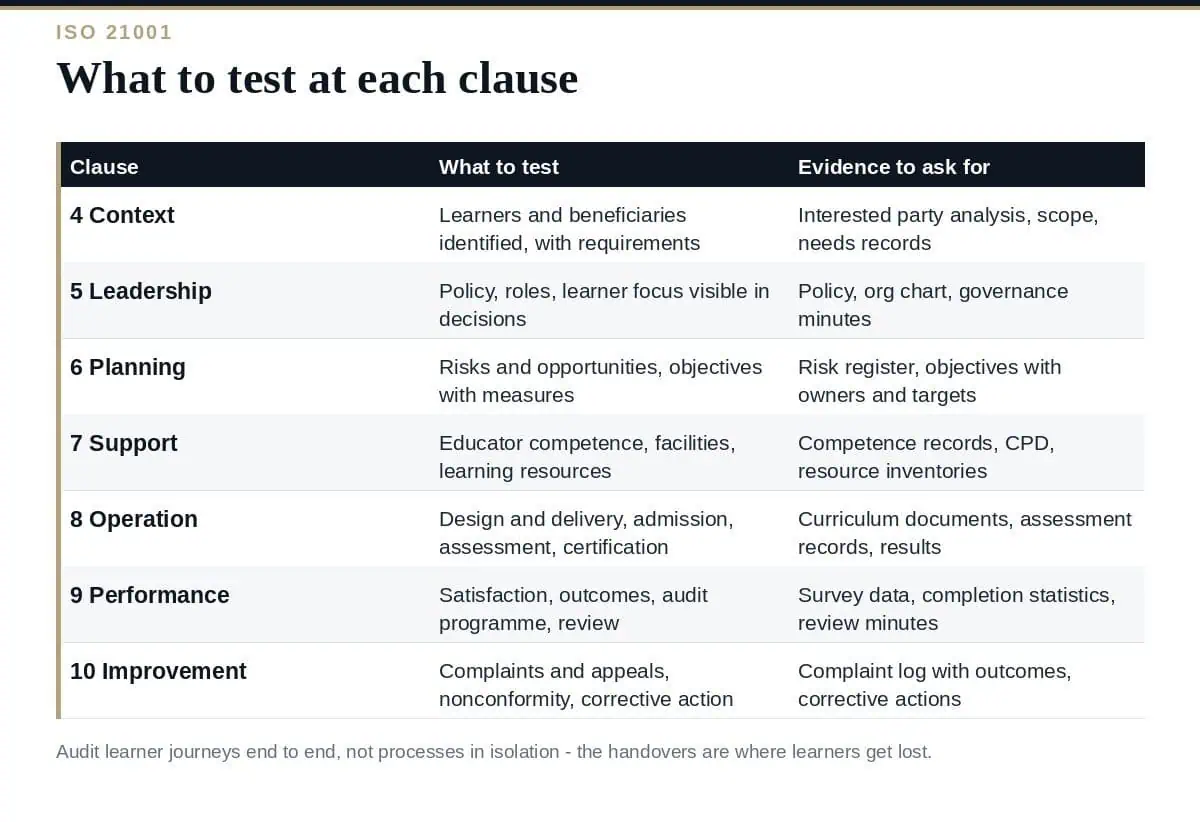
| Clause | What to test | Evidence to ask for |
|---|---|---|
| 4 Context | Learners and other beneficiaries identified, with their requirements | Interested party analysis, scope statement, needs records |
| 5 Leadership | Policy commitments, roles, and learner focus demonstrated in decisions | Policy, org chart, governance minutes |
| 6 Planning | Risks and opportunities, objectives with measures | Risk register, objectives with owners and targets |
| 7 Support | Educator competence, facilities, learning resources, communication | Competence records, CPD, resource inventories |
| 8 Operation | Design and delivery of programmes, admission, assessment, certification | Curriculum documents, assessment records, results |
| 9 Performance | Learner satisfaction, outcomes, audit programme, management review | Survey data, progression and completion statistics, review minutes |
| 10 Improvement | Complaints and appeals, nonconformity, corrective action | Complaint log with outcomes, corrective action records |
1. How do you know what learners need? Not what you assume they need. The standard is built around determining the needs and expectations of learners and other beneficiaries — employers, funders, families, regulators — and an organization that has never asked cannot demonstrate it. Ask for the method and the last time it produced a change.
2. Can you show learning happened? Attendance is not attainment and satisfaction is not attainment either. Look for outcomes measured against the stated learning objectives, and for the loop where poor results changed the programme.
3. What happens to a learner who needs something different? Accessibility, reasonable adjustments and provision for learners with special needs are explicit ground in ISO 21001 and the area most likely to be thin. Ask for a case, and follow it.
4. Where do complaints and appeals go? An educational organization without a working appeals route against assessment decisions has a gap that will surface at certification and, sooner, with a regulator.
Start by confirming which edition your management system is written against — checking the standard, and the documented information that cites it, is the first item on any ISO 21001 internal audit checklist. Clause references quoted from a superseded edition are a fast way to lose credibility with the auditee and with the certification body. Our guides to ISO 21001 and its implementation in six steps cover the current edition and what it expects.
Objectives that are not measurable. The most common ISO 21001 internal audit finding. “Improve the learner experience” appears in most first-cycle systems and cannot be audited, met or failed.
Educator competence assumed from qualification. A degree is evidence of subject knowledge, not of current teaching competence. The requirement covers both, and CPD records are how you show it.
Feedback collected, never closed. Surveys run every term and nothing visibly changes. The audit question is not whether feedback was gathered but what it caused.
Management review without outcome data. A review that discusses activity rather than learner outcomes cannot judge whether the system works.
How often should an ISO 21001 internal audit be run?
On a programme that covers every clause and every part of the scope within the certification cycle, with frequency set by risk and by past findings. Annual coverage of the full system is the common pattern.
Who can perform it?
Anyone competent in auditing and in the education context, independent of the area being audited. Trained internal staff from another department is normal; a small institution may need an external auditor.
Can we combine it with ISO 9001?
Yes, and it is efficient — the harmonized structure means clauses 4 to 7, 9 and 10 largely overlap. Keep the learner-specific requirements in clause 8 clearly tested rather than absorbed.
What is the most common nonconformity?
Objectives and measurement — either not measurable, or measured and not acted on. It shows up in clause 6 and again in clause 9.
Does ISO 21001 apply to corporate training?
Yes. It covers any organization providing educational products and services, including training providers and corporate learning functions, not only schools and universities.
Build the ISO 21001 internal audit around learner journeys rather than around the clause list, and use the clause list only to check coverage. Ask how learner needs were determined and what changed as a result, test whether outcomes are measured against stated objectives, and follow one learner who needed something different from the standard offer. Then check that feedback and complaints produced changes — an educational management system that collects everything and changes nothing is the finding you are looking for.
Audit checklists, programme templates and finding registers are in the ISO 21001 Educational Management Toolkit, or start with the free ISO templates.

October 24, 2026
October 23, 2026
October 23, 2026
October 22, 2026
October 22, 2026

