CART
A double materiality assessment decides what a company has to report on under the CSRD, and it survived the EU’s simplification round intact. The Commission adopted the simplified European Sustainability Reporting Standards on 3 July 2026; plenty was cut, but the requirement to look at sustainability from both directions was not.
This guide covers what the two perspectives mean, the six steps of a defensible assessment, what the 2026 standards changed about how you run it, and where these assessments fail.
Free gap assessment
Are you ready for the 2026 edition of ISO 14001?
Score every clause of the new edition, free, including the aspects, life cycle and compliance evaluation work that carries most of the findings.
Run the free ISO 14001 gap assessment → or View premium report sample
Impact materiality looks outward: how do the company’s own operations and its value chain affect people and the environment? Impacts count whether they are actual or potential, negative or positive, and whether they were caused by the company, contributed to by it, or merely linked to it through a business relationship.
Financial materiality looks inward: which sustainability matters create risks or opportunities that could affect the company’s cash flows, access to finance or cost of capital over the short, medium or long term?
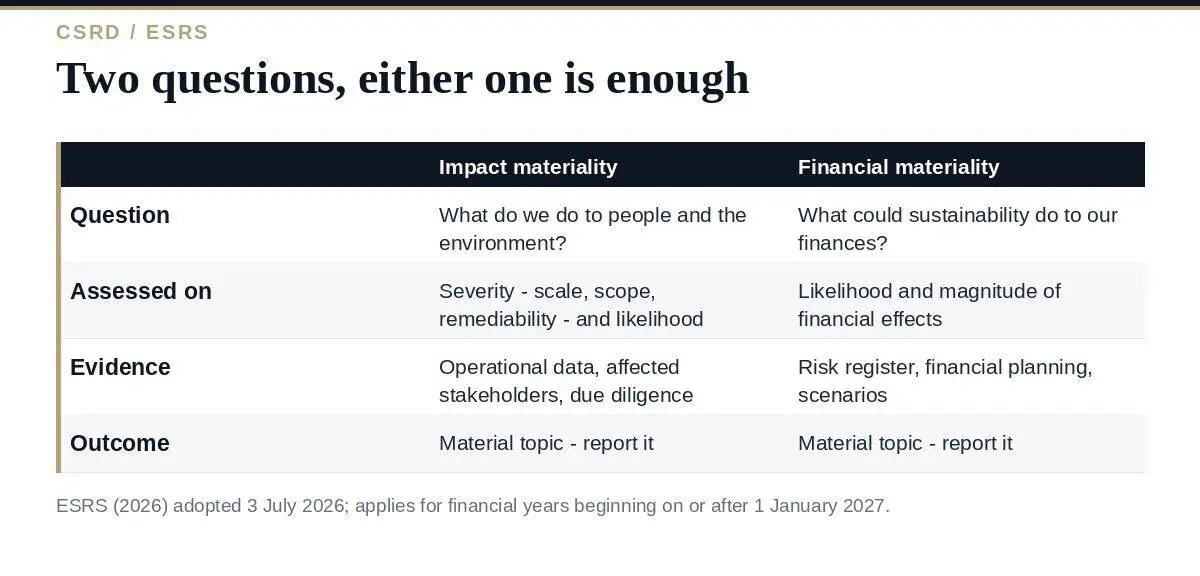
| Impact materiality | Financial materiality | |
|---|---|---|
| Question | What do we do to people and the environment? | What could sustainability do to our finances? |
| Assessed on | Severity — scale, scope, remediability — and likelihood for potential impacts | Likelihood and potential magnitude of financial effects |
| Evidence | Operational data, affected stakeholders, due diligence findings | Risk register, financial planning, scenario work |
| Outcome | Material topic — report it | Material topic — report it |
In a double materiality assessment either perspective is sufficient on its own. A topic that is material for impact but financially irrelevant is still reported, and that asymmetry is the whole point of the word “double”.
The simplified ESRS keep double materiality but make the double materiality assessment less onerous to run. Two changes matter most in practice. Companies may take a top-down approach, starting from the entity level and going into detail only where it is needed, rather than building up from every process. And the assessment may rely on reasonable and supportable information available without undue cost or effort, which is the language that lets you use what you reasonably have rather than commissioning new value chain data for every topic.
On timing: entities in scope apply ESRS (2026) for financial years beginning on or after 1 January 2027, with voluntary early application for financial year 2026. Our guide to what the EU simplification changed covers the wider package.
The survey becomes the method. A stakeholder questionnaire scored and plotted on a matrix is stakeholder engagement, not an assessment. Severity and likelihood have to be assessed against evidence, and unpopular topics can be material.
The value chain stops at tier one. Most impact sits beyond direct suppliers. The proportionality language helps with the effort involved; it does not license you to declare the rest out of scope.
Only downside is considered. Positive impacts and opportunities are part of the definition. An assessment that finds nothing positive has usually been run by the risk function alone.
No audit trail. Assurance providers test the double materiality assessment process, not just the conclusion. Undocumented thresholds and unrecorded scoring turn a defensible judgement into an assertion.
Is the double materiality assessment still required after the omnibus simplification?
Yes. Double materiality remains the basis for deciding what is reported; the 2026 standards simplified the datapoints and the way the assessment may be conducted, not the principle.
How is it different from single materiality?
Single materiality — the basis of most financial-market reporting — asks only how sustainability affects the company. Double materiality adds the company’s effects on people and the environment as an independent test.
How often should it be repeated?
Annually as a review, with a full reassessment when the business model, value chain, geography or regulatory position changes materially.
Who signs it off?
The administrative, management or supervisory bodies are responsible for the sustainability statement, so the assessment and its thresholds should be approved at board level, with the record to prove it.
Does a non-EU company need one?
Only if it falls within CSRD scope through EU subsidiaries, listings or the third-country provisions. Many run one anyway because customers and lenders ask the same questions.
Run the double materiality assessment as an evidence exercise with a documented method: map the value chain first, score impacts on severity rather than sentiment, keep the financial half connected to your real risk register, and write down the thresholds before you apply them. Use the 2026 proportionality allowances — top-down, reasonable and supportable information — to control the effort, and keep the working papers, because the process is what assurance will test.
Materiality matrices, scoring criteria and the stakeholder engagement record are in the ESG Toolkit, or start with the free ISO templates.

October 24, 2026
October 24, 2026
October 23, 2026
October 23, 2026
October 22, 2026

